


Shaded Silvers
Description
This section is from the book "The Book Of The Cat", by Frances Simpson. Also available from Amazon: The Book Of The Cat.
Shaded Silvers
Colour: pale, clear silver, shaded on face, legs, and back, but having as few tabby markings as possible. Any brown or cream tinge a great drawback. Eyes green or orange. Value of points:
Head | 20 |
Colour of coat | 25 |
Coat and condition | 20 |
Colour, shape, and expression of eyes | 10 |
Shape | 15 |
Brush | 10 |
Total ...... | 100 |
From this list it will be seen that for colour the highest points are given, and that eyes may be green or orange. But during the two years which have elapsed since the formation of the Silver Society, there has been a decided desire on the part of breeders for green eyes only, and certainly our best qualified silver judges are not partial to any other coloured eyes in this variety. In an article on the colour of eyes in silvers, "Zaida" of Fur and Feather writes: "Eye colouring threatens to become a matter of fashion. Some eight years ago we received from a first-rate fancier and exhibitor a letter respecting a chinchilla cat, which later became a great prize-winner. 'It is useless,' wrote this lady, 'to think of exhibiting her on account of her green eyes. ' What a change of opinion has marked the flight of eight years!"

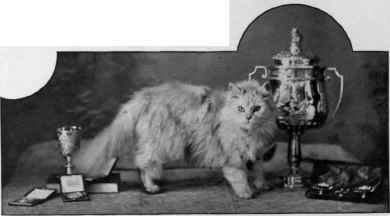
"Shah Of Persia. " The Property of Mrs. Anningson.
It will be observed that, as regards the description of chinchillas and shaded silvers, there is a distinction and yet no very great difference, and herein lay the difficulty of retaining these two classes at our shows. The lightest silvers were deemed eligible for the chinchilla class, and then came the question for exhibitor and judge to draw the line between the two so-called varieties, and to decide what degree of paleness constituted a chinchilla and what amount of dark markings would relegate the specimen into the shaded silver class. The cat world became agitated, exhibitors were puzzled, and judges exasperated. There were letters to the cat papers on the "silver muddle." Show secretaries were worried with inquiries. I recollect a would-be exhibitor writing to me sending a piece of her silver cat's fur, and asking whether her puss should be in the chinchilla or shaded silver class; but even with her lengthy description and the sample before me, I dared not venture an opinion, and I used generally to reply to such letters by saying I did not know in which class to enter my own silver cat, and so I was going to keep him at home.
"Fulmer Zaida (Photo: E. Landor, Ealing. )
One correspondent, appealing through the columns of the papers, wrote: "Everyone knows a black or white or brown tabby, but how can we exhibitors discern between the number of shadings on our silver cats as to which class they belong? Do kindly air my grievance, and oblige."
It was quite pathetic to see the faces of disappointed exhibitors at the Westminster show of 1901, when several beautiful creatures who had travelled many a weary mile to be penned and admired were rewarded with a " Wrong Class" ticket only. They were either too light or too dark for the class in which their owners had entered them, and all hope of honour and glory and golden coins and silver cups vanished into thin air ! At one show I recollect a cat was accounted by the judge a chinchilla and a shaded silver, and he came off very well with special prizes for both varieties. No doubt he really was either one or the other, or both !
It was no wonder, therefore, that a reaction set in, and exhibitors and judges felt alike that something must be done, and that, at any rate for a time, it would be better to have only the two classes for silvers and silver tabbies, and that specials might be given to encourage the lightest cats. The abolition of the threefold classification was therefore taken into consideration when the Silver Society was broken up by the departure of Mrs. Champion to America, and the Silver and Smoke Persian Cat Society came into existence, with Mr. H. V. James as Hon. Secretary.
The following are the objects of the Society: The title of this Society, which (under the name of The Silver Society) was founded in July, 1900, is "The Silver and Smoke Persian Cat Society. "
The objects of the Society are:
1. - To improve the breeds of long-haired silver (or chinchilla), shaded silver, silver tabby, and smoke coloured cats and kittens, male, female, and neuter.
2. - To guarantee extra classes for these breeds at shows supported by the Society, when necessary.
3. - To offer prizes for the said breeds at shows supported by the Society.
4. - To hold shows independently, or in conjunction with other Societies or Clubs when it shall be deemed expedient by the members.
5. - To elect specialist judges to make the awards at shows supported by the Society.
6. - To establish and maintain a standard of points for the above-mentioned breeds.
It was in March, 1902, that voting papers on this burning question were sent out to members of the new society, with the following result: For the threefold classification, 20; against, 32. Therefore, by the wish of the majority, it was decided to give up the threefold classification for the Present.
The Silver and Smoke Persian Cat Society is now in a most flourishing condition, with about 150 members. It is the fervent hope and earnest endeavour of each and all of the fanciers of silvers in the society to breed a perfectly unmarked specimen, and with perseverance we may in time puzzle the judge to decide which cat in a large class of lightly tinted silvers is the palest. We shall gradually but surely breed out the tabby markings if fanciers will, so to speak, nail the right colour to the mast and keep on striving to breed up to the perfect type.
To quote Mr. C. A. House: "What is wanted is for breeders to work on standard lines, and not push forward with such persistency their own pet particular whims. All that is required is for breeders to be determined to breed honestly and consistently for what the standard advocates, and leave severely alone all excesses and exaggerations. Let us have chinchillas free from markings by all means, but let us keep our shadings, our silver colour, remembering that pure silver is of a bluish tinge, and is not the whitey-brown article some would have us accept as the ideal in chinchilla cats." The same authority, writing on the threefold classification, says: "I have always maintained that the threefold classification in silvers was a mistake, and the majority of breeders, I am pleased to know, are coming round to that view. My opinion, when first enunciated, was not popular. With some it is not to-day. But many who at one time could not see the force of my arguments now do so, and there is a more general feeling that the craze for self silvers is not conducive to the welfare of the silvers as a breed."
Continue to:


My Books

