


Chapter XIV. Smoke Persians
Description
This section is from the book "The Book Of The Cat", by Frances Simpson. Also available from Amazon: The Book Of The Cat.
Chapter XIV. Smoke Persians
IT is only within recent years that smoke Persian cats have really come into notice at all, and even now these lovely cats may be said to be sadly neglected in the fancy. It was not till the year 1893 that they were considered sufficiently popular to deserve a class to themselves. They were formerly relegated to the "any other colour" class, and very often at smaller shows this is where we find the smokes penned. A really good smoke is a thing of beauty, and it seems certain that as the fancy expands and the Silver and Smoke Cat Society looks after their interests, a good time will be in store for breeders of this handsome variety.

Mrs. Stead's Smoke Litter By "Ranji." (Photo: Russell & Sons, Baker Street.)
Smokes may therefore be called a new breed, and it is a very distinctive one, made up, as it were, of the three self colours - black, white, and blue. It is a shaded cat without markings, the fur being pure white underneath and gradually assuming almost a black tone on the outer coat. The face, paws, and back down to the tip of the tail are the darkest parts, shading to a dark grey down the sides and on the under part of the tail. A very great beauty in smokes is the light frill and ear tufts, which lend an air of much distinction to this breed. The great failings in many smokes is the appearance of tabby markings; these especially mar the beauty of head and face, and take away from their value in the show pen. The tail should be quite free from any rims of light and dark, and should have the upper part an even dark colour, and underneath a cinder grey. Some smokes are so dense in the surface coat as to be really black cats with white under-coats, having none of the modulated grades of dark and light grey. These cats are often minus the light ear tufts and ruff, and therefore cannot be regarded as correct smokes.
Then, again, there are light smokes which might almost be called silver smokes - very beautiful cats to look at, but far removed from the ideal smoke.
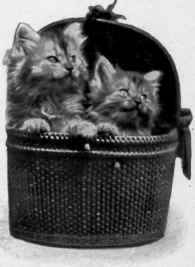
" Jo " And " Tiny " (Smokes) (Photo: Gross, Brooklyn, N.Y.)
Perhaps at some future time there may be a special classification for these cats, which are now without an abiding place at our shows. It is most important that the coat of a smoke should be long and of the true Persian flakiness, otherwise the chief beauty of the contrast between the light under-coat and dark outer-coat is not seen to full advantage.
I think I may say without fear of contradiction that, of all long-haired breeds, smokes present the most altered and absolutely dishevelled appearance when out of coat. The glory of the light frill disappears, and multitudes of lines and streaks can be plainly discerned. Then a very rusty brown tinge appears on the back, and the rich, glossy black surface coat vanishes. I owned a lovely smoke cat once that at certain times of the year - and, I may say, for most part of the year - was nothing better than a bad black, his only claim to the title of smoke being the general appearance of a dark cat that had spent his life in an ashpit. But when "Pepper" was in full feather, he was a joy to behold.
It is curious that when the kittens are first born they appear almost a dead black, with no trace of a white under-coat. This appears gradually as the kittens grow, and at three weeks old the lighter coat becomes visible. Their faces and paws should be intensely black when born, as the tendency in smokes is to get lighter and not darker. If a kitten is born with the appearance of a smoke it will generally turn into what I have termed a silver smoke later on. As with black kittens, so with smokes: they are often very rusty in appearance, but this will disappear with their kitten coat. This also applies to tabby markings, though, of course, if there is any tabby blood in the strain the markings may be retained. For this reason it is most undesirable to mate smokes with tabbies; neither is it advisable to select a blue as a cross. The blue tinge destroys the purity of the white under-coat, which is one of the glories of a perfect smoke. It is a case of " like to like" in breeding smokes, and, failing this, choose a good black sire for your queen with amber eyes.
This is especially advantageous if your queen should be light in colour and throw light kittens ; but if she is already too dark, mate with a chinchilla, avoiding, if possible, a green-eyed one.
Above all things shun, as you would Sin, tabbies of any colour, and let your choice fall on a heavily coated sire. I have been told by smoke fanciers that it is much more difficult to breed a good smoke female than a male, and that the latter sex predominates in litters.
I will here give the officially approved table showing the proportion of marks which should be awarded for points of smokes. This is as drawn up by the Silver and Smoke Persian Cat Society, which has Mrs. H. V. James, our principal breeder of smokes, as Honorary Secretary : -
Continue to:


My Books

