


Orange, Cream, Fawn, And Tortoise-Shell Cat Society. Part 4
Description
This section is from the book "The Book Of The Cat", by Frances Simpson. Also available from Amazon: The Book Of The Cat.
Orange, Cream, Fawn, And Tortoise-Shell Cat Society. Part 4
A herd of pure-bred goats supply the inmates of the cattery with milk, and rabbits, which abound, form their staple food when in season. The largest of the outhouses is fitted with a Tortoise stove, carefully guarded. The pride of Mrs. Neate's cattery is, of course, the famous orange stud "The King's Own." He is the sire of the two winning orange queens "Mehitabel of the Durhams" and "Glory of Prittlewell."
Fitting mates for him are "Wernham Titmouse" (tortoiseshell-and-white), "Evening Primrose" (a cream daughter of "Champion Midshipmite" and "Hazeline"), also "Mimosa" (an orange bred by Miss Cartmell from" Richmond Bough" and "Mistletoe") these occupy the house adjoining the stables.
"Champion Bundle" and "Betsy Jane," a lovely little blue with glorious orange eyes, are the only blues of the establishment. Latterly Mrs. Neate has reduced her own stock of breeding queens, and makes a speciality of receiving cats during the holidays. Judging by the number of cat fanciers who sent their pets to Mrs. Neate during the summer of 1902, it is certain that a great want has been most efficiently supplied. Not only does Mrs. Neate give personal supervision to her catty boarders and visitors, but they have splendid caretakers on the premises. These custodians are Mrs. Neate's big St. Bernard and a chow-chow, who jealously guard the Wernham cattery. These dogs are on the very best terms with the feline inmates, and the strange pussies very soon appear to settle down to an amicable cat-and-dog life. The accompanying photographs, as will be seen, were taken in the depth of winter. These brick-built houses, slate roofed and with wooden floor, are splendidly adapted for keeping the cats snug and warm during the cold weather. One of the buildings illustrated is 25 feet by 15 feet, and has three windows.
This house is provided with large table, shelves, and chairs, and cosy sleeping-boxes. An outside wire run, of the same length and width as the building, is erected for an exercise ground in summer weather.
Mrs. Neate has kindly supplied me with a few notes on orange Persian cats:"It was in 1897, at Boscombe show, that I claimed the winner in a class of twenty-six kittens, my now well-known orange Persian stud 'The King's Own.' The same year, at the Crystal Palace, I purchased a lovely orange female kitten sired by Mrs. Pettit's' Champion King of Pearls' and the tortoiseshell-and-white 'Dainty Doris.' From her I fondly hoped to establish a breed of blue-eyed oranges, which feature would be charming in the variety ; but alas ! she came home to sicken and die, as so many another valuable kitten has done, and I have never since been able to obtain an orange of either sex sired by a blue-eyed white.
"It is most difficult to breed oranges without white lips and chins ; the pink nose, too, is a feature in the breed that I do not like.
"I have found crossing an orange male with a cream female the surest way to breed sound-coloured specimens of both sexes and varieties, e.g.'Mehitabel of the Durhams' (a really rich-coloured unmarked orange queen, and quite free from the objectionable light shading on lips and chin) ; she was bred by Mrs. D'Arcy Hildyard from her cream female' Josephine of the Durhams' and 'The King's Own.' Again, from a blue male and a tortoiseshell queen you are more certain of breeding good oranges (though seldom of the female sex) than from mating tortoiseshell and orange together ; in the latter case more often than not black kittens predominate in the litter, and there is rarely, if ever, an orange female amongst them.
"Mrs. Vidal's famous orange stud'Torring-ton Sunnysides' was a son of my light blue 'Champion Bundle' and a tortoiseshell dam 'Torrington Owlet,' herself of an orange strain. Mrs. Walford Gosnall's' Rufus' (whose name discloses his colour) was also the result of this union. 'Red Ensign,' the orange kitten who won first and three specials at Westminster in 1902, was bred by me from 'Champion Bundle' and 'Mimosa,' an orange queen of cream breeding, and with his litter brother 'Scarlet Lancer' took first and silver medal for the best pair of kittens. The latter is now the property of Miss Cartmell, and has grown into a fine cat. Unfortunately for the cat fancy generally,' Red Ensign' was claimed at the show, and is now a house pet.
"The best orange kittens I have bred were from my'Wernham Titmouse,' a tortoiseshell-and-white who owns an orange dam, and' The King's Own' ; the whole litter were females, and redder than any oranges I have seen. These never lived to see a show, and their death was one of the greatest disappointments I have experienced in my career. The demand for good orange and cream females is greater than the supply ; in fact, these colours are decidedly' booming,' and better classification is given for them at our principal shows.
"At the Crystal Palace show of 1898 there were only four entries in the open class for orange and cream males, and four of the same varieties in the female class, compared to the ten entries in orange and cream male classes and the same number in the female classes at the Cat Club's show, held at Westminster, 1902. These facts speak for themselves of the increased interest now taken in these varieties.
"Unlike some of the warmer tinted of us humans, orange cats of both sexes are particularly sweet tempered, showing great attachment to their owners. They are of strong constitution and attain to great size, being at present free from the in-breeding that is practised amongst many other varieties of our show cats. A small piece of sulphate of iron in the drinking water will enrich the colour of orange and tortoiseshells, besides being an excellent tonic, especially during the moulting season.
"Orange Persian cats do not, as a rule, make good photographs, as they lack expression compared to the short-haired tabby varieties of this colour."
The Misses Beal, of Romaldkirk, near Darlington, have long been associated with orange and cream cats. "Jael" was quite unique as an orange female, and at fifteen years of age could yet win in her class by reason of her grand colour, perfectly shaped head, short face, and tiny, well-set ears. Such a cat stands out in any breed, and such a cat may never again be bred. "Jael" died in 1902, after a long and successful career.
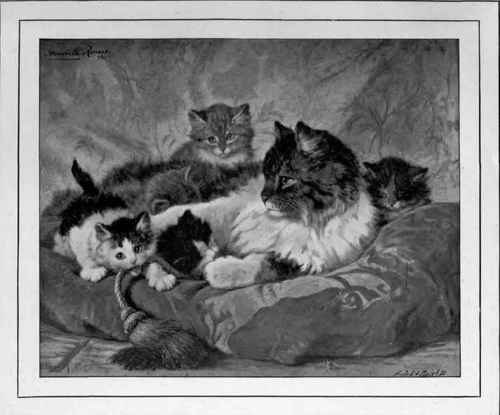
Musing (From a Painting by Madame Ronner.)
Continue to:


My Books

