


Chapter XV. Orange Persians
Description
This section is from the book "The Book Of The Cat", by Frances Simpson. Also available from Amazon: The Book Of The Cat.
Chapter XV. Orange Persians
IN the short-haired varieties, these cats are sometimes called red tabbies; but I do not think the term gives such a true idea of the correct tone of colour, which should be just that of a ripe orange when in perfection. As I write I have in my mind's eye the mass of bright colour presented by a pile of oranges in a greengrocer's shop, and this is the tone that is to be desired in our orange cats. There is a dash of red in the ideal orange cat, suggestive, perhaps, of the blood-oranges with which at Christmastide we are familiar. Anyhow, an orange cat should be as far removed as possible both from sandy or yellow or, as I have heard them called, lemon-coloured cats.

Mrs. Singleton's "Orange Girl." (Photo: J. G. Christopher, Crew kerne.)
I have left out the term "tabby" from the heading of this chapter, and I think advisedly; for in the Persian varieties the markings are gradually but surely vanishing, and orange cats may be said to stand in the same relation to orange tabbies as shaded silvers do to silver tabbies. I mean that most of the orange Persians now exhibited have shaded bodies, with tabby marking on head, face, and paws. The body markings, never very strong in Persian tabbies, are even less distinct in the orange than in the silver varieties. It may therefore be said that in judging this breed as they are represented in the show pen today, colour is taken into consideration first, and tabby markings are of less account. As regards other distinctive features of this breed, I may say that it is the exception, and not the rule, to find good round heads and short noses. The longest faces I have ever seen in any felines have been those possessed by orange Persian and short-haired cats. I have really sometimes felt quite sorry for a magnificent puss of this colour whose nose was so self-assertive that every other point, however excellent, seemed to be lost sight of, and that nose with the accentuated terminus stood out with distressing prominence.
Until the year 1894 the classification at the Crystal Palace was " brown or red tabby, with or without white," and the descriptions given in the catalogue by some owners on entering their cats read "brown and red," "red-marked tabby," "spotted red tabby," "sandy Persian." In 1895 orange and cream cats were placed together in one class.
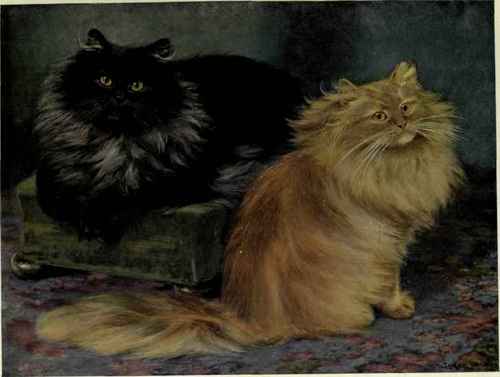
Smoke And Orange Persians (From a Painting by W. Luker, Jun.)
A specialist society for orange, cream, fawn, and tortoiseshell cats was founded in 1900, and although the number of members is small, yet they have proved a strong body of staunch supporters of these breeds, and a really astonishing amount of good work has been done by these few enthusiasts. The classification at the large shows has been greatly supplemented, and, whereas before the formation of the society the sexes were never separated, now this energetic little club asks for, obtains, and often guarantees extra classes. The result, therefore, to breeders of orange and cream cats is much more satisfactory, and males and females have their respective classes; and right well have they been filled. It was in 1900 that classes for creams were introduced at shows. At the Richmond show in 1902 there were thirteen entries in male and thirteen in female orange and cream classes, the sexes, but not the colours, being divided. This was really a splendid testimony to the efforts of a specialist society of less than two years' standing.
It is such a short time ago that orange, cream, and tortoiseshell cats were relegated to the "any other colour" class, even at our largest shows; now it is often remarked by reporters in the cat papers that the well-filled cream and orange classes were the chief attractions of the show.

"Puck," Son Of Mrs. Vidai.'s "Eli.WAYDA." The Property of Mrs. Moxon. (Photo: E. D. Percival, Ilfracombe.)
![Photo] [ Vidal. Swagger. Bred by Mrs. Vidal.](images/Cat-Photo-Vidal-Swagger-Bred-by-Mrs-Vidal.jpg)
Photo] [ Vidal. "Swagger." Bred by Mrs. Vidal.
I will here give a copy of the circular issued by the honorary secretary inviting members !to join, and the points for orange cats, as drawn up by the specialist society, which were decided upon at the inaugural meeting
Continue to:


My Books

