


Cats Of Today. Continued
Description
This section is from the book "The Book Of The Cat", by Frances Simpson. Also available from Amazon: The Book Of The Cat.
Cats Of Today. Continued
All sorts of stories are related of pussy's superhuman intelligence, but the most uncanny one of very recent date I will refer to here. It may be remembered that in the winter of 1901 a vessel named the Salmon was wrecked. On the morning of the accident, this vessel was lying alongside the Sturgeon, and her two cats, who had all their lives shown the most perfect contentment with their home and surroundings, made desperate efforts to get on board the Sturgeon. The crew drove them off again and again, and the ship's dog attacked them, but they would not be deterred, and when the Salmon at last cast off, the two cats landed with one frantic and final spring on to the Sturgeon's deck. It seems absurd to argue that those cats knew of the coming disaster, yet why should they take such a sudden and utterly unreasonable aversion to the ship which had always been their home ? And why should they insist on making their way to another vessel from which they had been so inhospitably repulsed?
We have many proofs of the extraordinary extent to which a cat's sense of hearing and smell are developed. On my voyage out to Australia flying fish would sometimes fall on to the deck. The cats that are always somewhere about the ship might be comfortably curled up asleep below, but the peculiar sound would fetch them up in a great hurry, and they would rush to secure the prize. The crew used to amuse themselves sometimes by trying to imitate the noise in various ways to deceive them; but the cats were not to be "had" - they could distinguish the peculiar thud of the flying fish from all other sounds.
Various theories have been put forward to account for the marvellous instinct which a cat possesses, enabling her to find her way home although miles and miles of untraversed country lay between her and the place from which she has been taken. It is contended that a cat which is conveyed in a bag or blindfolded will have its sense of smell in full exercise, and will, by this means take note of the successive odours encountered on the way, and that these will leave in its mind sufficient information of the route so as to make it an easy matter for the animal to find its way back again. Be this as it may, many of us can state facts which are even stranger than fiction of mysterious reappearances of cats who, with a homing instinct as true as any carrier - pigeon, return to the haven where they would be.
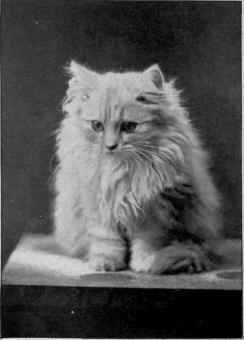
Kitten Belonging To Mrs. E. S. Owen, Detroit, Michigan By "King of the Silvers" - "Blessed Damozel. " (Photo: Albany Art Union, New York. ')

The Antiquaries (From the painting by Madame Ronner. )
The instinct of maternity is, perhaps, more largely developed in the cat than in any other animal. No creature shows such anxiety for the safety and welfare of her offspring as she does, and often her natural timidness will give place to bold and fearless courage when her little ones have been in any difficulty or danger. Mivart tells us of a cat that plunged into a swiftly running stream and rescued her three drowning kittens, bringing them one by one in safety to the shore. During a fire in a London theatre, which took place a few years ago, a poor cat with her family was left forgotten at the back of the stage. Three times the faithful mother rushed into the flaming building and reappeared each time with a kitten in her mouth. But alas! with fatal persistence the devoted creature returned to rescue the remaining one, and that she reached the spot was proved, for after the fire was extinguished, the charred bodies of mother and child were found lying side by side.
A clever writer has stated that "the human race may be divided into people who love cats and people who hate them; the neutrals being few in numbers." This is very true. There are also differences of opinion as to whether cats are desirable inmates of a household or not, but there can be no question as to the great utility of these animals, and it is only natural to suppose that they were created for the purpose of suppressing rats and mice and other vermin. There is a popular notion that if a cat is petted and well fed she will become less useful as a mouser. This is a fallacy, for the cat's inclination is to hunt the mouse or rat, not for food, but for sport, and an animal that is enfeebled by neglect and starvation is not in the best condition to successfully catch its prey. This love of sport is not, however, inherent in all cats, but is hereditary in the feline tribe as it is in the human race.
It may not be generally known that the Government pays annual sums for the purpose of providing, keeping, and feeding numerous "harmless, necessary cats" in their public offices, dockyards, and stores, thereby attesting to the worth and capability of pussy's services.
In the National Printing Office in France a considerable number of cats are employed in keeping the premises clear of rats and mice which would otherwise work havoc amongst the stock of paper always stored in large quantities. In Vienna, cats are placed on active service in the municipal buildings. At many of our great railway stations there is a feline staff engaged in the various warehouses and offices. The farmer will readily admit the usefulness of puss in his barns, stables, outhouses and fields Farmers are notori ous grumblers, but they would have grater cause for discontent and disappointment if rats and mice were allowed to live and thrive, and breed and multiply on their premises. The newly sown peas and corn stacks would suffer to a terrible extent, and the broods of ducklings and chickens would speedily vanish if puss did not keep a vigilant eye and silently but surely fulfil the duties of her calling.

"Kepwick Violet" And "Kepwick Hyacinth. " Blues belonging to the Hon. Mrs. Maclaren Morrison. (Photo: J. R. Clarke, Thirsk. )
In the live stock department of the Army and Navy Stores in London, an orange Persian cat may be seen strolling about amongst the cages of birds of every sort. The attendant informed me she had been on the premises three or four years, and had saved the company a "tidy sum." Previous to obtaining ner services the packets of bird-seed disappeared like magic, for they were demolished wholesale by the swarms of mice. Now rarely one is nibbled, and every morning dozens of lifeless bodies are cleared away. Curiously enough these dead mice have their tails eaten off, for apparently this cat has a weakness for the appendage, whereas, usually the head is considered the delicate morsel amongst the feline race. It seems that although the cat is left alone with all the fluttering birds at night, she never has attempted to molest them in any way.
I lately had occasion to visit one of our London theatres during the daytime, when it was empty; and observing a big brown cat walking about amongst the stalls, I made some remark about him to the official who accompanied me. He said they found it quite impossible to get along without a cat; they had tried, but the place became overrun with mice. During pussy's occupation of the empty playhouse plenty of bodies were dis-covered, but never a live mouse had been seen disporting itself.
The cats in Government service in America are very numerous. The army has a regular corps of them kept at the commissary depots of the great cities. It is customary for the officer in charge of each depot to submit to the War Department a request for an allowance for the cats of meat and milk.
More than three hundred cats are in the employ of the Post Office Department, distributed among about fifty of the largest offices.
The New York City office expends sixty dollars annually in cats'meat. At Pittsburg, there is a "cold-storage" breed of cats, which has special qualifications for enduring extreme cold. These cats are short tailed, with long and heavy fur, and their eyebrows and whiskers are extraordinarily long and strong. It is said they do not thrive when transferred to an ordinary atmosphere.

Miss Savery's Blue Persian Kitten (Photo: H Warschawski, St Leonards-on-Sea. )

A Pair Of Short-Haired Brown Tabbies (Photo: T. Fall, Baker St., W. )
Continue to:


My Books

