


Beekeeping Memorials. Part 2
Description
This section is from the book "History Of American Beekeeping", by Frank Chapman Pellett. Also available from Amazon: History Of American Beekeeping.
Beekeeping Memorials. Part 2
The writer very well remembers the day that news came to the office of the American Bee Journal that Doctor Miller had passed away. Maurice G. Dadant suggested that a memorial should be erected to his memory and at once began consideration of the manner in which the fund should be raised. It was decided that, since the Doctor had served both Gleanings and the American Bee Journal for so long, it should be started as a joint effort of the two magazines. Further consideration made it seem advisable to invite all the bee magazines to join together and make it a common cause for the entire industry. Later events proved the wisdom of this course since much help came from foreign countries, and the response was generous from all sections of America.
Mr. Dadant discussed with his associates the persons best suited to serve on the committee. He wanted all sections represented, as well as a fair representation of the business and professional sides of the industry. To represent the Journal he wrote down the name of his father, C. P. Dadant, and for Gleanings, E. R. Root. Dr. E. F. Phillips represented the industry as a whole in the light of his position as apiculturist in the United States Department of Agriculture. E. G. LeStourgeon, of Texas, was selected from the South, and B. F. Kindig, of Michigan, completed the committee.
Root suggested that C. P. Dadant act as chairman. Accordingly, announcement was made in the January and February, 1921, issues of the bee magazines of the proposal and of the names of the committee members.
Various forms of memorial were discussed, but the matter was left in the hands of the committee. A monument such as that erected to Langstroth was thought unsuitable and, for a time, a scholarship in beekeeping to be endowed in some university was seriously considered. In fact, the early announcements asked for $5,000 for such a purpose. It was not until the matter had been under discussion for some time that a library was decided upon as the most suitable.
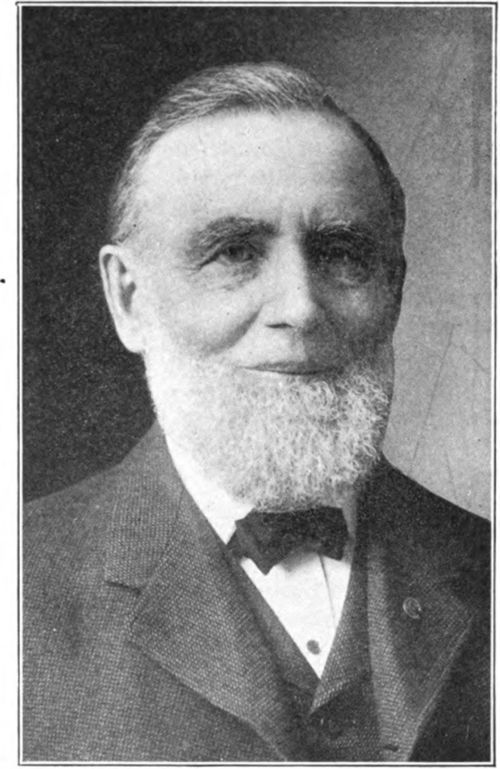
Dr. C. C. Miller, in whose honor the Miller Memorial Library was established at the University of Wisconsin.
Drives had been under way for all kinds of war relief, until raising funds was no longer popular. Red Cross drives, Salvation Army drives, a hundred different funds had been seeking support. Much money had been raised for relief in the war-torn regions of Europe. Even the beekeepers had joined in a special effort to raise funds to re-establish the beekeepers in the devastated sections of France and Belgium, under the leadership of C. P. Dadant (who was decorated as a Knight by the Belgian King), and a substantial amount of money and bee supplies had been sent there. While feeling much admiration for Doctor Miller, the beemen were not in a mood to respond readily to the request for a large sum.
The first report of funds received appeared in the American Bee Journal in August, 1921, and gave a total of $215. 33 received at that office. It was mostly in one dollar amounts, although there were several two-dollar subscriptions, a few for larger amounts, and one for $25.
In November, the committee announced the decision to use the available funds for the purpose of establishing a reference library, the object of which would be to bring together the beekeeping literature of the entire world. With this plan in mind, another appeal was issued for funds and, in addition, books, bulletins and journals relating to beekeeping were solicited. The location of the library was left for later determination.
The decision to establish a library, with all funds contributed to be used to establish an endowment, income only to be used, was a popular one. An attempt was made to procure all available beekeeping literature in the form of initial donations, and this met with gratifying success. Books and magazines began coming in, and the many duplicates received provided much material for exchange. Thus it became possible to provide a much more comprehensive reference library than at first was expected with the funds available.
When the American Bee Journal published its next statement of funds received, in January, 1922, the amount was $830. 79 in cash. Gleanings published a similar list in April with a total of $1, 233. 18.
X. J. Kennedy, of Lawrence, Kansas, offered to be one of fifty beekeepers to set aside a colony of bees for the benefit of the library. A number of beekeepers responded to the idea, and it served as one more means of stimulating interest.
When it became known that the memorial was to take the form of a library, there was keen rivalry on the part of the institutions which recognized beekeeping as an important part of their work. The members of the committee each felt special interest in some one college, but the inducements offered in the way of support by those seeking the library had much to do with the final selection.
The Wisconsin State University, at Madison, was finally selected as the one institution on which all members of the committee could unite, and the selection has proved a fortunate choice, for under Prof. H. F. Wilson the library has received much attention and has grown beyond the expectations of its founders.
In September, 1922, the committee announced the selection of the University as the permanent depository of the library and began making plans for the dedication.
After the death of Doctor Miller, his private library of books was purchased by the American Bee Journal. It was not an extensive collection and contained but few rare volumes. Its value was principally in the sentimental association with the former owner. When the memorial was established, these books were marked as having belonged to the Doctor and sent to Madison to become a part of the library.
Continue to:


My Books

