


Package Bees - From Arrival To Honeyflow. Part 4
Description
This section is from the book "Beekeeping for Beginners", by G. H. Cale, Jr.. Also available from Amazon: Beekeeping for Beginners.
Package Bees - From Arrival To Honeyflow. Part 4
Swarming reduces the worker population, and therefore, reduces the amount of honey crop, and if at all possible should always be prevented.
There are many ways to prevent swarming of bees. Giving them plenty of room for normal expansion is just one of them. Another aid is proper ventilation of the hive. As your colony of bees grows and increases in size, give it a larger entrance opening. The entrance closer supplied with your original outfit has two separate openings. When the package is first hived it is best to use the small opening, but by the end of the fourth week the larger opening should be used. As the honeyflow approaches you should remove the entrance block entirely and let the bees use the full entrance to the hive. This should provide adequate ventilation, but if the weather is extremely warm it would be well to place two small blocks of wood between the hive body and the bottom board. This will raise the hive and tilt it backwards and allow ventilation along the sides as well as increased ventilation in front. The use of a cover designed to lower hive temperatures and increase ventilation will aid you in your efforts to keep the colony from becoming too warm.
Just before the main honeyflow begins there is usually a lull in activity within the colony. By this time the colony has reached its numerical peak and without abundant flowers in bloom there are thousands of bees with little or nothing to do. This is a good time to put on your first super. It gives the bees plenty to do for they must draw the foundation out into comb before they can store honey. Putting on the first super is a swarm control measure that is effective if properly timed and executed. Be sure your bees have sugar sirup at this time if natural sources of nectar are not yielding.
Supersedure of the queen is nature's way of replacing a failing queen. The worker bees take matters in their own hands and construct queen cells in an attempt to replace their failing mother.
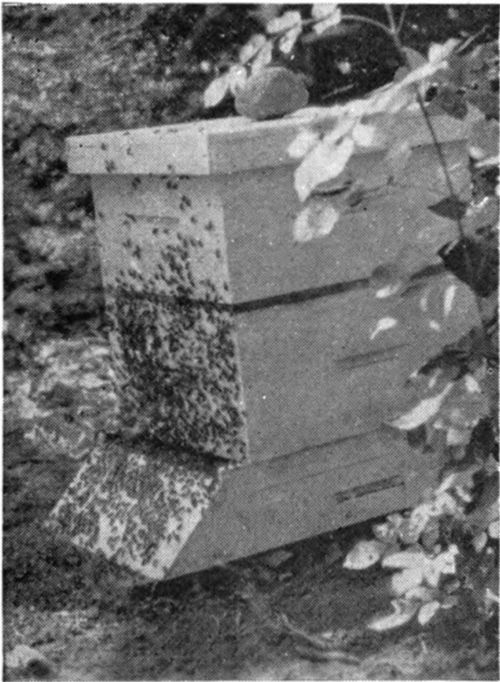
Here is a case where swarm prevention measures were not applied in time. The swarm is just leaving the colony. Weakened by the loss of the swarm, this colony will not make a profitable crop of honey without a considerable amount of help from the beekeeper.
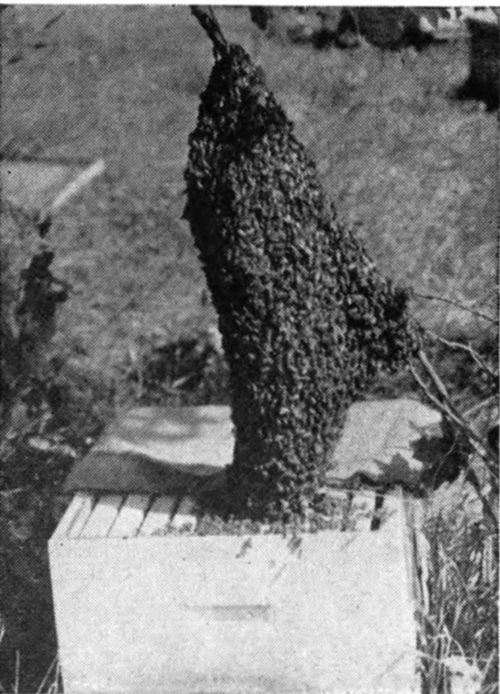
Fortunately, this swarm lit among the low-hanging branches of a nearby tree. It may now be captured and hived. After the honeyflow has started it may be placed back in the colony from which it emerged - thus increasing the population of the original colony.
A queen's quality may readily be recognized by the way in which she deposits her eggs in the cells. A good queen will lay in a compact area so that the sealed brood presents a solid mass of wax cappings. A poor queen usually lays irregularly with eggs scattered throughout the comb leaving many cells empty. Occasionally a queen will become a drone-layer-i. e., she will lay unfertilized eggs which will develop into nothing but drones. Such a queen should be replaced as quickly as possible. Order a new queen, and when she arrives kill the old one and place the new queen in the colony. (Instructions for introduction of a queen are included in shipment of the queen cage. )
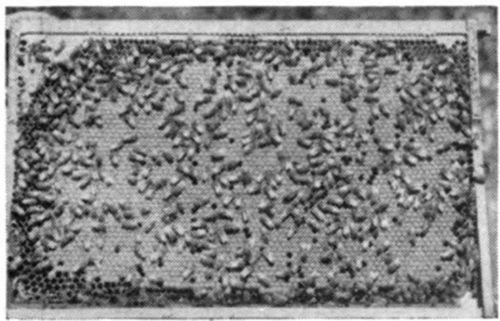
Good brood - the result of an excellent queen.
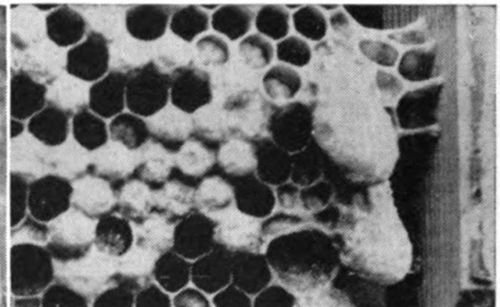
Poor brood - the result of a dronelaying queen.
Your package of bees should now be a full-grown colony, humming with activity and ready for the honeyflow.
Continue to:


My Books

