


Chapter VII. Fall Management And Wintering Of Bees
Description
This section is from the book "Beekeeping for Beginners", by G. H. Cale, Jr.. Also available from Amazon: Beekeeping for Beginners.
Chapter VII. Fall Management And Wintering Of Bees
THE end of the midseason flow is usually followed by a period when there is little or no nectar coming into the colony. This period of relative inactivity is followed in many localities by the fall flow-usually coming from such flowers as heartsease, commonly called smartweed, aster, goldenrod, Spanish needle, white boneset, wild cucumber, and climbing milkweed.
The beginning of the fall flow is one of the times during the year when the influence of the queen is felt greatly. An inferior queen at this time will leave you a colony weak in worker population and incapable of successfully surviving through the winter. If there is the slightest indication of a poor queen, the colony should be requeened during the fall flow, or preferably, towards the end of the spring flow.
If you are in a country which has little or no fall flow, or if you have been unable to obtain queens during the fall flow, you may safely requeen colonies after cold weather has set in and brood rearing has ceased. Go into the colony to be requeened on a cold day in late September or early October, remove the old queen, and place the new queen in the mailing cage in the center of the cluster of bees. Make sure that the cardboard has been removed from the candy end of the queen cage.
Care must be taken during the fall flow not to place too many supers on the colony. Additional supers should be added only when the one on the colony is practically full of honey. This prevents the bees from spreading the incoming nectar throughout more supers than they will fill. When the fall flow is over-usually after the first killing frost-the supers may be removed from the hives.
During the removal of the fall crop, one super completely filled with honey should be left on the colony. In addition to this super, the colony should have from twenty to thirty pounds of available sealed honey in the brood nest. This honey in the brood nest will usually be found along the tops of the brood combs. The honey in the super, plus the honey in the brood nest, should give the colony from sixty to seventy pounds of honey for their winter and early spring consumption.
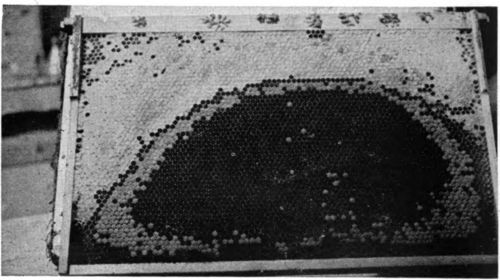
A colony ready for winter should have a rim of honey along the tops of the brood combs as well as a full super of honey.
If you are in a locality where fall flows are uncertain and where little fall surplus honey is gathered you will have to resort to feeding a sugar sirup for the bees to use during the winter. The minimum amount of stores (either honey or sugar sirup) necessary for the winter consumption of the colony is fifty pounds. The beginner will find it convenient to take a pair of scales, similar to ice scales, and weigh his colony of bees. A hive with top, bottom, inner cover, eleven combs, and bees will weigh about forty pounds. Any weight over that may be considered as stores. For example: if a colony weighs seventy-five pounds then it has thirty-five pounds of honey. To gain the additional fifteen pounds necessary for minimum stores sugar sirup should be fed to the colony. The best feed for winter stores is made by mixing two parts of sugar to one part of warm water. A gallon of this mixture increases the weight of the colony about seven pounds so a colony weighing seventy-five pounds would need two gallons of sugar sirup to bring it up to the minimum stores standard for successful wintering.
Common practice with the ten-frame hive is to leave a second hive body on each colony, one with sealed stores and pollen being desirable.
Uniting Weak Colonies
Occasionally time for winter arrives with some of the colonies in a weakened condition. This may have been caused by a failing queen, or by a bad season with a minimum of honey for the bees to gather. Even with the best of protection, these under par colonies will find difficulty in surviving the wintry blasts.
It is better to throw all the strength of two such colonies into one hive by uniting than to try to winter the two misfits. If such condition has been discovered early enough so that new queens could be supplied, or ample feed provided, or both, it may be possible to pull such colonies out of their doldrums and make them fit for wintering.
In a honeyflow uniting gives no difficulty. Nectar gathering bees unite very nicely with a minimum of fighting. It is a different matter in the short days of fall. In such a case the two colonies may be united by the newspaper plan.
Find the poorer of the two queens in the two hives to be united, and kill her. Or if uncertain, do not bother. The bees will see to a proper choice, or the queens will fight it out for themselves. Remove the cover and inner cover of one of your hives, exposing the tops of the frames. Place immediately over these a single sheet of newspaper. Over this place your second colony with its bottom board removed, and the job is done. In the course of a few hours, the bees of both colonies will have gnawed through the newspaper, getting acquainted a bit at a time, and amicably. After they have been completely united, it may be best to remove one of the supers or hive bodies. This can readily be done by smoking the bees down, or shaking them into the brood chamber which may consist of only one hive body; preferably two for winter.
Continue to:


My Books

