


The Engadine. Part 7
Description
This section is from the book "Engadine - John L. Stoddard's Lectures", by John L. Stoddard. Also available from Amazon: John L. Stoddard's Lectures 13 Volume Set.
The Engadine. Part 7

An Old Engadine House.
The temperament of the Engadiners seemed to me rather sad and reticent. Itinerant Italians sought, apparently in vain, to brighten them with music. Sometimes a row of people, sitting in the sunshine, lined a house-wall, motionless and silent as a sculptured frieze. Even among the younger peasants there was rarely any show of friendliness. Singularly enough, however, their manner often changed somewhat in outward manifestation toward us with the time of day! Thus, in the early morning, when only nature's peaceful sounds were audible, and the successive crowds of tourists had not yet begun to claim the right of way, the peasants whom we met would give us usually a cordial "God be with you," or "Good day." But at a later hour this greeting would be rarely uttered, even in response to ours. Apparently the fact that we, too, were astir soon after sunrise led them to recognize in us one element at least in harmony with themselves, and possibly this consoled and pleased them. They had been forced to rise thus early for their work; but if the rich and leisured did the same from preference, then surely the necessity which drives a peasant from his own poor bed betimes could not be, after all, the hardship they had always thought it. The coolness of the morning also may have made less poignant the contrast between seeming idlers and toilers trudging to their distant tasks. But with the fervent heat of noon why should we be surprised, if we encounter sullen and averted faces ? Fancy men, women, and children, who know practically nothing of existence save a bitter struggle for their daily bread, being taxed heavily for the making of fine carriage roads, on which they never have a chance to drive for pleasure, and being forced to leap into the gutter many times an hour, or haul aside their carts and loaded teams, and wait there, stifled by a cloud of dust, until a landau or a motor car has insolently swept along, with no consideration shown them by its occupants save a haughty stare. Small wonder then, in view of the increasing number of luxurious hotels, and all the sumptuous toilettes and magnificent jewels lavishly displayed in them, that even here the socialistic spirit is perceptible, and that the ostentatious pleasure-seekers, as a class, are almost hated by the peasantry? Would it not be the part of prudence, - not to mention any higher motives, - for travelers to show, not patronizing condescension, but genuine courtesy and kindness to these toilers of the fields ? The effort may not always be rewarded; but to see even one worn, poverty-saddened face light up with pleasure and a friendly smile, or to detect the kindly ring of even one sincere response to an unlooked-for greeting, will leave a warmth within the heart all day, and more than compensate for any previous surliness or subsequent reserve.
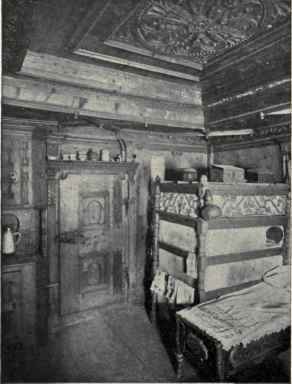
Interior Of An Engadine House.

Haying In The Engadine.

An Upland Pasture.
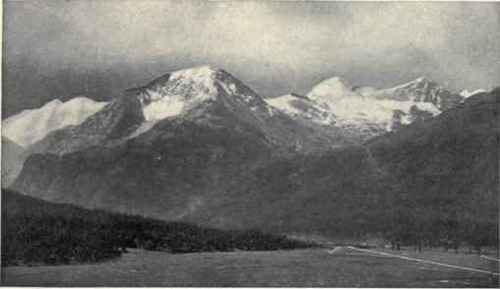
The Bernina Group, From Samaden.
Samaden is a prettily situated village at the junction of two routes, one of which leads to St. Moritz, the other to Pon-tresina. Impatient though I was to visit both these celebrated features of the Engadine, I halted here that I might climb the hill which overlooks the town, and stand within the little sunlit Court of Peace, where rests a friend whom I admired and loved. Some years ago, I first heard at a concert in an Austrian health-resort an artist whose superb bass voice had once filled Europe with its fame. A pupil of the conservatories of Geneva and Paris, he had begun with brilliant triumphs at La Scala in Milan, and had in his career achieved success in more than forty rôles. Auber, Halévy, and Gounod had recognized his talents, and one of them said of him at his graduation, - " He has the finest voice in France. What a pity that he is not French, but Swiss, by birth! " Verdi also called him his Gran' Fraseggi-atore, and he was known at one time as the "Samson" among bassos. But when I heard him, illness and misfortune, though they left his marvelous voice intact, had long since rendered his appearance on the stage impossible. The audience, though appreciative, was pathetically small, and as he sang a final aria from "La Fa-vorita," his sad face, noble dignity, and wonderfully vibrant tones made on my heart an ineffaceable impression. It seemed to me the swan-song of a mighty artist; - his farewell salutation to a heartless world. Impelled to speak to him at the conclusion of his work, a friendship then and there was formed between us, which lasted till his recent death,. Since then his widow - herself a gifted Russian pianist, trained by Rubinstein - has, at a sacrifice of health and means too sacred to be more than hinted at, caused to be made for him a beautiful, artistic monument. Beneath it she will place some precious souvenirs of his successes in both Europe and America, as well as copies of the music which he loved especially to sing. There, every summer now, beside his grave, forever bright with flowers, is seen each day the lonely figure of this faithful wife, gazing at times from her immediate surroundings toward the snow-crowned peaks of the Bernina, whose glaciers seem the pathways to a brighter world. Upon the monument designed to mark the resting place of one whose character was no less noble than his voice, have been inscribed these lines:
Continue to:


My Books

