


Egypt. Part 11
Description
This section is from the book "Egypt - John L. Stoddard's Lectures", by John L. Stoddard. Also available from Amazon: John L. Stoddard's Lectures 13 Volume Set.
Egypt. Part 11

On The Nile.
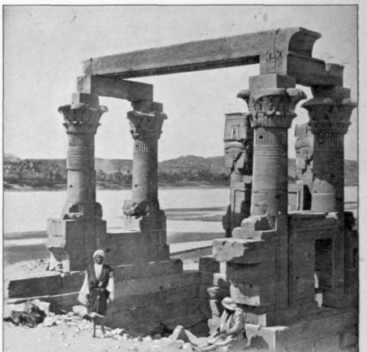
The Sculptured Lotus.
It would exceed the scope of this volume to enumerate all the ruined temples which the tourist passes in sailing up the Nile. It is interesting, however, to observe that almost all the columns of these ancient shrines terminate in the sculptured bell of the lotus flower, - an ornament that gives lightness to these ponderous masses, and seems to be the appropriate coronation of the columnar stem. Many of these chiseled lotus blossoms are just as perfect now as when they left the sculptor's hand; and even when mutilated by some vandal, their broken edges look like the crumpled petals of a flower, still blooming on from century to century. It is fitting that we should see Egypt's favorite blossom represented in her temples, for the poets of antiquity sang of the far-famed lotus that grew on the banks of the Nile, and claimed that if the traveler ate of it he at once forgot home and kindred, and lingered ever on this distant shore.

Luxor.
Next to the region of the Pyramids and Sphinx, the most attractive part of Egypt is the site of Thebes, the principal destination of all travelers who ascend the Nile. More than four thousand years ago there lay here, as there lies to-day, a mighty plain, cut by the Nile into two equal parts. Upon this plain was an Egyptian city that must have been to the ancient world what Rome was in the days of Hadrian. It so abounded in stupendous palaces and temples, that even their ruins are to-day the marvel of the world, and draw to them admiring travelers from every land. One of the most extraordinary of these structures is the temple built by Rameses II, which was a ruin long before most of the other ancient edifices of the world were reared. It was demolished by the Persian conqueror, Cambyses, six centuries before Christ, and only a few of its enormous columns are now standing, though everywhere we see the pedestals of many more. Some of its walls were supported by massive statues thirty feet in height, which are now headless and otherwise disfigured; and yet their folded arms still give to them an air of grandeur and mystery, as if they were guarding faithfully in their locked breasts the secrets of unnumbered ages.
Beside these standing giants, however, lies one whose mere fragments dwarf them all. It is the overthrown statue of King Rameses, the largest sculptured figure in the world. This monster, once a solid block of beautifully polished granite, measures twenty-six feet across the shoulders, and its weight, when entire, must have been nearly nine hundred tons. Yet it was transported hither over a distance of one hundred and fifty miles. It is alike difficult to understand how such a colossus could have been quarried, brought hither, or broken, as we now find it. An earthquake could hardly have shattered it so completely. Such devastation could only have been effected by the vandalism of man. Upon its surface were inscribed the words -"I am the king of kings. If any one wishes to know how great I am, let him try to surpass one of my works." But now, like Lucifer hurled from Heaven, the mighty Rameses lies overthrown, and several millstones have been cut from his head, without perceptibly diminishing the size.
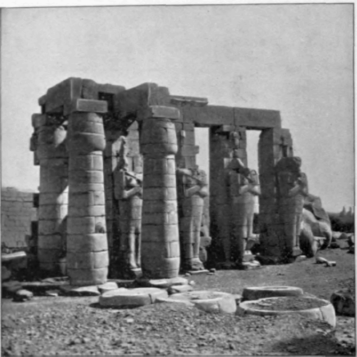
Temple Of Rameses.

Raising Water From The Nile.
A visit to another portion of the Theban city revealed to us the two colossal figures which photographic art has made familiar to the world. They are both sadly mutilated, but seated as they are, and have been for so many ages, in solitude and silence on this historic plain, they look like the abandoned deities of the place, whom grief has turned to stone. They do not, however, really represent deities; they are the statues of King Am-unoph III, and were originally placed here before the entrance of his temple. Each of these figures is a monolith, fifty-two feet in height without the pedestal, and weighs about eight hundred tons! It is true, they do not look like monoliths now, for one can see a multitude of different blocks composing their arms and shoulders. But both were solid masses of stone till they were riven by an earthquake shock twenty-seven years before Christ; and two hundred years later, the Roman Emperor Septimius Severus clumsily restored them. This fact of their restoration explains the mystery of the voice which the more northern of these colossi, called by the Greeks the "Vocal Memnon," was believed to possess, since every morning, at sunrise, there would issue from it a peculiar sound, which was interpreted as being a salutation to the god of day. In the early years of the Christian era this was deemed so wonderful that Greek and Roman travelers made a journey up the Nile to look upon this statue and to hear its "voice," with almost as much interest as they felt in visiting the Pyramids and the Sphinx.
Continue to:


My Books

