


Vienna. Part 9
Description
This section is from the book "Vienna - John L. Stoddard's Lectures", by John L. Stoddard. Also available from Amazon: John L. Stoddard's Lectures 13 Volume Set.
Vienna. Part 9
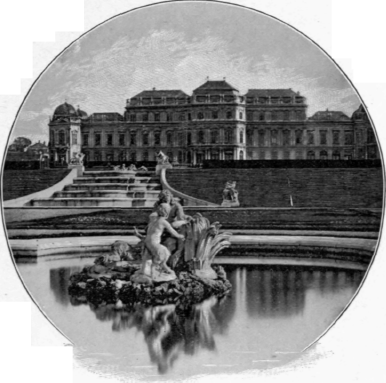
The Belvedere Palace.
Behind the Heroes' Square stands the Imperial Palace, which is not so much one enormous edifice as a collection of buildings that has been gradually growing and adding to itself for about six hundred years. So many interesting historical associations are, therefore, connected with this home of the imperial family that the Viennese have been reluctant to replace it by a modern structure; but it has at last been decided to do so, and an immense addition is now in process of construction, the cost of which is estimated at twenty million dollars. It must not be supposed that the imperial family reserves for its sole use the whole of this palace. The greater part of it has long been a museum, in which are three departments of great value. The first is the Imperial Library, in the long halls of which, in addition to the four hundred thousand books already mentioned, are twenty thousand precious manuscripts and twelve thousand volumes of music. The second is a rare and beautiful collection of ancient bronzes, cameos, and coins, among which one could spend with pleasure several hours; and the third is the Imperial Treasury, where the visitor beholds the renowned State jewels of the empire, resplendent in the crowns of both the Emperor and Empress, and, also, countless objects of historic value, such as Napoleon's crown and coronation robe as King of Italy; the cradle of his little son, inlaid with pearl and gold; the sceptre, sword, and crown of Charlemagne; and, among other gems, the famous diamond of Charles of Burgundy, which weighs one hundred and thirty carats, and is valued at two hundred and eighty thousand dollars.

The Vestibule Of The Belvedere Palace.

The Inner Gate Of The Imperial Palace.

The Hercules Statues At The Palace Entrance.
In 1805, when Napoleon was bombarding Vienna to compel its surrender, there lay in an apartment of this palace a young Austrian princess who, on account of illness, had been unable to leave the city with the rest of the imperial household. When this fact was made known to Napoleon, he at once ordered that the direction of the guns should be changed, and that great care should be exercised to avoid injuring the imperial residence. Little did he imagine that the young lady, whose life he perhaps thus saved, would a few years later become his wife, and, as Marie Louise, Empress of France, take the place of his discarded Josephine.

A Viennese Fountain.

The Museum And Monument.

A Courtyard Of The Palace, And Statue Of Joseph II.
In a little square, adjoining the Imperial Palace, stands the bronze equestrian statue of another famous sovereign of Austria,- Joseph II., son of Maria Theresa. Few men have been actuated by nobler motives than he, and few have been more cruelly disappointed in the execution of their plans. In Joseph's case the difficulty lay in the fact that he was in advance of his time. All the great reforms which he endeavored to inaugurate, such as the emancipation of the serfs, religious freedom, reduction of taxation, met with relentless opposition from both his clergy and nobility, and the Hungarian magnates openly threatened insurrection. Accordingly, in 1790, Joseph found himself compelled to revoke his proposed reforms, and confess that his noble aspirations and endeavors had ended in disastrous failure. Always delicate in health, he never recovered from the blow, and, in a few weeks, sank into an untimely grave. The lives of few European sovereigns present a more interesting study than that of Joseph II. In the performance of his public duties he worked as hard as Frederick the Great, whom, though the enemy of Austria, he greatly admired. In summer he usually rose at five, and in winter at six. Then, slipping on a dressing-gown, he would attend to his accumulated despatches until nine o'clock, when he stopped for a frugal breakfast. He then dressed and went to the audience-chamber. Here he was not only accessible to all, but, being well-acquainted with the tyranny of Court underlings, he used to go at regular intervals into the corridor, outside his audience-room, to personally ascertain if any one who wished to see him had been refused admission. He is said to have never kept any one waiting with whom he had made an appointment. At about twelve he would conclude his audiences, and go to the park, where he himself usually drove in an open carriage drawn by two horses. The drive finished, Joseph returned for dinner, which was brought to his apartment in five deep dishes, placed one upon the other. These were laid on the stove to be kept warm until the Emperor was ready; for, on returning from his drive, he often forgot his noon repast while looking over the important despatches that had arrived during his absence. His life was exceptionally lonely, for his independent, democratic spirit met with such opposition that he found among the aristocracy at times more enemies than friends. When an Austrian noble, one day, hinted that it would be more suitable for him to associate with his equals, rather than with people of no birth at all, like Mozart, for example, who was "merely a musician," Joseph retorted, " If I wished to keep company with only my equals, I should be obliged to go down to the vault of the Capuchins, and pass my time among the coffins of my ancestors."
Continue to:


My Books

