


The Kicking Game. Continued
Description
This section is from the book "Football For Public And Player", by Herbert Reed. Also available from Amazon: Football for Public and Player.
The Kicking Game. Continued
Against this shift the defensive line has to remember merely to stand fast, save when it results in a lop-sided formation, in which case the defensive line simply slides as against the other shifts. Against a team that has never seen it the wheel shift ought still to be effective, retaining its quality of temporary bewilderment. One of its serious defects, not found in the other shifts, is that a clever defensive line may by fast work reinforce one side of the line or the other against the shift, taking care, however, not to be caught in motion at the snap of the ball.
Fig. 6 The WHEEL SHIFT. Attack.
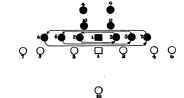
Line Defence.
Fig.7 LINE and BACK SHIFT. Attack.

LineDefence.
A very simple and very effective line and back shift is shown in the diagram (Fig. 7). It results in a lop-sided line with a tandem of the backs behind the reinforced side. In this form of the shift the backs experience little difficulty in finding their new positions, and the play can be made to go very fast. It has been used with effect by the Navy, which in recent years has had players who were both powerful and speedy.
In recent years punting has reached a higher degree of efficiency as a factor in the actual attack than ever before, and a team that can boast of a strong punter, backed up by a drop and placement kicker, need not hesitate to tackle the best elevens provided the ends are fast and the defense strong, as was the case at Princeton the last time Princeton defeated both Harvard and Yale without the semblance of a running attack. Indeed, kicking as used strictly in the sense of attack has usually reached a higher state of efficiency at Princeton than anywhere else in the East, or the West either, for that matter. A team equipped as described at the beginning of this paragraph might well follow the use of the zones mapped out in the diagram (Fig. 8), which is markedly different from the zone arrangement in the diagram (Fig. 1). The diagram (Fig. 8) shows the team with the wind at its back. The "zone of kicking defense" in the diagram might even stop at the center of the field, had the team a kicker like Brickley of Harvard, were it not for the fact that it is wise to allow more room for the recovery of the ball in case of a blocked kick. In the zone of kicking defense our team will kick on first down, or on second down if a cross-field change in the position of the eleven be found necessary. If the punting duel is steadily maintained and our ends keep the enemy from running back the ball the team will eventually work past the center of the field, and there is always the chance that the enemy will fumble and our team recover the ball in his territory.
Fig. 8. NORMAL METHOD of KICKING, ATTACK.

The territory within which it may be considered safe to open fire on the crossbar and the uprights is indicated in the diagram by the term "field goal zone" while the short punting attack may well wait until within that part of the field labeled in the diagram "zone of kicking attack." It is well to keep up the distance punting clear to the center of the field, I think, saving the crossfire and down the sideline punting until the enemy's forty-yard line is reached, taking care at all times that the ball does not cross the goal line.
Once on the forty-yard line and near the center of the field the punter should put the ball out of bounds just short of the ten-yard line. To drive it down closer might be risky, for were the leather to strike just inside and take a bound inward the wind might carry it across the goal line for a touchback, and the touchback is the one thing to be avoided since the defense may bring the ball out and kick. Kicking out of bounds in this way prevents a run-back, and gives the ball to the enemy in an awkward position. When near the side-line the good kicker should send his punt straight down the field, short, rather shorter perhaps than as shown in the diagram, so as to guard against a touchback. Such kicks are easy for the ends to cover and exceedingly difficult to face. There is every chance here of a picked-up fumble and a touchdown. From the thirty-yard line the use of zones shown in the diagram calls for a placement field goal from scrimmage. The placement at this distance is, I think, preferable to the drop-kick, for it leaves an extra man behind the line to aid in recovering the ball in case of a fumble. At the twenty-yard line the quick drop-kick is perhaps the better maneuver, for at this point the kicker can take plenty of room behind his line. When the team is on either of these lines and at the side of the field, the ball should be run out in front of the goal posts with no attempt to gain ground.
This particular scheme of kicking attack is planned especially for teams that are defensively strong and have a fine kicker and no running game to speak of, but a modified form of it might be adopted even by an eleven that boasted of a strong running game. There are variations innumerable according to the ability of the various units of the team, but the system diagrammed will serve as a basis on which to work.
The whole success of the kicking game, these days, depends upon placing more than anything else, for the burden of the defense against an accurate punter is very heavy and means a palpable weakening of the defense against the running attack. A fairly safe defense against punting from the kick formation on any but the fourth down is shown in the diagram (Fig. 9). Since there is danger of a run from this formation the ends may well go in fast to hurry the kick or prevent a run, while the two backs in the second line of defense close in a little in order to cover more territory in case of a forward pass. They can well afford to draw in a little, for they are still within reach of the enemy's ends, and if the fullback tries a run from so far back of the line they will still have plenty of time to reach the line of scrimmage as they have less distance to travel than the fullback. This formation applies only when there is considerable territory left to gain for a first down, for if there is only a little to go the chances are that another than the fullback will be sent into the line to make the distance. The two backs who are to handle the kick should be all the way from twenty-five to thirty-five yards back of the line according to the ability of the kicker and the strength of the wind. It will be objected by some that the formation outlined is very dangerous, but against a strong punter who can place his kicks it is better to take the chance of a short gain or even of a forward pass, as a general rule, than to have a difficult kick go driving down the field many yards away from a solitary player in the backfield, as Yale and Princeton would have willingly admitted after facing the deadly punting of Felton of Harvard in the big games of 1912.
Fig. 9 NORMAL KICK FORMATION.

NORMAL DEFENCE AGAINST KICK FORMATION ON 1st, 2nd OR 3rd DOWN.

The loosening or tightening of the formation depends upon the position of the kicking team on the held, the number of the down, whether first, second or third, and the number of yards to be gained, and no amount of diagramming can supplant the use of brains on the field.
When the kick formation is assumed on the fourth down, save when the defensive team is well down in its own territory, a punt is almost certain to follow, and the whole aim of the defense is to run the ball back as many yards as possible. The diagram (Fig. 10) shows what is known as the "basket" or "nest" defense against this fourth down kicking. In this case the ends may be dropped back about five yards, the fullback may take plenty of room back of the line, and the three other backs should spread out all the way from twenty-five to thirty-five yards back, ready to cover the greatest possible amount of territory, and to assist each other by interference. When the opposing ends come down the field, the defensive ends do not try to check them at once, but turn and come down with them, turning them in if possible so that there will be a clear path up the side line. The fullback should also come down, turning in time to take care of the first line man down the field under the kick. The other two backs, once the ball is safely caught and there is no chance of a fumble, should put out of the play any men who have eluded the ends and the fullback, doing so without waiting for the catch should they be too close upon the catcher. If the downfield men are well put out of the play and there is plenty of time for the catch these two backs should make interference for their comrade, first calling to him the clearest path, that he may not be tempted to take his eyes off the ball before he has it firmly gripped.
Fig.10 KICK FORMATION. (Fourth Down)

Continue to:


My Books

