


Position Light. Part 3
Description
This section is from the book "Military Pyrotechnics", by Henry B. Faber. Also available from Amazon: Military Pyrotechnics.
Position Light. Part 3
Binding Band
This binding band is used to hold together and firmly attach to the case the several disks previously described. The band is a strip of rope manila, 20-pound stock, cut in strips 6 inches long by 1 1/2 inches wide. This strip is pasted on, encircling the case and overlapping with a sufficient margin to hold the identification disk firmly in place.
Waterproofing
When fully assembled the light is dipped into a shellac paint, composed of lampblack, shellac, and wood alcohol, care being taken that the top of the light is brushed off carefully in order to prevent any confusion with regard to the identification disk. The end of the tape also is conspicuously in evidence, to facilitate the separating of the striker disk. Figure 187 shows the light after dipping.
Label
A label is now pasted around the light, giving directions how to ignite the same. These directions are printed in English and French. The red light has a red label; the green light, a green label, and the white light, a white label.
This is shown in figure 174.
Tearing Cord
This is a piece of strong cotton cord about 16 inches long, firmly tied to one of two lights, which are packed together.
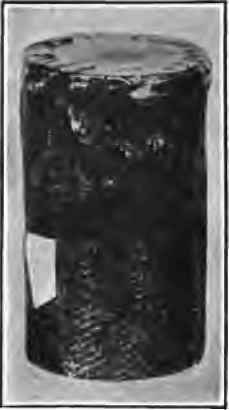
Fig. 187. - Light waterproofed.

Fig. 188. - Lights on wrappers showing tearing cord.
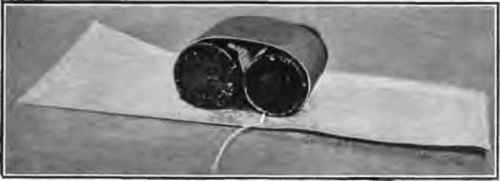
Fig. 189. - Inner wrapper assembled.
The cord is used to facilitate the opening of the two lights as is shown in figures 188 and 189.
Inside Wrapper
The inside wrapper is a piece of Bogus paper 0.013 cut in a strip 2 1/2 by 12 inches. This is wrapped around one of the lights and encircles its neighbor also, binding the two together.
Outside Wrapper
The outside wrapper is a piece of Kraft paper, 20-pound stock, 5 by 12 inches, used to pack two lights together. The tearing cord previously mentioned protrudes from one of the edges of the package.
Drumheads
These drumheads are of 20-pound Kraft paper, cut in rectangles 4 1/2 by 6 inches, with an inch cut off of each corner, beveling the same. These drumheads are pasted smoothly over each end of the package.
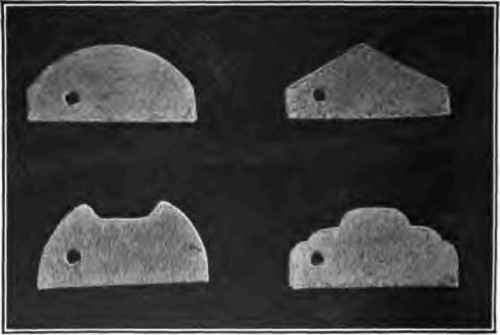
Fig. 190. - Identification tags.
Identification Tag
These tags are stamped out of 50-pound strawboard, having various shapes concordant with the surface form of the identification disk. Figure 190 shows these tags.
Outside Label
The outside label is similar to those used on the inside of the package and on the individual lights. It is shown in figure 191.
Paraffining
The package is now dipped in molten paraffin for the purpose of waterproofing.
Packing
Twenty-five packages with two lights in each are packed in a tin box, the cover of which is soldered with soft solder.
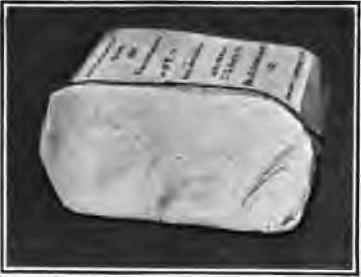
Fig. 191. - Lights wrapped and labeled.
A small tin attached to the corner permits the latter to be torn readily from the box. This tin container is then packed in a wooden case.
Position Light Flow Sheet
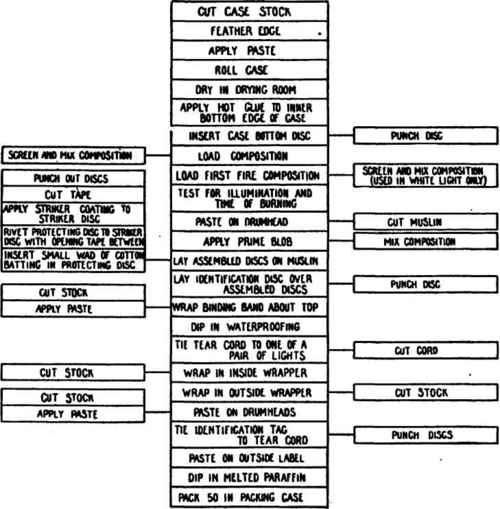
Plate 14. - Position light flow sheet.
Position Light Material Chart
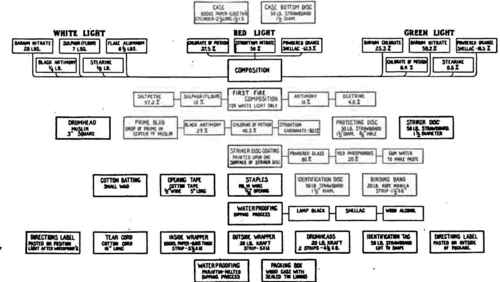
Plate 15. - Position-light material chart.
Continue to:


My Books

