


Compound Fireworks
Description
This section is from the book "The Pyrotechnist's Treasury: Complete Art Of Making Fireworks", by Thomas Kentish. Also available from Amazon: The Complete Art of Firework-Making: The Pyrotechnist's Treasury.
Compound Fireworks
Fig. 108
A triangular: 3 wheel cases and a case colour, at a. These cases are tied either to a hexagonal piece of deal board, or to three spokes, radiating from a nave. The colour is sometimes tied to a nail, driven in to receive it; or, it may be fixed on to a little peg. The peg is shown, by the side, at b. It is turned with a tenon, c; this tenon is glued in a hole, bored in the spoke; the part b may be half an inch in length; through it bore a small hole; charge the case colour on a foot, that enters the case half-an-inch; this void fits on to the peg b; pierce the case, through the hole in the peg, with a bradawl; push a bit of binding wire through, and twist. This is a far better way than tying it to a nail, as it cannot drop off. If the colour gets blown off, as it often does when tied, the piece is half spoilt. The colour may either stand at right angles, so as to face the spectator; or it may be fixed so as to lie in a plane with the wheel cases, very slightly sloping upwards; the mouth of the colour should point the same way as the mouth of the cases; if it were placed in the opposite direction, it would meet the current of air, be blown back upon itself, and burn the case rapidly.
With respect to the wheel cases, it is obvious that the mouths must all point in the same direction; the slightest consideration would suggest this; it is necessary, therefore, to have some certain rule of proceeding, so as to avoid mistakes. Now supposing, for the mere sake of illustration, if you had a case in your hand, it were to take fire, you would naturally wish the fire to be directed from you. Let this, then, be the guide. You are about to tie the cases on a wheel. Sit, to do so; take the wheel between your knees: place a case upon it, with the choke end from you; tie, near the choke,, also near the end; turn the wheel, place another case upon it, choke end from you; and so forth. Without this certain way of proceeding, you would be very embarrassed with the 12 cases on fig. 112; but, by attending to it, not the slightest difficulty will be experienced. Some of the cases will point obliquely upwards; some downwards; but they will all point from you. In the end of the last case, as at x, fig. 108, put a little dry clay, to prevent a stray spark igniting it, and tie the envelope; or, tuck in the envelope, like as with an ounce of tobacco. Avoid every source of failure.
Even the knots of the strings, with which the cases are tied on, are apt to come undone; they should either be touched with a dab of glue, or have a piece of paper pasted over them.
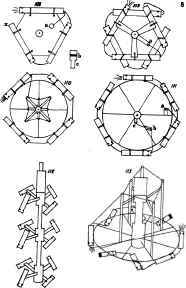
Fig. 109
A double triangular: 3 cases tied to the spokes; 3 to the previous 3. Double triangular frames are also made, with 6 spokes, on a long nave, 3 behind 3.
Fig. 110
A vertical wheel, illuminated. This is a wheel, with spokes, and a rim, or felly. The wooden hoops of the toyshops will furnish the latter. The illumination, as it is called, is made by lances, nailed with 1/2 inch Flemish tacks to the nave. The lances should be of different colours, but they ought, as nearly as possible, to keep time with each other. To effect this, it is necessary previously to adjust them; thus. Charge a number of cases, exactly two inches long, with different colours; use the same scoop to all, and give each the same number of blows, that they may be rammed as uniformly as possible.
Fasten a string to the end of a leaden bullet, and tie a loop at the other end of the string. Let the length from the top of the bullet to the top of the loop be 39 inches. Suspend this from something, and set it swinging. Light the lances, one after another, and count the number of oscillations each endures. Keep a list of these, and write against them 10, 12, etc, or 5 per inch, 6 per inch. The bullet will indicate seconds, with the length of string recommended; and it matters not whether you give it a start of 6 inches, or 12 inches; for, if it goes twice as far, it goes twice as fast, so that the swings isochronise; the inestimable discovery of Galileo, which led to the invention of the pendulum. In order that the lances may be nailed on, they should be charged upside down, and left with ½ an inch vacancy; they can then be pinched flat, to receive the tack. Scrape out a little from the other end, and prime with very slightly damped meal.
Fig. 111. A Rainbow Wheel
This is a vertical wheel, generally with 3 colours, as drawn; the tail of the second, or mouth of the third, lights a; the mouth of the fourth, b and c; but any arrangement may be made. Place the colours/red, green, blue, at different distances from the centre, so as to form rings, equidistant, when burning. Suppose the spoke 12 inches long; place the colours at 3, 6, and 9 inches from the centre. It receives its name from its resemblance to the rainbow. Fig. 112. A caprice, or furilona, according to the number of the cases. A caprice, from the capricious manner in which it turns, up, down, and round about, now this way, now that. A furilona, possibly, from the fury with which it plays, when 4 cases are burning together, at the end: though some call it a fruiloni, said to be from the name of its inventor. A furilona and caprice wheel are much the same; the former, generally, has fewer cases on it than the latter. A coloured gerbe, placed on the top, is very effective; or, it may have a mine, or jack-in-the-box. The cases are to be placed so that some of them play horizontally, some obliquely upwards, some obliquely downwards; the spokes, which are concave at the end, are glued in, so as to determine the slope of the cases.
If there are 10 cases, they may be fired thus, h, u, d, hud, hudp; that is, 1 horizontal, 1 up, 1 down; 3 at once, horizontal, up, down; 4 at once, horizontal, up, down, perpendicular. If 13 cases, thus: h, u, d, hu, hd, ud, hudp. While tying the cases on the frame, it should be on a short wire, held perpendicularly in a vice, or block of wood; properly, the wire should be tapering, so that the frame should bite, when dropped on; the tapering will allow it to be turned round, easily, by slightly lifting it. Let the leaders be drawn straight, and not left dangling in curves, nor crossing each other. There must be enough match, but there ought to be no more. Look well to the mouths and tails of the cases; it is best to put a piece of pasted paper over each, for as the piece dashes round with great violence, if a stray spark falls on any composition filtering out, the whole is spoilt.
Continue to:


My Books

