


Definitions. Part 3
Description
This section is from the "Encyclopedia Of Practical Receipts And Processes" book, by William B. Dick. Also available from Amazon: Dick's encyclopedia of practical receipts and processes.
Definitions. Part 3
10. Decantation
10. Decantation. The operation of pouring off the clear portion of a liquid from its sediment. This is performed either by gently inclining the vessel, or by means of a syphon.
When a liquid is set aside to settle for future decantation by the first method, it is best to use a bell shaped vessel, or one provided with a lip, for convenience in pouring; as in decanting from a full vessel whose side is straight, the liquid is very apt to flow down the outside of the vessel. This can, however, be obviated by holding a glass rod or stick, previously wetted in the liquid, nearly upright, with one end resting in or suspended over the receptacle into which the liquid is to be decanted; the liquid is poured gently down the upper side of the stick, keeping the rim of the vessel in contact with it. The liquid will be more strongly attracted by the wet stick, than by the dry surface of the outside of the vessel. (See illustration.)
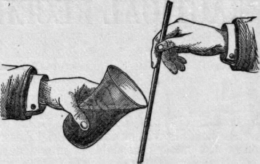
If this method of decanting is inconvenient, or, from the nature of the vessel, impossible, a syphon must be used. This is a tube of glass or metal, bent at an angle of about 30°, with one leg or end longer than the other. A piece of india-rubber tubing makes an excellent and easily adjusted syphon for decanting liquids which will not affect that material. The syphon must be first filled and then the shorter leg inserted in the liquid, care being taken to keep its extremity always below the surface, and the liquid will flow continuously out of the longer leg as long as there is any left in the vessel. For decanting caustic liquids, acids, etc., syphons of different kinds are provided, constructed especially for the purpose.
11. Deflagration
11. Deflagration. The sudden combustion of any substance, for the purpose of producing some change in its composition, by the joint action of heat and oxygen. The process is commonly performed by projecting into a red hot crucible, in small portions at a time, a mixture of about equal parts of nitre and of the body to be oxidized.
12. Desiccation
12. Desiccation. The evaporation or drying off of the aqueous portion of solid bodies. Plants and chemical preparations are deprived of their humidity by exposure to the sun, a current of dry air, an atmosphere rendered artificially dry by sulphuric acid, or by the direct application of heat by means of a water-bath, a sand-bath, or a common fire. Planks and timber are now seasoned, on the large scale, in this way, by which a condition may be attained in 2 or 3 days, which, on the old system, took as many years to produce.
13. Distillation
13. Distillation. Distillation consists in vaporizing a liquid in one vessel, and conducting the vapor into another vessel, where it is condensed and collected. The process is used for separating a liquid from solid substances with which it may be mixed; for impregnating a liquid with the volatile principles of plants, as in the preparation of Eau de Cologne and other aromatic spirits, and for separating a more volatile liquid from one less so, as alcohol from water.
For example, as alcohol is transformed into vapor at the temperature of 176°, while water remains, at this temperature, in a liquid state, it is only necessary to heat the mixed liquids to 176°, when the alcohol rises in vapor, and the water is left behind. The vessel in which the liquids are heated is closed by an air-tight cover, and from this cover a pipe is led and coiled through a cask of cold water; as the alcoholic vapor enters this cold pipe it is condensed to the liquid form. This process of evaporating and condensing a liquid is called distillation; the apparatus is called a still or retort, and the coiled pipe is the "worm of the still," or the condenser.
On the small scale distillation is performed in the simplest way by means of the common glass retort (a,) and the receiver (b,) as in Fig. 1. The retort may be either simple, as
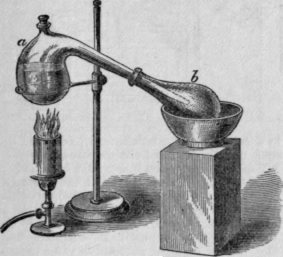
Fig. 1.
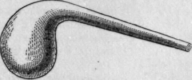
in Fig. 2, or tubulated as in Fig. 1, and sometimes the receiver has a tubulure to allow the escape of gas or expanded air, as in Fig. 3. The great advantages of the glass retort are that it admits of constant observation of the materials within, that it is acted upon or injured by but few substances, and may be cleaned generally with facility. Its great disadvantage is its brittleness.
The tubulated retort is more liable to crack than the plain one, on account of the necessarily Fig. 2.
greater thickness of the glass in the neighborhood of the tubulature; nevertheless it is very convenient on account of the facility which it offers for the introduction of the materials.
When the common glass retort and receiver are used for the distillation of liquids, care should be taken not to apply the luting until the atmospheric air is expelled (see Lute), unless the receiver has a tubulure for its escape. The operator should aim at keeping the body of the retort hot, and the neck and receiver cool. A hood of pasteboard will facilitate the former; and the latter will be
accomplished by keeping the neck and receiver wrapped in wet cloths, on which a stream of cold water is kept running. This may be conveniently done by means of a syphon, made
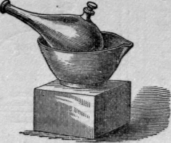
Fig. 3 bound loosely around the by dipping one end of a strip of cotton in a vessel of water, and allowing the other end to hang down upon the cloths, receiver and the neck of the retort. Retorts are heated in a water or sand bath, placed over the naked, fire, or they may be held by a circle of metal, in which case the retort may be heated by the argand gas flame, as in Fig. 1, or by live coals. Where it is to be subjected to a heat sufficient to soften the glass, the bulb may be previously coated with a mixture of clay and sand, and dried. (See Nos. 1695 (Burnett's Disinfecting Fluid) and following.)
Even on the small scale it is sometimes necessary to employ distillatory apparatus constructed of other materials besides glass.
The still in general use (see page 12) may be considered as composed of three or four parts:
I. The cucurbit or body of the still, A. This portion of the apparatus receives the direct action of the fire, and contains the liquid to be distilled when the process is to be conducted by a naked fire. It is in the form of a truncated reversed cone, A, mounted on a rounded portion, a a, which rests on the furnace, X X, and terminated at the top by a collar of somewhat smaller diameter than the lower part.
C is a hole by which. the liquid is introduced into the body of the apparatus; d d are the handles.
II. The water-bath, B, a cylindrical vessel of tin or tinned copper, which is placed in the cucurbit, A, closing it lightly by means of the collar, m, which rests on the collar, b b. This vessel is used only when the mixture to be distilled is not exposed to the direct heat of the fire; in this case the cucurbit, A, fulfills the office of a water-bath, and the vessel, B, takes the place of the cucurbit.
"When, instead of distilling by the naked fire, the water-bath is employed, water only is put into the cucurbit, in which the vessel, B, is placed containing the liquid to be distilled.
III. The head of the capital, G. This part may be placed either on the cucurbit, when distilling by naked fire, or on the vessel, B, if used, care having been taken to make both openings of the same size; it is very nearly the shape of the upper part of a retort, and is furnished with a large pipe by which the vapor is to be carried off to the worm or cooler.
n. A hole which, during the operation, is kept closed by a screw top, e, and its use is to introduce fresh liquid into the cucurbit without having to disconnect the apparatus.
IV. The cooler or worm, D. This is a long tin pipe, bent in the form of a screw, and enclosed in a copper or wooden vessel full of
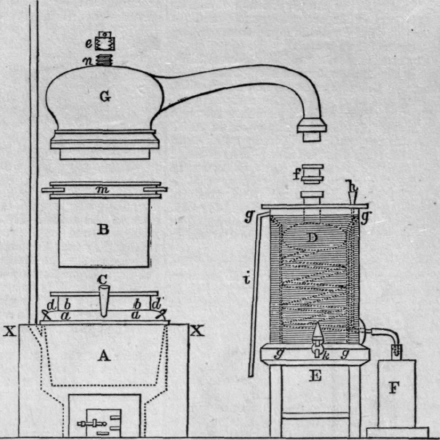
cold water. The upper part of the pipe, which is often enlarged in a globular form, receives from the beak of the cap-ital the vapors arising from the cucurbit; the lower portion is open be-ow, so that the condensed liquid flows into a vessel placed underneath.
All the joints of the apparatus are to be luted with bands ofpaper soakedin paste; the joint of the cucurbit, when used as a water-bath, must not be tight, in order to allow of the escape of the steam from the boiling water. (See Lute.) g g. Tin rests for supporting and fixing the worm in the vessel.
h. A vertical pipe fixed to the side of the vessel, open at both ends and terminated at the top by a funnel.
This pipe serves to renew the water in the cooler; cold water is poured in at the top which flows to the bottom of the vessel, and being of a lower specific gravity than the hot water, forces it out at the escape pipe, i.
k. A tap, by which all the water in the worm tub can be discharged.
/. A connecting pipe inserted between the beak of the capital and the collar of the still is of precisely the same height as the collar, m, of the cucurbit, B, and is only used in distilling by the water-bath; when a naked fire is used this pipe is unnecessary, as the beak will reach down to the collar of the still without it.
In distilling perfumes and cordials, the object is to extract or separate the odorous and aromatic principle from the roots, flowers, seed, or spices used to impart the characteristic odor and taste to the liquor, and it is usual to macerate such ingredients in strong alcohol several days before distillation. Great care should be taken that the heat should, in all cases, be as gentle and uniform as possible. Remember that accidents may be effectually prevented by distilling spirits in a water-bath, which, if sufficiently large, will perform the operation with all the dispatch requisite for the most extensive business.
Continue to:


My Books

