


Order Of The Garter
Description
This section is from "The American Cyclopaedia", by George Ripley And Charles A. Dana. Also available from Amazon: The New American Cyclopædia. 16 volumes complete..
Order Of The Garter
Order Of The Garter, the highest British order of knighthood, and one of the oldest and most illustrious of the military orders of knighthood in Europe, commonly said to have been instituted by Edward III. of England, about 1350. The precise date of its foundation has been much disputed. In Rasters Chronicle it is stated that the order was devised in 1192 by Richard I., who made 26 of his knights wear blue thongs of leather around their legs in a battle fought with the Saracens on St. George's day. One account says that Edward in 1346 gave his garter for the signal of a battle (supposed to be that of Crecy) which was crowned with success; and being victorious on land and sea, and having as prisoner David, king of Scotland, he instituted this order, April 23, 1349, in memory of these exploits. According to Selden, the order was instituted April 23, 1344; according to Nicolas, in 1347; according to Ashmole, in 1349. In Burke's "Peerage it is said that "the most noble order of the garter was instituted by Edward III. about August, 1348." In the accounts of the great wardrobe the garters of the order are first mentioned in 1348. Most writers, however, agree that its institution dates from a tournament at Windsor, held April 23,1344, to which Edward invited the most illustrious knights.
It was founded in honor of the Trinity, the Virgin Mary, St. George, and St. Edward the Confessor; and St. George, who was already the tutelar saint of England, was considered its especial patron and protector. An ancient tradition connects the emblem of the order with the story popularly told of Edward and the countess of Salisbury. When she happened at a ball to drop her garter, the king took it up and presented it to her, at the same time exclaiming, with reference to those who smiled at the action: Honi soit qui mal y pense ("Evil to him who evil thinks"). Edward added "that shortlv they should see that garter advanced to so high an honor and renown as to account themselves happy to wear it."-The habit and insignia of the order are: The garter, of dark blue velvet, edged with gold, bearing the motto in golden letters, with buckle and pendant of gold, richly chased, worn on the left leg below the knee; the mantle, of blue velvet, lined with white taffeta, with a star embroidered on the left breast; the hood, of crimson velvet; the surcoat, likewise of crimson velvet, lined with white taffeta; the hat, of black velvet, lined with white taffeta; a plume of white ostrich feathers, having in the centre a tuft of black heron's feathers, all fastened to the hat by a band of diamonds; the collar, of gold, consisting of 26 pieces, each in form of a garter, enamelled azure; the George, or figure of St. George on horseback encountering the dragon, attached to the collar, and the lesser George pendent from a broad dark blue ribbon over the left shoulder; the star, of eight points, silver, upon the centre of which is the cross of St. George, gules, encircled with the garter; and the ribbon of the order, garter blue.
By a statute passed Jan. 15, 1805, the order is to consist of the sovereign and 25 knights companions, together with such lineal descendants of George II. as may be elected, always excepting the prince of Wales, who is a constituent part of the original institution. Special statutes have since at different times been proclaimed for the admission of sovereigns and extra knights, the latter of whom have, however, always become part of the 25 companions on the occurrence of vacancies. The last sovereign elected was the sultan Abdul-Aziz, who was invested by the queen on board of her yacht at the naval review, July 17,1867. The knights are designated as K. G.,knights of the garter;" their strict designation, however, is equites aurete periscelidis, "knights of the golden garter." At the beginning of 1873 there were, besides the queen and the prince of Wales, 47 knights of the garter. They were: the duke of Edinburgh, Prince Arthur, and Prince Leopold, sons of the queen; the ex-king of Hanover and the duke of Cambridge, members of the royal family; the ex-emperor of the French, the king of Italy, the emperor of Germany, the king of Portugal, the king of Denmark, the king of the Belgians, the emperor of Austria, the emperor of Russia, the sultan of Turkey, and the emperor of Brazil; the crown prince of Germany, and 7 other German dukes and princes, and 24 British peers.
The officers of the order were: the bishop of Winchester, prelate; the bishop of Oxford, chancellor; the garter principal of arms, and the usher of the black rod.
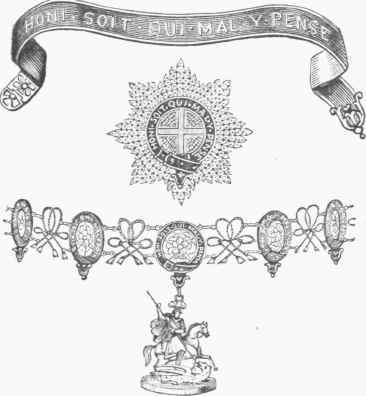
Insignia of the Order of the Garter.
Continue to:


My Books

