


Gladiolus
Description
This section is from "The American Cyclopaedia", by George Ripley And Charles A. Dana. Also available from Amazon: The New American Cyclopædia. 16 volumes complete..
Gladiolus
Gladiolus (Lat. gladius, a sword), a genus of ornamental plants of the iridaceoe or iris family. A flattened solid bulb or corm sends up a stem bearing several long, sword-shaped, strongly nerved leaves, and terminating in a spike of large and usually showy flowers, which are somewhat irregular from the difference in the size of the petals, and more or less two-lipped. Sword lily and corn flag are names sometimes applied to these plants, but they are generally called by their botanical name gladiolus. There are both hardy and tender species. The hardy ones are planted in autumn at the same time with hyacinths, tulips, etc.; the principal ones cultivated are G. communis, from Europe, which has been longer in the gardens than any other, and bears a few rose-colored, sometimes white flowers, and G. Byzantinus, from the Levant, which has larger and more showy purple flowers. Among the tender species which are grown in pots in winter, or planted in the open ground in spring, are G. cardinalis, G. blandus, and G. psittacinus, from the Cape of Good Hope. The most popular and brilliant of these plants are hybrids from these and probably others; they originated in the garden of the duke of Aremberg, a noted amateur of Ghent; and as their characters are permanent and they are fertile among themselves, these hybrids have received the garden name of gladiolus Gandavensis. In size, beauty of form, and variety of coloring of the flower, these hybrids far excel any of the species, and they are constantly improving in these respects; new seedlings of merit are each year raised both in Europe and America, and the catalogues now offer named varieties in hundreds.
The colors range from pure white through rose to crimson, scarlet, and violet; some have yellow as the predominating color, and there are various intermediate shades of salmon, chamois, and others; besides self-colored flowers, there are those variously striped, stained, and shaded in the most brilliant and pleasing combinations. The cultivation is very easy, as they will grow in any light, rich garden soil; the bulbs are planted in spring, and, if a succession of flowers is desired, at intervals from March until May; they are set 2 or 3 in. deep, and 10 to 12 in. apart each way, and need no other care than to be kept clear of weeds, and to have such stalks as need it tied to sticks. A very effective plan is to plant the bulbs where the flowers will be seen against a background of evergreens; they may also be introduced among rhododendrons, azaleas, and other spring-flowering shrubs. In autumn when the stalks are dead the bulbs are taken up, labelled, wrapped in papers, and kept in a dry place, where they will not freeze, until spring.
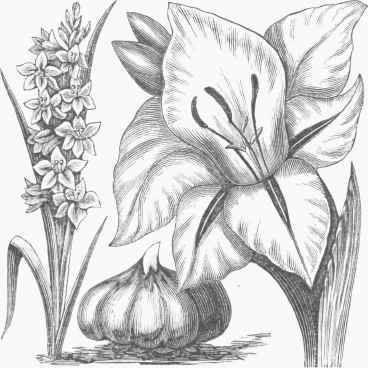
Common Gladiolus.
The number of bulbs annually produced varies from one to several, according to the variety. At the base of the bulbs there will usually be found numerous bulblets, the size of a pea or smaller; planted the next spring, these make flowering bulbs in two years. New varieties are obtained from the seed; these produce flowers the third or fourth year after sowing.
Continue to:


My Books

