


Germany. Part 4
Description
This section is from "The American Cyclopaedia", by George Ripley And Charles A. Dana. Also available from Amazon: The New American Cyclopædia. 16 volumes complete..
Germany. Part 4
The culture of the vine extends to lat. 51° 30'. (See Germany, Wines of.) -The three free cities excepted, the greatest density of population prevails in the principality of Reuss elder line (473 to the square mile), the kingdom of Saxony (442), the grand duchy of Hesse (288), and the duchy of Saxe-Altenburg (256). In the following states it exceeds the average:Wurtemberg, Baden, Brunswick, Saxe-Coburg-Gotha, Schwarzburg, Reuss younger line, Lippe, Anhalt, and Saxe-Weimar. In Prussia it is 184, in Bavaria 166. The number of large cities, proportionately to the population, is greater in Germany than in any other country except Great Britain, Belgium, and Holland. There is one city with more than 800,000 inhabitants (Berlin), two with more than 200,000 (Hamburg and Bres-lau), seven with more than 100,000 (Dresden, Munich, Cologne, Magdeburg. Konigsberg, Leipsic, and Hanover), 22 with more than 50,-000, and 50 with from 20,000 to 50,000. More than nine tenths (92 per cent.) of the population of Germany belong to the German race; the remainder, belonging principally to the Slavic race, is mainly confined to the eastern Prussian provinces.
The entire number of Slavs in Germany is about 2.640,000 (2,450,000
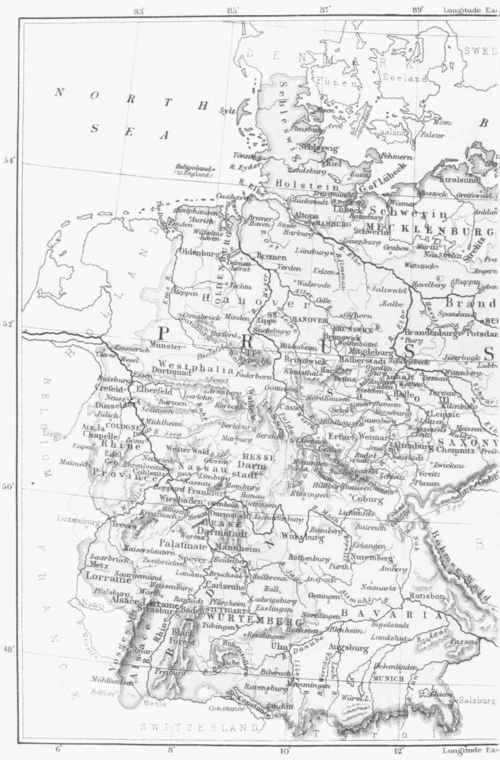
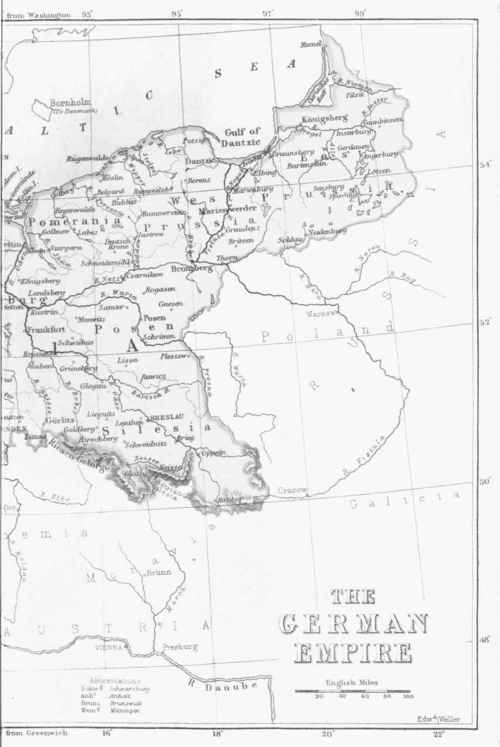
Poles, 140,000 Wends, 50,000 Czechs), or 6 1/2 per cent., of which number only about 50,-000 are outside of Prussia. In the latter country there are also about 150,000 Lithuanians and Letts. The Danes, in Schleswig, number about 150,000, and the French, chiefly in Lorraine, 230,000. Except Ireland, no country of Europe has lost so large a number of inhabitants by emigration as Germany. From 1819 to 1855 the aggregate number of German emigrants was estimated at 1,800,000. The number of German immigrants into the United States from 1820 to 1872 amounted to 2,580,-000. The Germans are usually classified into Low Germans and High Germans, or northerners and southerners. The dividing line may be drawn from lat. 50° 30' in western Germany to lat. 52° 30' on the eastern frontier, or along the course of the Sieg (a tributary of the Rhine) to the southern slope of the Hartz mountains, crossing the Elbe near its confluence with the Saale, then a little to the northward along the southern banks of the Havel and of the Warthe. In physical development the Germans are superior to either the Latin or the Slavic race. Their frame and their muscular development are strong, almost heavy. Among the lower classes of the rural and laboring population stoutness and strength often approach to clumsiness.
Generally the northerners are taller and have better-shaped features and limbs than the southerners. The blonde complexion prevails only in the north; in central and southern Germany light or dark brown is more frequently found. In power of endurance the Germans are surpassed by the Slavic race, in agility by the Latin. The prominent features of the German national character are honesty, faithfulness, valor, thoughtfulness, perseverance, and industry. The Germans have largely promoted the progress of human knowledge. There is scarcely a single branch of science in which they have not excelled. In music, painting, and sculpture they occupy a very high rank among nations. The German artisan is valued for his dexterity and steadiness. The sectional and local diversities of character are very great in Germany. While the Protestant northerners have many characteristics in common with the Anglo-Saxon, the Catholic southerners approach in some important respects the Latin race, particularly in a certain preponderance of imagination over reason.
The Low German assimilates far more readily to the English or American than to the Austrian or Swabian.-The culture of the soil in Germany is highly developed, and inferior only to that of England. The products of agriculture have been nearly doubled by the introduction of more rational methods of cultivation since 1816. All German states have agricultural colleges, some of which enjoy a world-wide reputation. The methods of cultivation are different in different portions of the country. The triennial and quadrennial rotations of crops are most in use. According to the first method, winter grain is raised in the first year, spring grain in the second, and potatoes, pulse, or fodder in the third year; according to the second method, recommended by Thaer, a grain crop is always followed by a crop of fodder or pulse. In some of the northern states crops of grain are raised on a certain portion of the farm for several successive years, after which the field is allowed to lie fallow from three to seven years, according to the number of lots into which the farm is divided. In Mecklenburg agriculture approaches to horticulture, inasmuch as many different kinds of fruit are raised on little plots of ground, one by the side of another.
The culture of forests is conducted upon a more scientific basis than in any other country. Having in former times thoughtlessly destroyed their forests, many German states have been compelled to replant them in order to satisfy the wants of agriculture and industry. In many states the forests mostly belong to government, and are as carefully kept as gardens; but even private owners are prohibited by law from wasting their forests without regard to the public good. The most extensive forests are found in central and southern Germany and in the eastern provinces of Prussia. The entire superficies of wood land in Germany is 52,939 sq. m., of which Prussia has 31,423, Bavaria 9,376, and Wurtemberg about 2,29G.-Of all European countries, Germany has the oldest manufactures. In the last century it had fallen in regard to the extent of its mechanical pursuits behind England and Belgium, but within 50 years it has advanced rapidly, and is now in a fair way to recover its former position. As early as the 13th century Germany was celebrated for its cloth and linen manufactures, its glass wares, carved and chiselled wares, etc.
Continue to:


My Books

