


Georgia, Grusia, Iberia, Gurjistan. Continued
Description
This section is from "The American Cyclopaedia", by George Ripley And Charles A. Dana. Also available from Amazon: The New American Cyclopædia. 16 volumes complete..
Georgia, Grusia, Iberia, Gurjistan. Continued
In the 13th century the Mongolians subdued the country, but in the middle of the 14th George VI. threw off their yoke and extended his sway over the neighboring provinces. Tamerlane reduced the country to subjection, but it was again liberated by George VII. In 1424 King Alexander divided his kingdom among his three sons, and the history of the next two centuries is one of conflicts between the three governments, and of quarrels with Persia and Turkey, in which Russia interfered. The country was reunited under Vakhtang IV. or V., whom the Persians call Shah Naos. He died in 1676, and for a century after Georgia was the scene of intestine feuds and divisions, in which the Turks and Persians took part. In 1783 Irakli (Heraclius) II. of Ivakhetia, who had united under his sway a large part of the ancient kingdom, being pressed by the Persians, announced himself a vassal of Russia. His successors having new difficulties with the Persians and Lesghians, Georgia was made in 1801 a province of Russia, and in 1810 Ime-rethia was added to it.-The Georgian language is written in an alphabet of 40 letters, somewhat varying in different manuscripts.
The following are used in Brosset's dictionary:

Georgian Costumes.

A

B

G

D

E

W

Z

H

TH

I

C

L

M

N

I

O

P

J

R

S

T

V

VI

P

K

GH

Q

CH

TCH

TZ

DZ

TS

DCH

KH

KHH

DJ

II

HO

F

E
The characters used in the ecclesiastical style of writing differ from the common ones. The languages of the four tribes, the Georgians, the Mingrelians, the Suanethians, and the La-zians, are related to each other, and show a common development from one primitive form, either primitive Aryan or Dravidian; but there is no foundation for connecting them with the languages spoken by tribes north of the Caucasus. The Georgian is written from left to right. It makes no distinction of gender. To distinguish sex, the words male and female are introduced, except for the words king, queen, young man, young woman, him, and her. No article is used. There are two numbers, singular and plural, and six cases, nominative, genitive, dative, vocative, instrumental, and instrumental modal. There are special forms for the comparative and superlative of adjectives. Nouns are inflected by means of suffixes, and verbs by means of suffixes, prefixes, and changes in the radical letters. The verbs are either active, passive, reciprocal, or neuter, and are modified according to one of the 20 classes of conjugation into which they are divided.
Prepositions govern either the genitive, dative, or instrumental.-Among the literary remains of ancient Georgia, some of the manuscripts written in the ecclesiastical style of alphabet are probably of high antiquity; but must of them date subsequently to the introduction of Christianity, and consist of homilies and translations of portions of Scriptures, and of Plato, Aristotle, and other Greek authors. Some manuscripts contain novels and romances; one gives in verse the history of Shah Naos, and several, dating principally from the 17th century, are poetical works of some merit. The most important of Georgian manuscripts are: a volume of 63 treatises, historical and biographical, which has thrown much light on the history of the Khazars during the 8th century; a translation of the Gospels by Droudch, dating from the 10th century; and a romance entitled "Tariel, the Man with the Tiger Skin," a general of Queen Tamar, by Skhotta of Rustvel. The following is a facsimile of the last verse of Rustvel's romance:
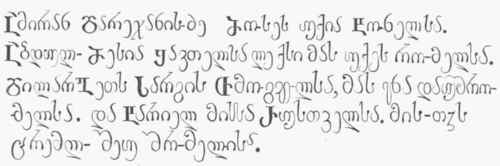
The literal translation is as follows: Moses of Khori has glorified Amiran, the son of Da-redjan; the poem of Abdul Messia, written by Khevtel, and the history of Dilar by the indefatigable writer Geth Sargis of Tmogvi, were worthy of praise; but Rustvel has wept without ceasing over his Tariel." Among similar compositions, an epic on Queen Tamar, by Tchakhadze, ranks equally high. During the 18th century, in spite of the incessant wars that harassed the country, there was a rich supply of meritorious literature, and the language attained that definiteness, richness, and energy which are now its most prominent features. Prince Sulkhan-Saba-Orbelian published in that century a dictionary of the language, containing at least 25,000 words, and King Vakhtang VI. caused an extensive history of the country to be written. The Russian language has now generally superseded the Georgian in the schools, and books in the Georgian language are printed in Russian characters. The language and literature of the Georgians have been specially studied by Ade-lung, Brosset, Dorn, Josselin," Klaproth, Saint-Martin, and Tchubinoff. Brosset is considered the highest authority on the subject.
Ethnological studies of the Georgian race are contained in the books of travel of Cunynghame, Dorn, Dubois de Montpereux, W. J. Hamilton, Haxthausen, Mounsey, Poulett-Cameron, and Wagner.-See Histoire de la Georgie depuis Vantiquite jusqii'au XIXe siecle, traduite die georgien, by Buosset (2 vols. 4to, St. Petersburg, 1849-'57);History of Grusia," by Baratoff (St. Petersburg, 1865 ct seq.) and La Georgie, by De Villeneuve (Paris, 1871).
Continue to:


My Books

