


Gavial, Or Garrhial
Description
This section is from "The American Cyclopaedia", by George Ripley And Charles A. Dana. Also available from Amazon: The New American Cyclopædia. 16 volumes complete..
Gavial, Or Garrhial
Gavial, Or Garrhial, a crocodilian reptile of Asia and Africa, of the genus gavialis (Geof-froy), characterized by its very long, straight, and narrow jaws, somewhat enlarged at the extremity. The number of teeth is greater than in other crocodilians, being 100 to 120 in all, from 50 to 60 in each jaw; the upper mandible is not pierced for the passage of the lower teeth, but has two grooves in each side for the reception of the first and fourth under teeth, the anterior being deep and in the front of the jaw; the five or six anterior pairs, both above and below, are larger than the rest of the teeth, the largest being the first, third, and fourth above, and the first, second, and fourth below, and all are of a conical form, slightly depressed from before backward. The division of the lower jaw into two branches begins about the 22d tooth of the series of 26. The bony opening of the nasal fossae is triangular, and this is closed in the males by a large oval cartilaginous sac, whose cavity is supposed to serve as a reservoir of air when the animal plunges under water.
There are five toes on the fore paws and four on the hind, the middle three of the former being united at their base by a very short web, and the external three of the latter by a thicker and more extensive membrane covered with small granular scales; the nails are feebly curved. The nuchal plates are two, of large size and ridged, and oval form, sometimes with a small plate on each side of them; the cervical . plates, four pairs, extend from the middle third of the neck to the dorsal covering in a longitudinal band, and are ridged on their median line; the upper part of the trunk is protected by four longitudinal series of ridged quadrilateral scales, each containing about 18, and the sides of the neck and flanks by flat smooth scales of medium size; the tail has from 34 to 40 circles of scales, becoming crested about the sixth or seventh on each side, the double portion becoming single and the highest near middle of the length; the under surface of the body is covered by about 60 transverse rows of smooth, oblong, quadrilateral scales, each pierced on the posterior border by a small opening. The scales of the limbs arc rhomboidal, and on the posterior ones from the ham to the little toe furnished with a serrated crest.
The common species, the gavial of the Ganges (G. Gangeticus, Geoff.), is of a deep sea-green color above, with numerous irregular brown spots, smallest and thickest about the jaws, and below pale yellowish white; the young have the back and limbs banded with black. It attains a length of over 20 ft., though the specimens usually seen are considerably smaller than this; in the adult the head is a little less than one fifth, and the tail about one half of the total length of the animal. Though most common in the river Ganges, it is found in other rivers of Asia; and other species have been described from Africa. Notwithstanding its large size and numerous teeth, the gavial feeds on fishes and small prey; the narrowness and feebleness of the jaws do not enable it to seize large land animals, like the wide and stronger jawed crocodile and alligator. The general structure and habits of the gavial do not differ essentially from those of the crocodile.-The fossil crocodiles which existed toward the end of the secondary epoch all had the elongated jaws of the gavial, the true crocodiles not appearing until the tertiary period at the same time with their mammalian prey.
The crocodilus priscus of Sommering, the teleosaurus and the steneo-8aurus of Geoffroy, all had the cranial charac-ters of the gavial. This reptile, though now confined to the warmest regions, in former geological ages lived in northern Europe.
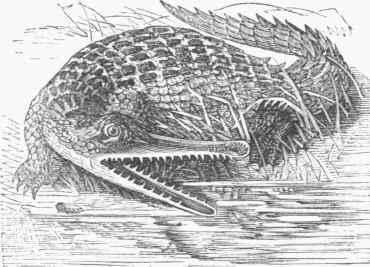
Gavial or Gangetic Crocodile.
Continue to:


My Books

