


Ganoids. Continued
Description
This section is from "The American Cyclopaedia", by George Ripley And Charles A. Dana. Also available from Amazon: The New American Cyclopædia. 16 volumes complete..
Ganoids. Continued
Among the most interesting genera is dipterus, in which D. macrolepiJotus of the old red sandstone resembles a fish carved in ivory, crusted with enamel, and thickly dotted with minute punc-turings; with circular scales, thickly enamelled tin rays, strong angular pectorals, scaleprotected ventrals like the hind fins of the ichthyosaurus, and a long dorsal and anal, the former consisting of two portions. Osteolepis, also British Devonian, has two anals alternating with two dorsals, large and rounded pectorals, small ventrals, large mouth, and scales of moderate size.
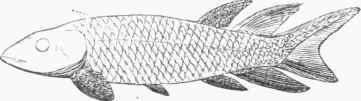
Dipterus macrolepidotus.
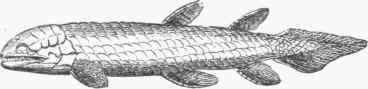
Osteolepis.
Among the genera most numerous in the coal measures are palceoniscus, a small, handsome, and well proportioned fish, with moderate-sized fins and scales, a single dorsal opposite the space between the ventrals and anal, and all with small rays at their margins-about 30 species in North America and northern and central Europe; eurynotus, a flattened and breamshaped species, with large dorsal, ventrals, pectorals, and head; and anthodes with lengthened body, very small scales, dorsal opposite anal, no ventrals, large pectorals, and very wide mouth, in proportions resembling the conger eel or ling. Among those most numerous in the Jurassic age are tetrayonolepis, with a broad flattened body, rapidly decreasing to the tail, rounded head, moderate fins, and pointed teeth-about 20 species in Europe; lepidotus, with body shaped like a carp's, large rhomboidal scales, and caudal fin almost square-about 30 species; and pholidophorus, resembling the herring, but with rhomboidal scales, homocer-cal or equal-lobed tail, and small teeth-more than 30 species.-In the family of cephalaspids, which contains the extreme acanth forms for a long time not recognized as fishes by palaeontologists, the body and head are covered with a" few non-imbricated plates or shields; the heterocercal tail, covered with imbricated scales, has no true caudal fin; and in place of pectorals are two long bony appendages or stilets; the dorsal cord like that of the sturgeons; they belong to the old red sandstone formation, and were short-lived in comparison with some other ganoids.
The genus pterichthys (winged fish), discovered by Hugh Miller in the Cromarty sandstone, first appears at the base of the old red sandstone, and disappears with its upper beds; one of the best known species, P. Milleri is 8 in. long; it is as strange a form among fishes as the plesiosaurus and pterodactyl among reptiles; in his work on "Fossil Fishes," Prof. Agassiz says:It is impossible to find anything more eccentric in the whole creation than this genus." Hugh Miller describes it, when seen from the under surface, as resembling "the human figure, with the arms expanded as in the act of swimming, and the legs transformed, as in the ordinary figures of the mermaid, into a tapering tail." There is no separation between the head and trunk, and the whole animal is in a complete armor of solid bone; the strong helmet of the head is perforated in front by two circular holes for the eyes, the body above and below protected by a curiously plated cuirass, and the tail sheathed in a flexible mail of bony scales; the plate-covered arms are articulated by a complicated joint to the lower part of the head; the flat abdomen and ribbed and groined arch of the back add to the strength of the armature without increasing the weight-the creature resembling a " subaqueous boat, mounted on two oars and a scull;" and this strange fish is a characteristic organism of the old red sandstone.
The genus coccosteus has not the pectoral appendages of the preceding animal, and the head and anterior part only of the trunk are covered with a bony helmet and cuirass, the caudal portion being naked; it has one dorsal and one anal fin; the mouth is furnished with small, equal, conical teeth. The most remarkable peculiarity in this fish, unique among vertebrated animals as far as known, is that the jaws possessed both the usual vertical motion, and also a horizontal movement as in crustaceans, indicated by the two sets of teeth, one on the upper edge of the jaw and the other on the line of the symphysis, the latter of which, if brought into action at all, could only be so by the lateral movement of the jaws. The jaws of coccosteus are also interesting, as presenting the most ancient internal bone which has displayed its structure under the microscope. ' The jaw of this ancient fish shows the Haversian canals, the lacunae and osseous cells, as in the bones of man at the present time; showing the extension of the same plan through the most distant ages, and by a fair inference to the beginning of vertebrate existence.
The genus cephalaspis, or buckler-head, had a thin triangular body, and crescent-shaped head covered with a singular shield-like plate, with lateral prolongations extending along the sides; body covered by vertical rows of scales; no ventrals nor pectorals, and two dorsals. It lived at the same time with large placoids, armed with dorsal spines (of which the spines only remain), and with a gigantic lobster-like crustacean more than 4 ft. long; it belongs to the middle portion of the old red sandstone.-The family of sauroids, of which the gar pike is one of the few living representatives, had pointed conical teeth alternating with small brush-like ones; the skeleton bony; the scales flat, rhomboidal, and completely covering the body; those living before the Jurassic age had unequal-lobed tails, while the homocercal genera flourished at a more recent period. The genus megaliclithys was a formidable fish of large size; the scales of the body and the plates of the head had such a brilliant enamelled surface,that they may still be occasionally seen in the shale of a coal pit, catching the rays of the sun, and reflecting them across the landscape, as is often done by bits of highly glazed earthenware or glass." The genus diplopterus was of smaller size, with an elongated tapering body, flat head, rounded muzzle, two dorsals, two anals, and the caudal fin truncated almost vertically, the lobes coming off laterally from a prolongation of the vertebral column; their scales were of great brilliancy, and must have flashed brightly through the woods of the coal period, as they leaped into the air in sport or in pursuit of prey.
The genus pygopterus had the fins greatly developed, and a heterocercal tail. Aspidorhynclius had a much elongated body, homocercal tail, the upper jaw prolonged into a beak and extending beyond the lower; the scales large. The former belongs to the coal and magnesian limestone formations, and the latter to the Jurassic.-The coelacanth family is characterized by having all the fin rays and bones hollow, a peculiarity not found in other ganoids; and all the fin rays are stiff, articulated only at their bases, and supported on interapophysal small bones; they occur in all the ages from the lower Devonian to the chalk formations, most numerous in the red sandstone and coal strata. In the genus asterolepis, one of the earliest and largest of the ganoids, the bony plates of the head are ornamented with star-like markings, and the scales of the body are delicately carved; Hugh Miller says its cranial bucklers have been found in the flag stones of Caithness,large enough to cover the front skull of an elephant, and strong enough to have sent back a musket bullet as if from a strong wall." It must have equalled in size the largest alligator, and its teeth throughout the jaw had the reptilian peculiarity of being received into deep pits opposite, causing them when the mouth is shut to lock like the serrations of a bear trap.
The genus lioloptychius was of very large size, with rough scales several inches in diameter, the cranial bones sculptured like those of the crocodile, and conical teeth larger than those of any living reptile. The II. (rhizodus) Hibberti, the largest of about 20 described species, was of such a giant size that the words applied in Job to leviathan might appropriately be given to it; this reptilian fish must have been 40 ft. in length, with teeth three times larger than those of the largest crocodile, and covered with an impenetrable coat of mail. There were several smaller holoptychians in the red sandstone, even more strongly armed than this giant of the coal period.-For further details on fossil ganoids of these and other families, see the great work of Prof. Agassiz on "Fossil Fishes;" and for a popular description of the most interesting genera, the writings of Hugh Miller, especially "The Testimony of the Rocks," " Footprints of the Creator," " Old Red Sandstone," and " Popular Geology."
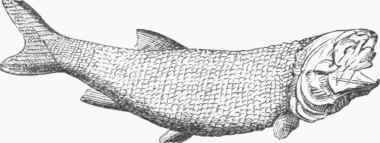
Palaeoniscus.
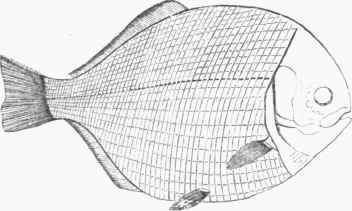
Tetragonolepis.
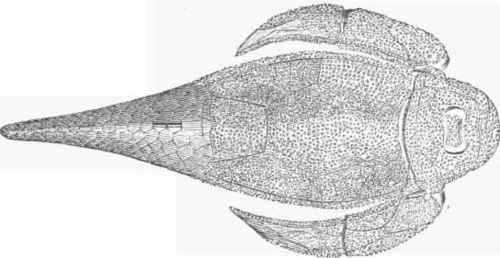
Pterichthys Milled.
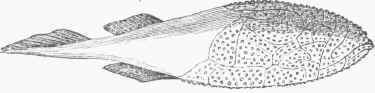
Coccosteus.
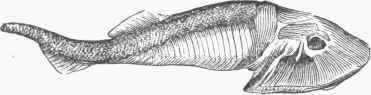
Cephalaspis.
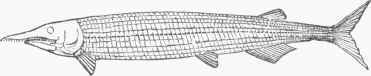
Aspidorhynclius.
Continue to:


My Books

