


Gannet
Description
This section is from "The American Cyclopaedia", by George Ripley And Charles A. Dana. Also available from Amazon: The New American Cyclopædia. 16 volumes complete..
Gannet
Gannet, a web-footed bird, of the family sulidae and genus sula (Briss.). The genus is characterized by a bill longer than the head, strong, straight, and broad at the base; the sides compressed and grooved toward the tip, which is slightly curved, with the lateral margins obliquely and unequally serrated; the nostrils basal, linear, in a lateral groove, and almost invisible; the wings long and pointed, the first and second quills longest; the tail long and graduated; the tarsi short and stout, rounded in front and keeled behind; the toes long, all four connected by a full membrane; the claws moderate and rather flat, the middle one serrated, and the hind one rudimentary; beneath the lower mandible is a naked sac, capable of moderate distention. There are about ten species described, in various parts of the world, of which two are natives of the western hemisphere, the booby (S. fiber, Linn.), treated under its own title, and the gannet, or solan goose (S. bassana, Briss.). The gannets are usually found in immense numbers on desert and rocky islands near the mainland, migrating southward in small parties on the approach of cold weather; they sometimes float lightly on the sea, but are generally seen on the wing; their flight is powerful, rapid, buoyant, and long sustained; their food consists of fishes which swim near the surface, upon which they dart headlong from a considerable height, making a great splash, and sometimes remaining under water a minute or two; they swallow the fish head foremost, and their gullet is so expansible as to take in the largest herring.
The common gannet (S. bassana) has a close dense plumage, of a general whitish color, buff yellow on the head and hind neck, and primaries brownish black; the bill is pale bluish gray; bare space about the eye and on the neck blackish blue; iris white. The length to end of tail is 40 in., to end of wings 38, the extent of wings about 6 ft., and the bill 4 in.; the weight is 7 lbs. The female is like the male, but smaller. The young are brown and white above, and grayish white below. This species breeds in great numbers on the rocky islands near the coast of Labrador, and after the breeding season, in May and June, is found all along the Atlantic states to the gulf of Mexico; it is entirely maritime, and never seen inland unless forced in by violent gales. The flight, when travelling, is low, performed by 30 or 40 flaps of the wings, and then by sailing for an equal distance with extended neck; the walk is exceedingly slow and awkward. The nest is a hole in the earth surrounded by weeds and sticks matted together for a height of 10 to 20 in., and only a single pure white egg, about 3 in. long, is laid in it; the young are hatched in about a month; the males assist in incubation.
They congregate on the same rock in vast numbers, and are quarrelsome during incubation, being fond of stealing from each other the materials for the nests, which are sometimes brought a distance of 30 miles. A young gannet, with its large head, closed eyes, thin neck, small wings, large abdomen, naked skin, and bluish black color, is a most uncouth and disagreeable object. When shot at or wounded, gannets disgorge their food like vultures. They have very few enemies among birds or beasts; the eggs and young are sometimes devoured by the larger gulls. According to Audubon, the feathers on the lower parts are very convex externally, giving the appearance of light shell work.
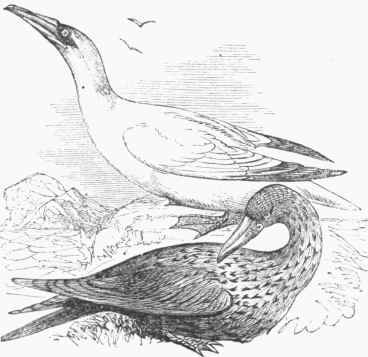
Common Gannet (Sula bassana), adult and young1.
Continue to:


My Books

