


Gallinule
Description
This section is from "The American Cyclopaedia", by George Ripley And Charles A. Dana. Also available from Amazon: The New American Cyclopædia. 16 volumes complete..
Gallinule
Gallinule, a wading bird, of the suborder gralloe, family rallidae, and subfamily gallinu-linae; comprising the genera porphyrio (Briss.), tribonyx (Dubuis.) from Australia, gallinula (Briss.), and fulica (Linn.); the last has been described in the article Coot. In the genus porphyrio (Briss.), or porphyrula (Blyth), the bill is short, thick, and strong, with the culmen much elevated at the base, and dilated on the forehead, with a large frontal plate and compressed sides; nostrils nearly circular; the wings and tail are short and rounded, the second, third, and fourth quills nearly equal and longest; the tarsi long and slender, with broad transverse scales; the toes very long and free at the base, claws long and somewhat curved. More than a dozen species are described, richly colored, inhabiting warm and temperate regions in pairs or small flocks, on the borders of lakes, rivers, and marshes; they prefer land to water, walk in a dignified manner, run lightly and quickly, and from the length of the toes are able to glide over the surface of floating water plants; their food consists chiefly of fruit, seeds, aquatic roots, and small fish and mollusks; their nest is concealed in the high reeds near the water's edge, made of dry grasses, and the usual number of eggs is three or four.
The only American species is the purple gallinule (P. Martinica, Linn.), with the head and lower parts fine bluish purple, darker and often nearly black on the abdomen and tibiae; the sides and under wing coverts bluish green, and lower tail coverts white; upper part of body dark green shaded with olive, and tinged.with brown on the back and rump; quills and tail brownish black, with green outer edging; bill bright red with yellow tip, frontal plate blue, iris bright carmine, tarsi, toes, and claws yellow. The length to end of tail is about 13 in., extent of wings 21 1/2, tarsus 2 1/4-; weight about 8 oz. It is distributed over the southern states, and is accidental in the middle and northern; it is found also in South America. It runs, swims, dives, and flies well; when travelling far its flight is high, but low and short in its feeding or breeding grounds; it alights with the wings spread upward like the rail; the rapid jerking motions of the tail when alarmed are very remarkable; it sometimes alights on ships 200 or 300 miles from land. Its flesh is not generally held in estimation.
It breeds at the south, very early in the year; the nest is built of rushes, 2 or 3 ft. from the ground, and is about 10 in. in diameter on the inside; the eggs, from five to seven, are of a light grayish yellow, with blackish brown spots; the young, at first nearly black, are fully fledged by the first of June.-In the genus gallinula (Briss.) the bill is shorter and less stout, the tarsi are stronger, and the toes are margined by a slight membrane throughout their length, though in no way comparable to the pedal lobes in the coot. There are about 12 species in various parts of the world, living on the borders of slow and deep streams edged with reeds; they are more aquatic than the preceding genus, preferring water to land, swimming well and striking the water with the tail; they are excellent fliers and divers, and swim under water by means of their wings; they also walk well, flirting up their tails, and run swiftly among the reeds and through narrow places; they can pass lightly over the leaves of aquatic plants; they eat slugs, worms, insects, grains, etc.; the nest resembles that of porphyrio, the number of eggs is eight to ten, and the young take to the water as soon as hatched.
The American species is the Florida gallinule (6. galeata, Licht.), very closely resembling the G. cliloropus (Linn.) of Europe; the principal differences seem to be that in the American bird the frontal plate is quadrate instead of acute, and the toes are longer. The head, neck, and under parts are deep bluish gray, blackish on the head and neck, and lighter on the abdomen; few feathers on the sides edged with white; lower lid, lateral lower tail coverts, edge of wing at shoulder, and outer edge of first primary, white; back and wings deep olive, darker on the rump; quills dark brown; tail brownish black; frontal plate and bill bright red, tipped with yellow; bare space on the tibia next to the feathers red; rest of legs yellowish green. The length to end of tail is about 13 in., extent of wings 22; weight 12 oz. The female is like the male. This species is common in the winter along the rivers, ponds, and lakes, from eastern Florida to Texas, whence it migrates in spring and summer to the Carolinas, and occasionally even to the middle and northern states; it is also found in South America. It is both nocturnal and diurnal in its habits, often seeking for food on land, walking and nipping insects and grass like the common fowl; it is rarely seen on salt water, but sometimes in the winter visits the banks of bayous in which the water is brackish.
The nest is generally a few feet from the water, among the rankest weeds; the eggs, about an inch and a half long, are of a dull dark cream color, with reddish brown and umber spots and dots; when the female leaves her nest she covers the eggs to protect them from crows and other enemies, and both sexes incubate; if not disturbed, they will hatch several broods in a season.
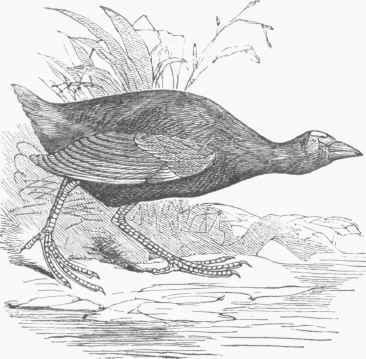
Purple Gallinule (Porphyrio Martinica).
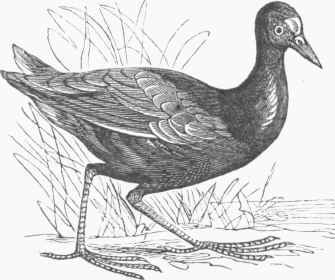
Florida Gallinule (Gallinula galeata).
Continue to:


My Books

