


Fungi. Part 5
Description
This section is from "The American Cyclopaedia", by George Ripley And Charles A. Dana. Also available from Amazon: The New American Cyclopædia. 16 volumes complete..
Fungi. Part 5
An extensive group of this order comprises those minute pustular forms which, resembling the true ascigerous fungi in many respects, differ in producing their spores on the ends of the filaments instead of being contained in asci. There is great obscurity overhanging this whole group. They exhibit themselves in so many anomalous forms that it is almost impossible to establish limits to genera which may be clearly understood. Writers on the subject record great numbers of genera, but hardly any two agree upon their characters, and the whole subject is burdened with an inharmonious synonymy. New light has been shed upon the subject of later years by the observations of Berkeley, Leveille, Tulasne, and others, who have pretty clearly established the fact that many so-called genera are merely stages of growth of true ascigerous fungi. Some genera, such as erysiphe, ate known to produce several different kinds of reproductive bodies; and Tulasne has carried his researches into this manifold fructification, showing that many ascigerous species are attended by processes (pyenidia) which produce minute bodies {spermatid, stylospores) differing much from true spores, and growing beside them, sometimes within the same receptacle.
He shows that certain growths recorded as distinct species of different genera and orders are, in fact, different forms of one single plant, whose perfect state is ascigerous. If such be true of the few whose progressive growth has been followed, we may safely conclude that the whole mass of coniomycetoid species, or at least those of the suborder sphoeronemei, may be arrested or non-developed stages of growth of higher ascigerous forms. Such being the case, the classification of this whole order of plants will one day need rearrangement. 5. Gasteromycetes (Fr.), mycelium gelatinous, floccose, or cellular, giving rise to a stalked or sessile peridium, composed of one or more coats; the spores borne on the apices of filaments lining the interior. This includes the whole tribe of puff-balls, as well as the subterranean fungi which look like truffles, but are dusty and smutty within. The peridium is generally of a rounded form, cracking in various ways at maturity, and giving forth myriads of spores like a cloud of dust.
In some the hymenial tissue dries up at maturity, leaving the spores free (lycoperdon); in others it resolves itself into a fluid which drips from the elongated receptacle (phallus). In some it retains its form, after parting with its spores, in an intricate mass of anastomosing fibres (triehia, arcyria). The oethalium, which infests the hotbeds of greenhouses, belongs here. The earth stars (geaster) are peculiar in the dehiscence of the outer peridium, which splits into segments and unfolds in a starry manner; it is also very hygrometrical, unfolding or closing as it is moist or dry. The little bird's nest fungus (crucibulum) is peculiar in having its spores in distinct masses at the bottom of its nest-like peridium, looking like little eggs. Sphoerobolus stellatus has the remarkable power of projecting its sporangium to a great distance; the lower, internal part of the peridium is suddenly inverted at maturity, ejecting its soft sporangium, of the size of a mustard seed, several inches. The species of phallus and cla-thrus are notorious for the intolerable stench of their dissolving hymenium. 6. Hymeno-mycetes (Fr.), mycelium floccose, webby, giving rise to a distinct hymenium, borne either immediately on the mycelium or on special receptacles bearing the spores on gills, wrinkles, tubes, prickles, etc.
Here occur the jellylike exidioe, so common on trees after rains; the branching coral-like clavarioe, abounding in our woods in autumn, all of which are edible; the corky polypori, bearing their spores in minute, compacted tubes beneath the receptacle termed a pileus; the boleti, which resemble the last except that they are fleshy, and of which many are eaten; the hydna, which bear their spores on the exterior of pricklelike processes; and, lastly, the agarici, which include the edible mushrooms and kindred forms, whose spores are borne on radiating blades beneath a cap borne up by a stem like an umbrella.-Mycology, as the study of fungi is termed, is among the most recondite of sciences. Among the authors whose works are of principal value are Berkeley, Bulliard, Cor-da, Desmazieres, Fries, Greville, Klotzsch, Kromholz, Leveille, Link, Montagne, Nees von Esenbeck, Persoon, Schaeffer, Schweinitz (for American species), Sowerby, Tulasne, and Vit-tadini. The principal recent American authors are the Rev. M. A. Curtis and Mr. H. W. Rave-nel. Of special value is Cooke's Handbook of British Fungi" (2 vols., London, 1871). Rust, Must, and Mildew," by the same author, gives a popular account of the microscopic fungi.
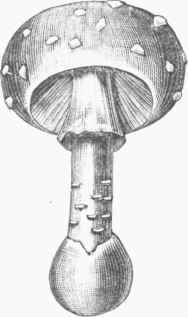
Agaricus muscarius.
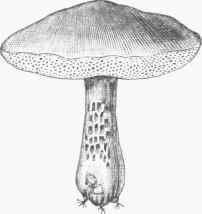
Boletus edulis.
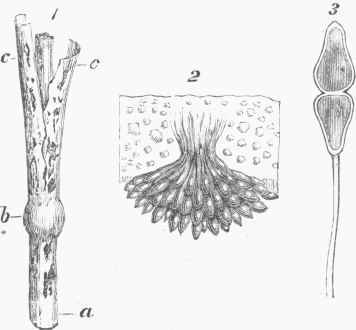
1.Wheat straw attacked by mildew, a, a. The stem, on which is the swelling 6, from which has grown the sheathlike leaf c, c. 2. Cluster of spores of corn mildew magnified. 3. Single spore of corn mildew magnified 800 times.
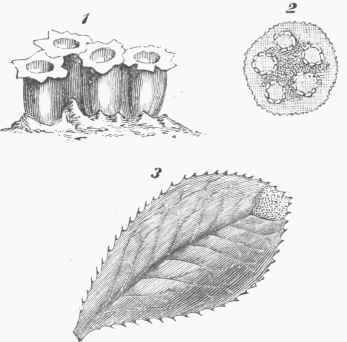
1. Cluster of cups from the berberry magnified. 2. Same, from above. 3. Leaf of berberry, with a similar cluster.
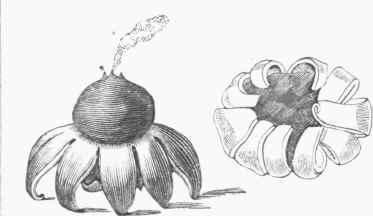
Earth Star (Geaster hygrometria).
Continue to:


My Books

