


Funchal
Description
This section is from "The American Cyclopaedia", by George Ripley And Charles A. Dana. Also available from Amazon: The New American Cyclopædia. 16 volumes complete..
Funchal
Funchal, a seaport town and the capital of the island of Madeira, on the S. E. coast, in lat. 32° 37' N., Ion. 16° 54' 30" W.; pop. about 25,000. It stands on a wide shallow bay, embraced by the steep promontories of Punta da Cruz on the west and Cape Garajao on the east, and enclosed in the rear by broken volcanic ridges. The town is defended by four forts. It presents a picturesque appearance, the white walls of the houses, which are mostly of stone, contrasting with the never failing foliage of the gardens. The streets are narrow, with steep ascents, and paved with small stones. Travelling and the transfer of merchandise are done on sleds, drawn by oxen. There are no public buildings of much elegance, and the numerous churches and convents have no architectural beauty. The cathedral, however, deserves mention. The harbor, which is covered by the forts, is indifferent. Fresh meat and poultry are sold at high prices, but the richest fruits, excellent fish,, and vegetables may be had cheaply in abundance. The town is resorted to by invalids from all countries on account of its delightful climate.
The mean temperature is about 68° F., and the difference between the hottest and coldest months (August and February) averages only 10°. The imports for 1871 amounted to $1,006,373; the exports to $796,-800, of which wine constituted $633,000, nearly the whole of which was sent to Great Britain and the British colonies. The entrances to the port were 266 steamers and 205 sailing vessels. The trade is chiefly in the hands of the English residents.
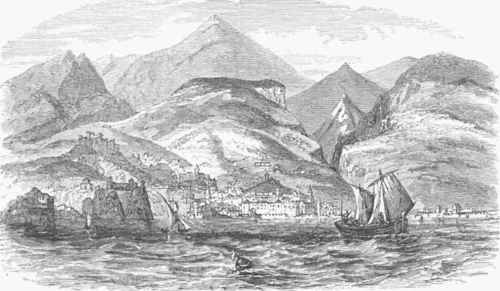
Funchal.
Continue to:


My Books

