


Fulbe (Sing Foolahs. Pullo), Fellani, or Fel-latah
Description
This section is from "The American Cyclopaedia", by George Ripley And Charles A. Dana. Also available from Amazon: The New American Cyclopædia. 16 volumes complete..
Fulbe (Sing Foolahs. Pullo), Fellani, or Fel-latah
Fulbe (Sing Foolahs. Pullo), Fellani, or Fel-latah, a people of west and central Africa, comprising many tribes scattered along the Niger valley, between Timbuctoo and the kingdom of Dahomey, and Bondoo and Darfoor. Originally they were nomadic, their chief occupation being cattle breeding; but about the middle of the 18th century, most of them be-coming converts to Islamism, they began to found independent states, and to conquer the adjacent tribes. About 1802 one of their chiefs, called Othman or Danfodio, undertook to emulate the career of Mohammed, and laid the foundation of an empire at Sackatoo. He died in a sort of fanatical ecstasy in 1818. His successors a few years ago could bring into the field about 25,000 cavalry. Gando, about 40 m. from Sackatoo, is the seat of another powerful Foolah prince; and at Timbo, the capital of Foota Jallon, resides a third. The aggregate area of these Foolah countries is estimated at over 300,000 sq. m.; the population at about 6,000,000. It is the opinion of modern travellers that the Foolahs are destined to become the dominant people of Negroland, and they have excited more interest and scientific research than almost any other African race.
In language, appearance, and history they present striking differences from the neighboring tribes, to whom they are superior in intelligence, but inferior, according to Barth, in physical development. Golbery describes them as robust and courageous, of a reddish black color, with regular features, hair longer and less woolly than that of the common negroes, and high mental capacity. Lander, who saw them near Borgoo, says that they differ little in feature or color from the negroes; other travellers speak of them as having tawny complexions and soft hair. Dr. Barth found great local differences in their physical characteristics, and Bowen describes the Foolahs of Yoruba as being some black, some almost white, and many of a mulatto color varying from dark to very bright. Their features and skulls were cast in the European mould. They have a tradition that their ancestors were whites, and certain tribes call themselves white men. Some of them relate that they came from the country around Timbuctoo, and the prevailing opinion has been that their course of conquest was, from central or east Africa westward; but Dr. Barth agrees with Clapperton in thinking that they made a second migration from the Senegal toward their birthplace, in the course of which they absorbed or conquered the tribes in their march.
Their language is neither African nor Semitic. Foolahs are found in the suburbs of most of the towns of Soodan, pursuing the avocation of dairymen and cattle breeders. Most of them are Mohammedans. The usual dress of the men is a red cap with a white turban, a short white shirt, a large white robe, white trousers trimmed with red or green silk, and sandals or boots. The women wear a striped garment falling as low as the ankles. The children of both sexes of the better classes are taught to read and write Arabic. The men wear swords at all times, and even go armed with bows and arrows on horseback. The sovereign of each Foolah state appoints governors of the provinces at pleasure, and on their death succeeds to all their effects. The Foolahs are in continual hostility with the Arabs.-See, besides the narratives of the travellers above mentioned, and the ethnological works of Prichard and Latham, Histoire et origine des Poulhas ou Fellans, by Gustave d'Eichthal (Paris, 1842).
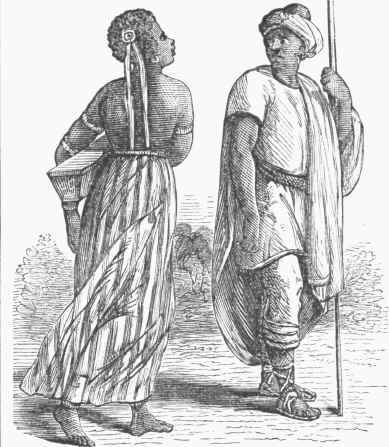
Foolahs.
Continue to:


My Books

