


Fuchsia
Description
This section is from "The American Cyclopaedia", by George Ripley And Charles A. Dana. Also available from Amazon: The New American Cyclopædia. 16 volumes complete..
Fuchsia
Fuchsia, popularly called Ladies' Eardrop, a genus of ornamental and mostly very showy plants, belonging to the natural order ona-graceoe. The flowers of the fuchsia have the tube of the calyx adherent to the ovary, with the limb four-lobed, spreading or recurved; four petals, attached to the calyx tube, and usually shorter than the calyx lobes and of a different color; eight stamens, and a threadlike style. The fruit is a four-celled, many-seeded berry, which is ovate-globose or oblong in shape. The species are shrubs or small trees, having usually opposite leaves, the flowers borne upon single axillary pedicels, or sometimes they are disposed in racemes at the ends of the branches. Perhaps the history of no other greenhouse plant presents so many interesting items as do the changes produced by the hybridizing and rearing of new varieties of this elegant flower. Loudon, in his Encyclopaedia of Plants (1829), gives only four species and a single variety; in his "Arboretum et Frutice-tum Britannicum (1844) he gives 21 species. At present there are about 50 admitted species,. while the varieties produced by cultivators are almost innumerable, each year bringing a long list of "novelties" in fuchsias.
With the exception of two found in New Zealand, the genus is an American one, most of the species being natives of the Mexican and Brazilian mountains. The fuchsias in cultivation may be divided into three sections: the long-flowered, the short-flowered, and those with the flowers in panicles. Among the short-flowered fuchsias is F. coccinea (also called F. globosa by some florists) from Chili, which for many years was the only kind known in the United States, and considered not more than 40 years ago one of the most elegant of plants, conspicuous for its axillary and drooping flowers, with scarlet calyx and violet-colored petals. In the long-flowered section the calyx tube is elongated to the length of two or three inches. F. fulgens, a brilliant Mexican species, belongs here, as does the corymbose fuchsia (F. corymbiflora, Ruiz and Pavon), the flowers of which are 2 in. long, scarlet, and hang down in beautiful corymbs; an elegant shrub about 6 ft. high, native of Peru about Chincao and Muna. As an example of those with panicled or clustered flowers, we may cite the tree-like fuchsia (F. arborescens), which not unfreqnently attains a height of 15 ft.; its branches are smooth, the leaves disposed in whorls of threes, oval-oblong, acuminated at both ends, petiolate, quite entire; the panicle terminal, trichotomous, nearly naked; the calyx funnel-shaped, with the lobes ovate-acute, spreadingly reflexed, as are also the petals; a native of Mexico. It would be difficult, if not impossible, to determine at this time from what species the present highly reputed varieties have been obtained, as they have been hybridized and crossed to such an extent that the typical forms are obliterated.
We have now both double and single varieties; indeed, in some the petals are multiplied to an extent that renders the flowers monstrous, and there is one variety in which not only is the number of petals increased, but the long stamens have become petaloid and give the flower a singular two-storied appearance. In a florist's classification we have: calyx red and corolla white, both single and double; calyx red and corolla purple or bluish, single and double; and calyx white and corolla red or other color, single and double. Besides these sections, under each of which there are many varieties, there are a few kinds with variegated foliage. The taller growing kinds are frequently trained to single stems, and form superb-looking objects for the conservatory. Mr. Downing thought the F. corallina, among many kinds, was the finest sort for this treatment. The flowers are seen at their best when viewed from below, and these " pillar " fuchsias, as they are called, lift their flowers well above the observer's head; we have seen the same effect produced by training the plants to the rafters of a greenhouse. Fuchsias are admirable plants for summer decoration; the winter-blooming kinds are few, and disappointment often results from a want of knowledge of this fact.
They are used in England to some extent as bedding-out plants, but the heat of our summers is too severe for these natives of the Brazilian mountain forests. Their proper use is in the summer decoration of rooms, conservatories, and verandas, though in a well shaded place they may be turned into the open border. When they have finished flowering the plants should be allowed to rest and be kept in the cellar until February or March, when they may be brought into growth. Fuchsias are propagated with the greatest ease from cuttings of the new shoots; a cutting an inch or two long, if properly treated, may be grown to a plant several feet high in a single season. Owing to the readiness with which shoots start from the stem, the plants are readily trained to a pyramidal, bush, or globular form. The wood of F. coccinea is used in Chili to make a black coloring matter, and the leaves and branches are used for some kinds of medicine. The berries of F. microphylla are very sweet. Those of F. excorticata a native of New Zealand, are greedily eaten by swine; and so sweet are they when ripe, that attempts have been made to use the species as a sugar plant.
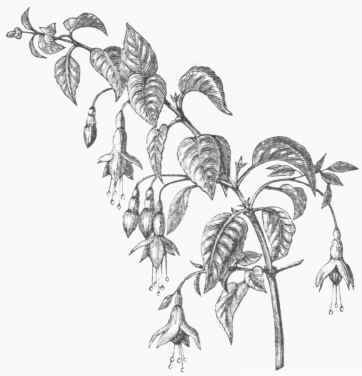
Fuchsia coccinea.
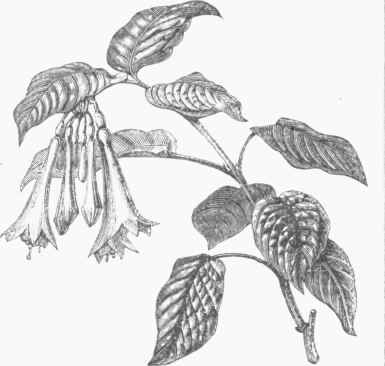
Fuchsia fulgens.
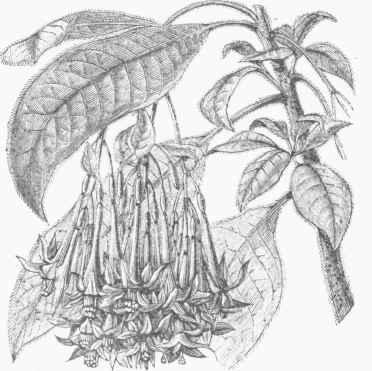
Fuchsia corymbiflora.
Continue to:


My Books

