


Freiburg
Description
This section is from "The American Cyclopaedia", by George Ripley And Charles A. Dana. Also available from Amazon: The New American Cyclopædia. 16 volumes complete..
Freiburg
Freiburg (Ger. Freiburg im Breisgau), a city of Germany, in the grand duchy of Baden, capital of the circle of the Upper Rhine, in the old district of Breisgau, on the Dreisam, 72 m. S. S. W. of Carlsruhe, and 32 m. N. E. of Basel; pop. in 1871, 24,599. It is 940 ft. above the level of the sea, on the outskirts of the Black Forest, at the mouth of the Hollenthal. The town was several times captured by the French, who in 1744 destroyed its fortifications, and in their place public walks and vineyards have been laid out. The streets are in general open and well built, particularly the Kaiserstrasse, which is remarkable for its width and the excellence of its houses. Since 1827 the town has been the seat of the archbishop of the ecclesiastical province of the Upper Rhine. In 1454 a university was founded here, which has a library of more than 100,000 volumes, and in 1873 had 50 professors and 275 students. It has a faculty of Catholic theology. The principal public edifices are the archi-episcopal and ducal palaces; the cathedral, one of the most beautiful and perfect specimens of Gothic architecture in Germany; the government offices, courts of justice, town hall, museum, theatre, gymnasium, orphan asylum, hospitals, and seminaries.
The corner stone of a new Protestant church was laid April 7, 1874. The manufactures include leather, paper, sugar, starch, tobacco, soap, bells, musical instruments, and chemicals. The Basel and Mannheim railway passes through Freiburg.
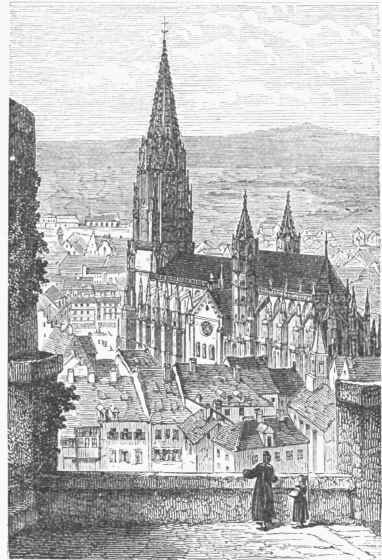
The Cathedral of Freiburg.
Continue to:


My Books

