


Fortification. Part 5
Description
This section is from "The American Cyclopaedia", by George Ripley And Charles A. Dana. Also available from Amazon: The New American Cyclopædia. 16 volumes complete..
Fortification. Part 5
The caponniere in many cases extends across the ditch, projecting into the outwork on the other side, and also into the interior of the enceinte. It serves in this case three purposes: to flank the ditch; as a redoubt for the outwork; and as an interior work to sweep the terrepleins of the enceinte.

Fig. 1.-a, the rampart, of which a b is the slope, and b c the terreplein; b', the parapet, of which c d e f g h is the outline: c' c'. the main ditch; d, the scarp wall; e\ the counterscarp wall; f, the embankment of the covered way. of which m n is the terreplein, nop the outline of the banquette and interior slope, and p r the glacis: m' n' the natural surface of the ground: /, the interior crest; f g. the superior slope; g h, the exterior slope; f e, the interior slope; d e. the banquette tread; c d, the banquette slope.
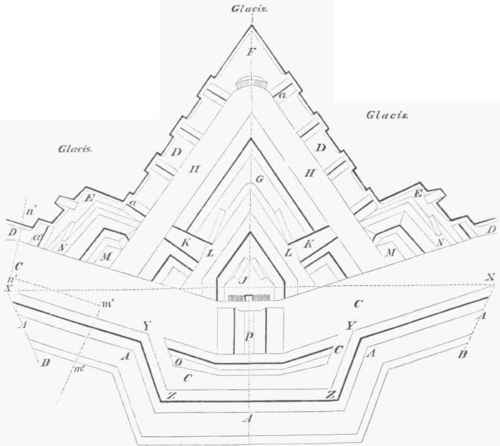
Fig. 2.-A AAA. the enceinte or body of the place, or main enclosure; B B, the bastions; C C C C, the main ditch, or the ditch of the enceinte; D D D D, the bastion and demilune covered ways; E E, the reentering places of arms; F. the salient place of arms; G. the demilune: H H, the demilune ditch; J. the demilune redoubt; K K, cuts in the demilune; L L. the ditch of the demilune redoubt; M M, the redoubts of the reentering places of arms; N N, ditches of the redoubts; O, the tenaille; P, double caponniore; X X, exterior side; a a, traverses of the covered way.
Where the caponniere is not flanked from the main work, by scarp galleries or batteries, other arrangements are devised, as projecting wings, or small caponnieres attached to the main one. Free use of casemated defences is made in this system; also, systems of mines for interior as well as exterior defence are arranged in connection with the counterscarp galleries. The profile differs but slightly from that used in the bastioned system. The use of detached and semi-detached scarps affords facilities for arranging corridors or open passages around the works, and opportunities for loopholes. To sum up, this system proposes to flank the ditches not from the work itself, but by auxiliary works; to provide an overwhelming artillery fire protected in defensive casemates; and to organize strong permanent works within and independent of the enceinte, which are to serve as a secure retreat tor the garrison when forced to give up its defence. The advantages of this system, compared with the bastioned, may be stated as follows: 1, that the interior space enclosed by equal lengths of enceinte is greater than in the bastioned; 2, that the faces of the work, from the greater obtuseness of the salient angles, are less exposed to ricochet fire;, 3, that the fire of the faces has a better bearing on the distant defence; 4, that, requiring fewer points on a given extent of line to be fortified, there will be fewer flanks, and more artillery will be disposable for the faces and curtains; ' 5, that the besiegers will be forced to a greater development of trenches for the same number of points.
On the other hand, the system is deficient in the strong concentrated cross fires that exist in the bastioned system in front of the salients. The flanking arrangement of the ditch being an exterior work, as soon as its fire is silenced the main work will be exposed to an escalade. It is further objected to this system that the numerous works of masonry can be easily ruined by distant batteries of heavy calibre, especially when weakened by loopholes and casemates, as is the case in the caponnieres and defensive barracks; that the distribution of troops and material of war throughout the independent works deprives the defence of that unity and concert of action so necessary for a successful resistance; that the works are more costly from the greater amount of masonry used; and finally, that it is imprudent to abandon a system that has been tested for one that does not possess this advantage. In the discussions which have taken place upon the merits of the two systems between engineers advocating them, an exaggeration of the defects and the depreciation of the advantages of the system analyzed seem to be the governing principles.
The truth is that both possess great merits, and due credit should be given to each system.
The fragility of masonry and the ease with which it can be destroyed by heavy projectiles, the increase in calibre of the cannon used and in accuracy of tiring, must naturally incline engineers to limit its employment as much as possible; reserving its use for positions where it will not be exposed, or is so covered that nothing can be feared from the besieger's guns. -It is unnecessary to dwell here upon the circular and tenailled systems. They observe the general conditions that we have given as common to all systems of permanent works. The advantages they possess and the objections that are made will be apparent to those who have carefully examined the bastioned and polygonal systems.-General Remarks. So far in the consideration of fortifications we have confined ourselves to the first three conditions and an allusion to the fourth. No work would be complete without bomb-proof shelters for the troops and magazines, whatever be the system adopted. The details of these works must be looked for in books treating specially of these constructions. The fifth general condition involves the use of water when it can be obtained, the character of the soil, the use of mines, and the arrangement of the parts of a work when placed on an irregular site.
The last case calls largely upon the skill and the science of the engineer. When the terreplein of a work is arranged so as to shelter the troops and materiel by the parapet or by traverses from the fire of the enemy who occupies ground higher than the site of the work, it is said to be defiled from that fire. This fire may be direct or in reverse. These problems of direct and reverse defilement are among the most important in the profession, and demand a minute and laborious study of the natural features of the position in relation to the defence. No rules but of a very general character can be laid down for the guidance of engineers in such cases. We may conclude that in order to arrange the different parts of a fortification and combine them properly, a knowledge of the means which may be employed to fulfil the general condition before given, and a suitable adaptation of these parts to the natural features of the position, are necessary. The utility of permanent fortifications has been seriously called in question; but it is enough to say that Napoleon, the archduke Charles of Austria, the duke of Wellington, and others have all regarded them as of great utility and of absolute necessity for a country.
Continue to:


My Books

