


Flax. Part 3
Description
This section is from "The American Cyclopaedia", by George Ripley And Charles A. Dana. Also available from Amazon: The New American Cyclopædia. 16 volumes complete..
Flax. Part 3
The addition of a pound of caustic ammonia or of common salt or Glauber salt to every 150 lbs. of rain water is recommended; and the temperature being kept at from 90° to 120°, the operation may be completed in 30 hours. The most rapid process, however, is to steep the flax for a short time, and then exhaust the air from its fibres by the action of an air pump. Twice steeping and twice exhausting the air serve to remove the glutinous matter in a few hours. Attempts have been made to substitute for the retting mechanical methods of separating the fibre from the boon, but they have not been successful, owing to the inferior quality of the filaments thus prepared. The introduction of chemical matters to hasten the fermentation has been greatly objected to from their liability to weaken the fibres. The reducing of the fibre to the condition of cotton by the process of the chevalier Claussen has excited strong opposition on this account. He had observed that the flax caught in the branches overhanging a stream in Brazil, which ran through his flax fields, was by repeated wetting and exposure converted into a substance exactly like cotton.
He then contrived a way of attaining the same result by exposing the flax to the action of a weak alkaline solution, and afterward removing the alkali by boiling in water to which 1/500 to - 1/200 of sulphuric acid is added. The straw is next steeped in a strong solution of bicarbonate of soda; and when the fibres are filled with this salt, it is transferred to a solution of sulphuric acid, weak like the former. Carbonic acid gas is generated throughout the substance, and this bursts and splits the fibre in a remarkable manner, giving it the appearance of cotton. Samples of various fabrics of this material, both alone and mixed with cotton, and others with wool, and also with silk, were placed by Claussen in the London exhibition of 1851, and attracted much attention. The same article, however, appears to have been made in England and Germany during the last century, and a factory was established near Vienna in 1780 for its manufacture. Berthollet, Gay-Lussac, and Giobert have experimentally investigated the subject, and Berthollet states that as fine cotton may be obtained from the commonest refuse tow as from the best flax.
For some reason, however, possibly the expense of the process or the inferior quality of the fibre, the operation does not seem to have prospered.-After the flax has been retted and dried, it is submitted to the process called breaking, by which the straws are cracked repeatedly across, the effect of which is to produce the separation of the brittle woody portion, which falls away in pieces from the filaments when afterward beaten by a broad flat blade of wood in the operation of scutching. A variety of machines are used for cracking the boon. The most simple is made with a large wooden blade, called a swingling knife, worked by a handle at one end, and fastened by a pivot at the other into a block with a cleft into which it fits; across this block the flax is laid, a handful together, broken by the blade, and moved along, as straw or hay is chopped in a common cutter. Other brakes are worked by the foot-a grooved block being brought down by each impulse upon the flax, which is held across a fixed block with corresponding grooves; a rude spring jerks the movable block up again as the foot releases it.
In the winnowing or scutching the Germans make much use of a thin sabre-shaped wooden knife, with which they strike the flax as a handful of it is held in a horizontal groove in an upright board. The coarse tow and woody particles are thus removed, those which adhere most firmly being scraped or rubbed off by laying the flax upon the leather worn for this purpose upon the leg of the operator. It is estimated that 100 lbs. of dried retted flax should yield 45 to 48 lbs. of broken flax; and from this when the boon waste is further removed by scutching about 24 lbs. of flax are obtained and 9 or 10 lbs. of tow. The breaking of 100 lbs. of straw by the machine described requires the labor of 17 to 18 hours; and the cleaning of 100 lbs. of broken flax by the swingling knife takes about 130 hours. Flax is broken also upon a larger scale by machines consisting of fluted rollers, variously contrived; and other labor-saving machines with rotating blades have been applied to the process of scutching. The next process is hatchelling or carding. As performed by hand, a wisp of flax, held in the middle and well spread out, is thrown so as to draw one end of it over a set of sharp steel teeth which are set upright and serve the purpose of a comb.
One end of the bundle being hatchelled, it is turned round, and the other is treated in the same way; and the process is repeated on finer hatchels. By this means about 50 per cent. of tow and dust and woody particles are separated from the long fibre, now called line. This is fit for spinning into linen threads, and the tow may be used for the same purpose for coarser fabrics. Machine hatchelling, however, has for the most part taken the place of hand labor, and is conducted upon a large scale and with many modifications in the extensive linen mills. The flax, being cut in lengths of 10 or 12 inches, is arranged in flat layers called stricks, the fibres parallel and ending together. Each of these is held by two strips of wood clamped together across its middle, or sometimes across one end. They are placed around a revolving drum, within which another drum armed with teeth rapidly revolves in a contrary direction, and combs the flax as the ends fall among the teeth. When hatchelled on one side the strick is turned over and the process is repeated on the other. The outer drum revolves slowly, and discharges the stricks when they have been carried over the top of the inner drum, beyond the point where the fibres could no longer fall among the teeth.
Much ingenuity is displayed in the modifications of this machinery, and also of a preparatory machine for dividing the fibres into equal lengths and sorting the lower ends, the middles, and the upper ends, each by themselves. The stricks when hatchelled are sorted according to the fineness of the fibres, those made up of the lower ends being the coarsest; but the divisions are much more minute than those of each fibre into three lengths. In making this separation the line sorter, as the operator is called, is guided entirely by the sense of feeling, this indicating the quality of the fibres more delicately than the sight. The next operation preparatory to spinning is to lay the fibres upon a feeding cloth, each successive wisp overlapping half way the one preceding it. The feeding cloth conveys them to rollers, between which they are flattened and held back as a second pair more rapidly revolving seizes the part in advance and draws out the flax. A tape or ribbon of flax is thus formed, which is discharged into a tin cylinder, a row of cylinders standing upon the floor in front of the machines.
The tapes or slivers are afterward joined several together, and at the roving frame are slightly twisted, when they are wound upon bobbins, which is the last process before spinning. (See Linen.)-The principal treatise upon this subject is the prize essay of James MacAdam, jr., secretary to the society for the promotion and improvement of the growth of flax in Ireland. The prize was awarded to it by the royal agricultural society of England, and the essay was published in vol. viii. of their Journal." It has furnished a great part of the data of many of the valuable papers published in the English scientific dictionaries.
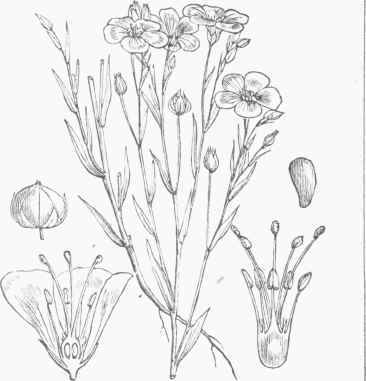
Flax (Linum usitatissimum').
Continue to:


My Books

