


Flamen
Description
This section is from "The American Cyclopaedia", by George Ripley And Charles A. Dana. Also available from Amazon: The New American Cyclopædia. 16 volumes complete..
Flamen
Flamen, in Roman antiquity, a member of an ancient college of priests, established by Numa, each of whom was confined to the service of a particular deity. The original three, the dialis, martialis, and quirinalis, consecrated to Jupiter, Mars, and the deified Romulus, were afterward distinguished as majores, and chosen from a select class of the patrician order (see Confarreation); while the later 12, called minor'es, were elected from the plebeians. Their dignity was for life, but could be forfeited by neglect of duty, or lost in consequence of an ill-omened event disturbing any of their sacred performances. Their official dress was the apex, a cap either conical or close-fitting, having at the top a pointed piece of olive wood, surrounded at its base by a lock of wool (filum, whence, according to some, their name, while Plutarch derives it from pileum, hat), the loena, or mantle, and the laurel wreath. The most distinguished member of this college of priests was the dialis, honored with the privileges of a seat in the senate, the toga proetexta, a lictor, and the higher prerogative of procuring pardon or respite for criminals who came to him for refuge; but he was also burdened by several restrictions, being forbidden, for instance, to leave the city even for a single night, to swear an oath, to wear a ring, to ride or touch a horse, and to remarry after the death of his wife, who assisted him in the performance of some of his sacred functions, and was called flaminica.
In later times the deified emperors of Rome had particular flamens appointed to their worship.
FLAMING0, a wading bird of the order nata-tores, family anatidoe, subfamily phoenicojyteri-nce, and genus phamicopterus (Linn.). The bill is longer than the head, high at the base, compressed, suddenly bent at a right angle in the middle, the sides growing narrower, and rather obtuse at the tip; the lateral margins are incurved and finely laminated; the base to around and behind the eye is covered with a soft and delicate skin, finer than the finest kid, the end being corneous; the nostrils are near the base, linear, 1 1/4 in. long; length about 5 in.; beyond the curve the color is black, the base being orange and yellow. The wings are moderate, with the first and second quills nearly equal and longest; the tail is 6 in. long; the tibia is lengthened and naked; the tarsi are very long and slender, and both covered by transverse scales; the toes are short, the anterior ones united by a membranous web; the hind toe is very short, almost touching the ground, and free; the claws are short and flat.
There are five or six species, inhabiting the warmer parts of the globe, frequenting the seashore and marshes in considerable flocks; one acts as sentinel while the rest are feeding or resting, and on the approach of danger gives the alarm by a trumpet-like noise, and starts off leading all the rest; they fly either in triangular lines like the wild goose, or in Indian file when they are about to alight; they can run quickly, but when walking are said to assist themselves by placing the upper mandible on the ground; though web-footed, they do not swim, the webs serving to support them in wading over soft mud. The food consists of mollusks, crustaceans, fish spawn, marine insects, and small fish; the singular form of their bill enables them, by turning it toward the body, to place the upper mandible downward, and thus to collect their food as in the bowl of a spoon. The small head, angular bill, long and slender neck, stiltlike legs, comparatively small body, and brilliant colors render the flamingo one of the most extraordinary forms among birds.-The American flamingo (P. ruber, Linn.) is about 4 ft. long from bill to end of tail, and 5 1/4 ft. to end of claws; the extent of wings is 5 1/2 ft., that of each wing being 16 1/2 in.; the tarsus 12 1/2 in.; bill along gape 5 in., along the curve 6 in.; middle too 3 1/2 in.; the circumference of the body is only 24 in., and the weight about 7 1/2 lbs.: the female is considerably smaller.
The space between the bill and eye is bare, but the plumage generally is compact and the feathers rounded, those on the neck being short; the color is a bright scarlet, deepest on the wings; the quills are black, the legs red, the feet lake color, and the iris blue. The habits of the fla-mingo are more nocturnal than those of the heron; over the water they fly low, but over the land very high, with neck and legs extended, alternately flapping their wings and sailing; before alighting they generally sail around the place, and come down in the shallow water, often wading to the shore; they are very shy. The nest is made on a hillock of mud about 2 ft. high, in the hollow top of which on the bare earth two or three white eggs are laid about the size of a goose egg; the bird covers the eggs standing, with one foot in the water, and the young are hatched about the end of May; they take to the water at once, it is said, and cannot fly till they are three months old; they do not attain their full scarlet plumage until the second year, being rose-colored during the first. On account of its shyness the flamingo is rarely hunted, and then only for its handsome feathers. It is easily tamed, and in captivity feeds on rice, maize, and similar substances.
It inhabits the warmer parts of America, especially the West Indies; it is not uncommon in West Florida and northern Alabama, but is rare to the north and west of these points.-The European bird (P. antiqitorum, Temm.) is smaller and less brilliant. It is a regular visitant to the shores of the Mediterranean, and sometimes wanders to France and Germany; it is extensively spread over the warmer parts of Asia, and is very common along the shores of northern Africa. Its appearance and habits are the same as those of the American species. According to Gould, this species requires four years to reach maturity, during which the plumage changes greatly; before the first moult the color is uniform gray, with black tail and secondaries; in the male, the head, neck, upper and under surfaces, are a delicate rosy white, the centre of the wing bright scarlet, the primaries black, the bill reddish at the base and black at the tip, the tarsi and toes rosy red; the scarlet color is not assumed until the third or fourth year, and is brightest during spring and summer.
The flesh of the flamingo is savory, and its fatty tongue is considered a delicious morsel; they were especially esteemed by the ancient Romans, and many allusions to this dish are found in their writings.-The position of the flamingo among birds is a subject of dispute; some authors place it among the waders or grallatores, from its long neck and legs, and consequent habits; but the best authorities rank it among the anseres, or web-footed swimmers, on account of its lamellar duck-like bill, webbed feet, and muscular gizzard; if it be true that the young run to the water as soon as they are born, this of itself would seem to establish their rank among the anseres.
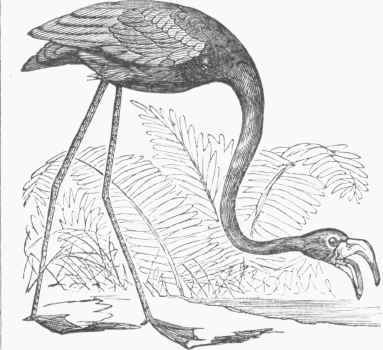
American Flamingo (Phoenicopterus ruber).
Continue to:


My Books

