


Fantee
Description
This section is from "The American Cyclopaedia", by George Ripley And Charles A. Dana. Also available from Amazon: The New American Cyclopædia. 16 volumes complete..
Fantee
Fantee, a country of the Gold Coast, W. Africa, bounded N. W. and X. by Assin and Dubbin, E. by Aquapim, S. by the gulf of Guinea, and W. by Wassaw, lying near lat. 5° 30' N., Ion. 1° W. Capital, Mankasim. It is watered by several rivers, is said to be fertile and populous, and has several important trading stations along its coast. The inhabitants are remarkably cleanly, are more muscular than the Ash-antees, and may be distinguished from other African tribes by small scarifications on the back of the neck and the upper part of the cheek bones. Their heads are high and round, and their color is a dull brownish black. They have long faces with jaws protruding to an unusual extent, flat noses, thick lips, and very large ears. The dress of both sexes consists of a single piece of cloth wrapped loosely around the body. They pay a nominal obedience to chiefs called caboceers, besides whom every village has its local magistrate. They formerly governed or influenced a seaboard district extending about 100 m. along the coast.
About 1807, becoming involved in a war with the king of Ashantee, they obtained the active interference of the English, who had a small fort in Anamboe, one of their towns; but this alliance, while it plunged the British into a disastrous quarrel, proved of no benefit to the Fantees, whose territory after a long struggle was occupied by the victorious Ashantees. In 1823 the Fantees, encouraged by the British, rebelled, but were again subdued, the British being defeated by the Ashantees, and their commander, Sir Charles McCarthy, captured and put to death. In 1826, however, the British defeated the Ashantees and compelled them to retire to their own territories. From that time for nearly half a century the Fantees were unmolested under British protection. But in 1872 the Dutch possessions on the Gold Coast were transferred by treaty to Great Britain, and in 1873 Koffee Calcalli, king of Ashantee, complaining that some of the stipulations of his treaties with the Dutch had been violated by the British, declared war against them, overran and ravaged the Fantee territories, and in September was threatening Cape Coast Castle with a numerous army.
The British government, holding itself bound to protect its allies, the Fantees, sent a powerful force to the Gold Coast under command of Gen. Wolseley, who in November was advancing toward Coomassie, the Ashantee capital, driving before him the army of Koffee Calcalli, which was estimated to be about 40,000 strong. (See Gold Coast.)
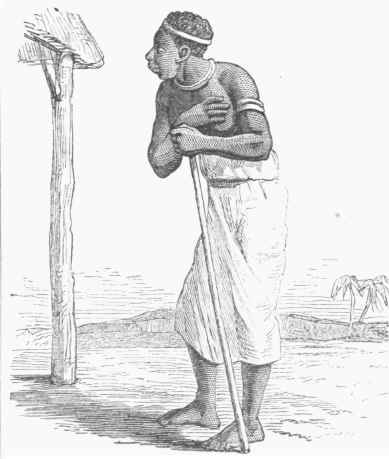
A Fantee Woman.
Continue to:


My Books

