


Fallow Deer
Description
This section is from "The American Cyclopaedia", by George Ripley And Charles A. Dana. Also available from Amazon: The New American Cyclopædia. 16 volumes complete..
Fallow Deer
Fallow Deer (dama vulgaris), a cervine animal, distinguished from the stag or red deer by its smaller size, spotted coat, and. palmated horns. There are two varieties, the one spotted, said to be descended from the spotted axis of India, the other deep brown, said to have been introduced into England from Norway by James I. It is remarkable that where fallow and red deer are kept together in the same parks, as often in Great Britain, they never associate in companies, much less are ever known to breed in common, but carefully avoid each other, even so far as to shun the places which either species may have chanced to frequent. The bucks of the fallow deer are much smaller than the harts of the red deer, and are easily distinguished by their horns or antlers, which, instead of being round and pointed at the upper extremity, with several forward tines or branches, are round only at the base near the head, having a single pair of brow antlers, and a single pair of anterior points a little higher up the stem, above which the horns spread out into flat palmated surfaces, projecting a little forward at the top, and having several posterior sharp snags or processes.
The buck during his first year is called a fawn; the second, a pricket; the third, a sorrel; the fourth, a sore; the fifth, a buck of the first head; the sixth, a great buck. The fallow deer breed at two years; old, and bring forth one, two, or three fawns; they come to their maturity at three years, and. live to about 20. The rutting time of the buck commences about the middle of September, after which he is out of season, his flesh being no longer eatable. He sheds his horns in April or May, and his new ones are fully grown about the end of August. He is in height of season in July. The doe comes into season when the buck goes out, and continues until twelfthtide. She begins to fawn in May, and. continues until midsummer. The bucks herd together, and are easy to be tamed, when they become impudently familiar and intimate. The cry of the buck is called braying or grunting, sometimes growling, as that of the hart is termed belling. The fallow deer are kept in I England merely as ornaments to park scenery and for supplying venison to the table; never any longer, as of old, for sporting purposes. The venison is more succulent, tender, and juicy than that of the red deer, and it is not unusual to find the buck, in high season, with three and four inches of fat on the brisket.
Various pastures produce various degrees of excellence in the venison. Where the wild thyme is abundant, the flesh is noted for its delicious aromatic flavor; and it is remarked that the more level and luxuriantly pastured parks of the south of England produce the fattest venison, while those of the north, abounding in broken ground, glens, and knolls, covered with broom and fern, yield it of the highest flavor.-So late as the reigns of the Stuart monarchs, shooting the fallow deer with the crossbow, coursing it with greyhounds in the royal parks and chases, and turning it out to hunt with the buckhounds, were royal amusements. The buckhounds are still kept up, and the "master of the buckhounds" is a high, honorary court office, held by some sporting nobleman; but they no longer hunt the buck, the hart or stag of the red deer having been for many years substituted for the fallow buck, as being far more cunning, stronger, fleeter, and capable of supporting longer chases. In many parts of Germany, in Denmark, Norway, and Sweden, the fallow deer ! runs wild in the forests, and is strictly preserved for the use of royalty and the territorial nobles. It is usually driven with hounds or beaters, and killed with fowling pieces and buckshot. The height at the shoulders is about 3 ft.
The skin affords a valuable leather, and the horns are used for knife handles and similar purposes.
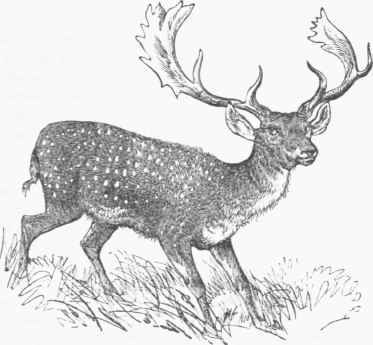
Fallow Deer (Dama vulgaris).
Continue to:


My Books

