


Fakir
Description
This section is from "The American Cyclopaedia", by George Ripley And Charles A. Dana. Also available from Amazon: The New American Cyclopædia. 16 volumes complete..
Fakir
Fakir (an Arabic word meaning a poor man), the name of a mendicant order in the East Indies, like the dervishes of Persia and Turkey. The first condition of an Indian mendicant monk is poverty. He wears a rent robe, such as the Mussulmans pretend the ancient prophots wore. In 10 things, according to Hassan al-Bassri, he is like a dog: he is always hungry; he has no sure abiding place; he watches by night; he never abandons his master, even when maltreated; he is satisfied with the lowest place; he yields his place to whoever wishes it; he loves whoever beats him; keeps quiet while others eat; accompanies his master without ever thinking of returning to the place he has left; and leaves no heritage after death. The number of Mussulman and Hindoo fakirs in India is estimated at more than 1,000,000; besides whom there are many other religious ascetics. Some fakirs remain isolated, go entirely naked, and sleep on the ground with no covering. They never use wood for making fire, but employ the dried dung of cows; regarding this as an act of devotion, since the cow is a sacred animal in India. They carry a cudgel, a battle axe, or spear, on which are hung rags of various colors, and they traverse the country begging and instructing credulous people in religion.
It is dangerous both to his money and life for an unprotected person to meet them. Another class of fakirs unite into companies, and wear fantastic and many-colored robes. They choose a chief, who is distinguished by having a poorer dress than the others, and who has a long chain attached to one of his legs. When he prays he shakes his chain, and the multitude press around him, embrace his feet, and receive his counsel and precepts. He has formulas for the cure of the paralytic, and especially of sterile women. One class of fakirs is highly honored. They are the children of poor parents, who live in retirement in mosques, devoted to the reading of the Koran and the study of the laws, till they become qualified for the duties of mollahs or doctors of theology. The fakirs often inflict upon themselves very severe penances. Some remain bent forward in the form of a right angle until they grow permanently into that shape. Others lay fire on their heads till their scalps are burned to the bone. Sometimes a fakir ties his wrists to his ankles, has his back plastered with filth, and then makes a journey of hundreds of miles, rolling along like a cart wheel, and stopping at the villages for rest and food.
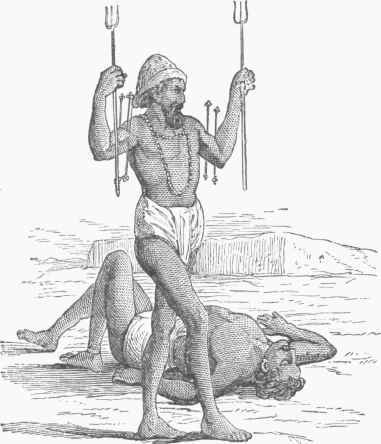
Fakirs performing Penance.
Continue to:


My Books

