


Battle Of Fredericksburg. Continued
Description
This section is from "The American Cyclopaedia", by George Ripley And Charles A. Dana. Also available from Amazon: The New American Cyclopædia. 16 volumes complete..
Battle Of Fredericksburg. Continued
Here the confederates encountered so severe a fire that they recoiled, and fell back to their old position on the heights. This put an end to the action on the Union left. The federals here lost about 3,700 in killed and wounded; the confederates about 3,200. In the advance the federals had made about 500 prisoners, and lost as many in the retreat.-In the mean time a more severe fight had been going on 3 m. to the right, where Sumner had assaulted the foot of Marye's hill. The strength of this position was wholly unknown to the assailants, and it was not till long after that they learned why it was that they were unsuccessful. Kershaw, one of the confederate generals, is the only one who gives any full account of it. He says: Marye's hill, covered with batteries, falls off abruptly toward Fredericksburg to a stone wall which forms a terrace on the side of the hill and the outer margin of a road which winds along the foot of the hill. This road is about 25 ft. wide, and is faced by a stone wall about 4 ft. high on the city side. The road having been cut in the side of the hill in many places, this last wall is not visible above the surface of the ground." This sunken road was like the ditch of a fortress, affording complete protection to the troops in it.
About 2,000 men occupied it, standing four deep. The crest of the hill was crowned by a battery of 11 12-pounders, and about 50 heavier guns were placed so as to enfilade all the approaches, which must be made over an open plain about 350 yards wide.
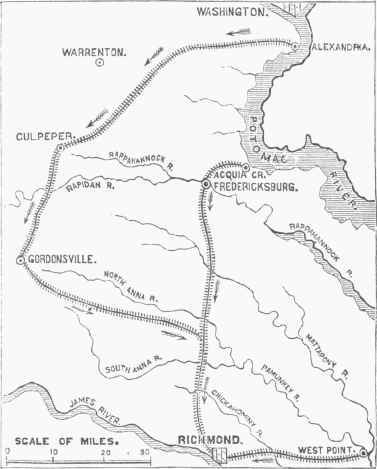
Diagram illustrating the advantages in point of distance of the three proposed routes to Richmond: that of McClellan in the spring of 18G2, from West Point; that of McClellan, abandoned by Burnside, from Alexandria, by way of Culpeper and Gordonsville; and that proposed by Burnside, direct from Fredericksburg.
The bulk of Lee's artillery was posted on the ridges in the rear, and out of action. Lee himself does not seem to have been aware of the existence of this sunken road, which actually formed the strength of his position here. He seems to have assumed that the enemy would gain the crest of the hill, and that the real battle would be fought on the plateau beyond; while Burnside assumed that when the crests were gained the battle would be won. The attack was made here by the two divisions of French and Hancock, French in the advance. His men moved across the narrow plain, galled by a fire from the confederate batteries. Half way across they came within range of the men in the sunken road, who poured in a solid sheet of musketry fire, before which the heads of the columns melted away, and the whole fell back, leaving half of their numbers behind. Hancock now advanced, until he came within range of .the musketry from the sunken road. The front was so narrow that only a single brigade could be put in at once. Brigade after brigade took the places of those which had been driven back, so rapidly that this action, which lasted three hours, as seen from the heights of Falmouth, looked like a single continuous assault.
French and Hancock brought 10,000 men into action, of whom 4,000 were cut down. Burnside had watched this action from the heights across the Rappahannock, and had seen the troops which were to carry the hill swept back from its base. Still he was determined that the heights should be carried, and he ordered Hooker to renew the attempt. Hooker crossed the river, examined the position, consulted with the officers who had been engaged, and returning remonstrated against the order. But Burnside was inflexible. Of his six divisions Hooker had but two with him. It was nearly night when he opened fire with all his artillery, hoping to make a breach; but this sunken road was not to be touched by any fire. At sunset he ordered the division of Humphreys to charge with unloaded muskets, for there was no time to load and fire. As it happened, the confederate battery on the hill had exhausted its ammunition and gone to the rear to replenish, so that Humphreys was not exposed to the artillery fire by which French and Hancock had been so sorely galled, and his men went a few yards further than the others had gone. But they also met a solid sheet of fire from the sunken road, which drove them back.
The assault lasted only a quarter of an hour, but in those few minutes, out of 4,000 men, nearly half fell, while it is doubtful whether the enemy lost a man. Hooker forbore to press the unavailing assault. Having," he said,lost as many men as my orders required me to lose, I suspended the attack, and directed that the men should hold for the advance line a ditch which would afford shelter." The confederates lay upon their arms all that night, fully expecting another attack in the morning; for, says Lee, the attack had been so easily repulsed, and by so small a part of our army, that it was not supposed the enemy would limit his efforts to one attempt, which, in view of the magnitude of his preparations and the extent of his forces, seemed to be comparatively insignificant; hut we were necessarily ignorant of the extent of his losses." Burnside was indeed inclined to renew the action on the following day, but finally forbore, yielding to the representations of the majority of his generals. He was still uncertain whether to hold Fredericksburg or to recross the river, and all through Sunday and the greater part of Monday the two armies lay in sight of each other, each expecting and wishing to be attacked, but neither choosing to venture upon the offensive.
Toward night of the 15th Burnside decided to re-cross, and under cover of a storm which had set in the troops went over, the pontoons were swung back, and the river again separated the two armies.-According to official reports, the confederate loss was 595 killed, 4,061 wounded, 653 missing; in all, 5,309. The Union loss was reported by the medical inspector general just after the battle to have been 1,152 killed, 9,101 wounded, 3,234 missing; in all, 13,487. But, he adds,the return of killed may be too small.1' About 1,200 of those originally reported as missing came back to their commands, reducing the number of missing to about 2,000. Lee asserts that he took about 900 prisoners, leaving about 1,100 of the federal missing to be accounted for. Of these probably about 350 should he added to the number reported as killed; so that in round numbers the Union loss was 1,500 killed, 9,100 wounded, 900 prisoners, and 750 stragglers; 12,250 in all, almost two and a half times that of the confederates. The great disparity of loss was in the action on the right, at the foot of Marye's hill. In proportion to the numbers engaged, the losses in this battle were unusually large.
Of Burn-side's 100,000 men who crossed the river, only about 32,000 were fairly brought into action; of the confederate 80,000, only about 25,000.
Continue to:


My Books

