


Ash
Description
This section is from "The American Cyclopaedia", by George Ripley And Charles A. Dana. Also available from Amazon: The New American Cyclopædia. 16 volumes complete..
Ash
Ash, a name applied to four genera of forest trees. I. Fraxinus (Gr. separation, from the wood being used for fences, or from the facility with which it splits), of the family oleaceœ, Juss., diœcia diandria, Linn. Polygamous, calyx minute, 3 to 4 cleft; corol deeply 4-parted or none. Stamens 2 to 4; pistillate flowers; ovary superior, compressed, 2-celled, with 2 ovules each; capsule with a membranaceous lanceolate wing (samara), 1-seeded by abortion; seed pendulous. Most of the species are indigenous in North America (more than 30 E. of the Mississippi), many in Europe, few in Asia (one in Nepaul). Most are large trees, affecting shady and moist places, banks of rivers, or marshes; they prosper less in barren and bleak localities. The wood of most species is tough and elastic, and is used by wheelwrights, carriage-makers, and ship-builders, for many purposes. The most important species are the following: F. acuminata {Americana, discolor, white ash); leaves pinnatifid, leaflets petiolate, oblong, 3 to 4 pairs and 1 odd one, acuminate, shining, entire or slightly toothed, glaucous beneath, downy when young; grows 60 to 75 feet high. This furnishes the best wood of all. It flourishes from Canada to Carolina, and is believed to be an antidote to snake poison.
F. sambucifolia (black or water ash); leaves large; leaflets 7 to 9 pairs and 1 odd, sessile, ovate, lanceolate, rounded at base, rugose, shining and smooth above, villous beneath on the veins; 60 to 66 feet high. F. tomentosa (pu-oetcem, red ash); leaflets 7 to 9 pairs and 1, elliptic, acuminate, nearly entire, very long; petioles and young branches downy. It furnishes good wood, more reddish than that of the others. F. juglandifolia (viridis, swamp ash); leaves very large, leaflets 4 pairs and l, petiolate, ovate, serrate, glaucous beneath, pubescent on veins; a small tree. Michaux and Nuttall describe 7 more species and some varieties, among which F. quadrangulata (blue ash), of Tennessee and Kentucky, attaining 70 feet in height, with valuable wood, and F. Oregona, attaining 80 feet, are the most remarkable. In Europe the principal species is F. excelsior (common ash), attaining 90 feet, with excellent wood, though inferior to the Americana. On its leaves swarm cantharides (Spanish flies), spreading a disagreeable smell.
A variety with drooping branches (weeping ash) is grafted on tall stems, and converted into an arbor shading all around.
II.. Ornus (Gr. mountainous) of Persoon {fraxinus ornus, Linn., flowering ash), of the same family with fraxinus, but of the class diandria monogynia, Linn. Calyx 4-parted; corolla 2 or 4-parted, segments long, ligulate; stamen inserted, with 2 barren filaments; stigma emarginate; fruit winged, 1-celled, 1-seeded; leaves opposite, unequally pinnate; flowers in terminal or axillary panicles. It grows in shady woods in Europe, N. Asia, and America. Among the American species, O. dipetala and O. Americana are most remarkable. In Europe, O. rotundifolia exudes the manna, a sweet substance which differs from sugar by not fermenting with water and yeast, and serves as a purgative medicine. The best manna is collected in Calabria and Sicily. The lilac and olive can be successfully grafted on the species of fraxinus and ornus. The cultivated species of ornus are often grafted on fraxinus excelsior; and as ornus grows the more rapidly, a curiously protuberant stem is formed, and may by alternate grafting be made to take grotesque shapes.
III. Sorbus (its bark being supposed to be an absorbent in consumption), of the family pomaceœ, Juss., icosandria 2-5 pentagynia, Linn., classed under the genus pyrus. Calyx tubulous, urceolate, limb 5-parted; petals roundish; styles 2 to 5; drupe closed, 5-celled, with cartilaginous putamen; cells 2-seeded. The species are: P. or S. Americana (mountain ash); leaves pinnatifid; leaflets oblong, lanceolate, acuminate, somewhat serrate; common petiole very smooth; flowers white, in terminal corymbs; fruit globose, yellowish red, persistent almost all winter. It grows in Canada and the northern states. P. microcarjja (small-fruited) extends from New York into Carolina; smaller than the preceding; fruit scarlet. 8. aucupta-ria (rowan tree), common in the forests of N. Europe; grows up to 25 feet; fruit edible, after being frost-bitten and kept in hay for some time. The fruit of other species also affords food to many birds. Only one species (on the Sandwich islands) is known in the tropical regions.
The fruits of many contain malic acid, and the flowers, bark, and root of aucuparia yield hydrocyanic (prussic) acid.
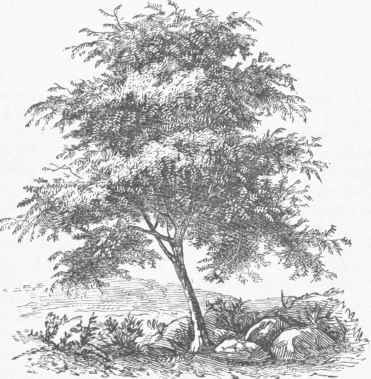
Mountain Ash.
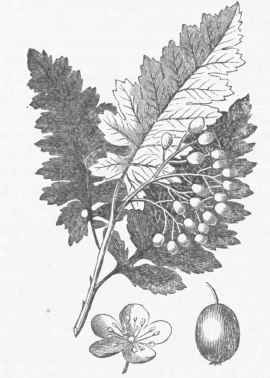
Oak-leaved Mountain Ash.
The wood is valuable for many uses, and the branches were employed by the. Druids in their rites.
IV. Xanthoxylum (Gr.  yellow, and
  wood), of the family xanthoxylaceœ, Juss., diœcia pentandria, Linn. X. Caroli-nianum (prickly ash, toothache tree), a middle-sized tree with prickly branches. X. ma-crophyllon (pterota, bastard ironwood), in Arkansas and Florida; from 15 to 20 feet high. This species, as well as others (called yellow wood, satin wood, etc.) of much greater size, have hard, cross-grained wood.
Continue to:


My Books

