


Artichoke
Description
This section is from "The American Cyclopaedia", by George Ripley And Charles A. Dana. Also available from Amazon: The New American Cyclopædia. 16 volumes complete..
Artichoke
Artichoke, an edible plant of the genus cynara, order compositœ, resembling a large thistle, known in the south of Europe as early as 1548. C. scolymus and its variety C. her-tensis are the green and globe artichokes of the garden. The portion eaten is the under side of the head before the flower opens. The whole head is removed and boiled, the leaves laid aside, and the bottom eaten, dipped in butter with a little pepper and salt. A sauce made of butter and spices is frequently used. The French sometimes gather the heads when not larger round than a dollar, and eat the lower end of the leaves raw, dipping them in oil, pepper, and vinegar. The globe variety is generally preferred by gardeners. Artichoke seed should be sown in a gentle hot-bed or warm open border as early in the spring as frost will permit. The plants should be set four feet apart each way, in a stony soil, well prepared. They will bear heads the succeeding year. Some gardeners place six plants in a lull, making the hills six feet apart. Artichokes may be raised from sets or shoots, which should be removed and carefully transplanted. As often as heads are removed from a plant, it should be broken down to encourage the growth of new shoots. In autumn all plants should receive a good supply of earth or litter.
Stable dung is too heating, and should never be employed. In the spring remove the autumn covering and take away all offsets except two or three of the best. During the first season the young plants of the previous year will produce heads from June to October. In succeeding years they will give heads from May to June or July. To have them the whole season, an annual plantation must be made. The flowers of the artichoke have the property of rennet in curdling milk. The French use the heads of the second crop of artichokes when dried, baked in meat pies with mushrooms. Artichoke heads are sometimes made to grow larger by tying a ligature tightly around the stem three inches below each. - The Jerusalem Artichoke (helianthus tuherosus, order compositœ) is not a true artichoke, but the root of a species of sunflower. In Italian it is named girasole, or sunflower, which in English is corrupted into Jerusalem. In America it is sometime called Canada potato or Virginia potato. It was well known in England as an edible root about the year 1620, having been brought from Brazil. The tubers are good for swine and cattle. They are capable of resisting the severest degree of cold when left in the soil the whole winter; being lifted in spring, they form excellent food for stock.
The Jerusalem artichoke may be raised in all classes of soil, and when grown in light sands and gravels, swine are allowed to dig the tubers for themselves. It is difficult to eradicate this plant from the soil, and it is seldom entirely removed where once rooted in a rich soil. The tops cured in autumn form an excellent hay, yielding five or six tons per acre. Sandy soil of fair quality is said to yield from 1,200 to 1,500 bushels per acre. They are not quite as nutritious as the potato, containing 72.2 percent, of water, being about 4 per cent. more than is contained in the potato. Cordage is sometimes made out of the tops, and in the south of Europe a kind of coarse cloth is manufactured from them.
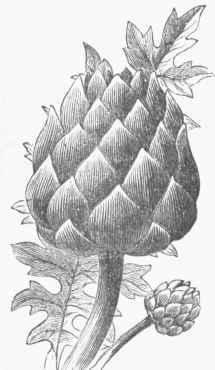
Globe Artichoke.

Tuber of Jerusalem Artichoke.
Continue to:


My Books

