


Arctic Discovery. Part 8
Description
This section is from "The American Cyclopaedia", by George Ripley And Charles A. Dana. Also available from Amazon: The New American Cyclopædia. 16 volumes complete..
Arctic Discovery. Part 8
They were dragging a boat and sledges with them. They could not speak Esquimaux, but the natives gathered that their ships had been crushed, and they were now going where they could find deer to shoot. They purchased a little provision from the natives, who judged that they were nearly destitute of food. The officer with them was described as a tall, stout, middle-aged man. At a later date, the same season, but previous to the disruption of the ice, the corpses of some 30 persons, and some graves, were discovered on the continent, and five dead bodies on an island near it, about a long day's journey N. W. of the mouth of a large river supposed to be Back river. Of the bodies on the island, one was supposed to be a chief, as he had a telescope slung about his neck. These men, from all appearances, had been driven to cannibalism before they perished. From the fact that shots were heard, and the feathers of wild fowl were found near the bodies, it is conjectured that a few of the men survived till May, 1851. They seem to have had an abundance of ammunition.
There were also numbers of telescopes, guns, watches, etc, pieces of which articles were found among the natives by Dr. Rae, in considerable quantities.
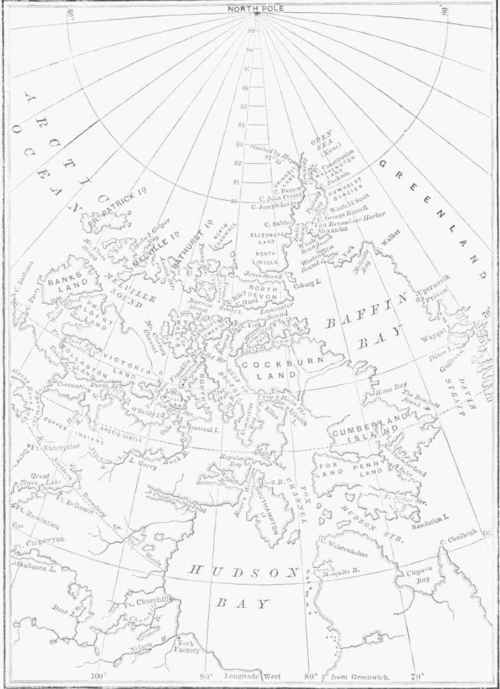
Dr. Rae's opinion was that the party died by starvation, and not by the hands of the natives. Mr. James Anderson was sent out in 1855, to explore more perfectly the spot designated as the scene of so much suffering. On June 30, a little way from the mouth of Back river, he came upon some Esquimaux, who had with them numerous articles belonging to a boat equipage. The natives stated that the owners of these articles had died of starvation. On reselling Montreal island, where the five men had perished, according to report, Mr. Anderson found chain hooks, tools, rope, bunting, and a number of sticks strung together, on one of which was carved the name of Mr. Stanley, surgeon of the Erebus. On a plank was found the word "Terror." Not a vestige of the remains, nor any paper, was found. At Point Ogle some small articles were also found, but no bodies.
The party were unable to reach King William land, the scene of the chief disaster. - Dr. Kane, the American explorer, sailed in the Advance from New York, May 30, 1853. The discoveries of Inglefield in Smith strait, and those of Belcher at the head of Wellington channel, had convinced him that there was somewhere between lat. 80° N. and the north pole a vast open sea, and a milder climate than was found some degrees to the south; and further, that in this sea were to be sought, and he hoped found, tidings of Sir John Franklin's long absent expedition. His determination was therefore to penetrate as far up Smith strait as possible, in the hope of being able to enter the polar sea, and there have clear water for his explorations. He entered the ice Aug. 2, and on the 20th found shelter from a hurricane under lee of a rocky island, which he named Godsend ledge. Leaving his men, on the subsidence of the gale, to tow the vessel along the ice, Dr. Kane, Aug. 29, passed ahead with a boating party to explore the coast. He thus passed numerous points of land, and reached Cape George Russell, whence he saw the great glacier of Humboldt, with Cape Jackson on one side, Cape Barrow on the other, and a sea of solid ice between.
Not finding on this trip a good place for winter quarters, he returned, and the Advance was moored for the winter in Van Rensselaer harbor, in lat. 78° 37' and lon. 70° 40'. During the continuance of daylight in the autumn excursions were made into the interior of Greenland, in which over 800 m. were traversed, and the coast was traced for 125 m. to the north and east. Kane's winter harbor is further i north than that of any other expedition whatever. The crew were much enfeebled by the long winter, and it was not till April that Kane started on his chief sledging tour to the north. Owing to the severity of the climate and great obstacles, the expedition failed in its main object; but they discovered on this trip some remarkable natural features: the Three Brother Turrets, Tennyson's Monument, and the great glacier of Humboldt. They returned to the vessels May 14. Dr. Hayes and William Godfrey started on another expedition May 20. They crossed Smith strait, and attained to lat. 79° 45' and lon. C9° 12. They saw, 30 m. ahead, two capes, which they named Capes Joseph Leidy and John Frazer. On June 30 Messrs. McGary and Bonsall left on a third expedition, Kane being yet ill. They reached Humboldt glacier on the 15th. Four of the party returned on the 24th, entirely blind.
Two, Mr. Morton and a companion, pushed on, and on June 21 saw open water to the north, called by them Kennedy channel. They penetrated as far as Cape Constitution in Washington land, lat. 82° 27'. The open channel abounded with animal life, such as bears, birds, and seals. The results of this excursion seemed to Kane to prove that Smith strait in fact opens into Kennedy channel, and this into a great open polar sea, abounding with life. The shores of Kennedy channel and Smith strait had been explored for 760 m. Mr. Morton returned to the ship on July 10. Dr. Kane, seeing no probability of the release of his vessels during this summer, determined to communicate with Belcher's expedition. Failing in this, it was determined that part of the crew should abandon the vessel. The party, however, returned after a few days, and the crew were beset for another winter. It was resolved to abandon the brig in early spring, and make for the Danish settlements at the south. On May 17 they left in boats and sledges, and, after much privation and many narrow escapes, reached Upernavik Aug. 9, in 84 days from the time of leaving the Advance. Fears for Kane's safety had induced the United States navy department to send out in the spring of 1855 two vessels, the Release and the steamer Arctic, to the relief of the missing brig's crew.
Continue to:


My Books

