


Air Pump. Continued
Description
This section is from "The American Cyclopaedia", by George Ripley And Charles A. Dana. Also available from Amazon: The New American Cyclopædia. 16 volumes complete..
Air Pump. Continued
In order to ease the labor when such a pump has to be used continuously, a fly wheel may be attached, working by means of one or more cranks one or more pistons, as in fig. 4. Babinet made such pumps, in which the air from one cylinder was thrown into a second; and Richard in Paris makes pumps with series of barrels, say eight to each pump, all moved by one axle with cranks. These remarkable pumps possess some other peculiarities, described in Prof. F. A. P. Barnard's report on the Paris exposition of 1867. - In order to do away with the great friction of a close-fitting piston in the barrel, Deleuil made a pump in which the piston does not touch the barrel at all, but leaves a very narrow space between. In order to guide its motion without contact, it has, besides the upper piston rod which moves it, another piston rod with packing box below passing through the under cylinder head. To prevent the air from passing the piston, the latter is a cylinder of great height, nearly half the length of the barrel, and around its circumference arc a great number of circular grooves, each of which has to be filled with air before this can pass to the next groove, which takes much more time than each stroke of the piston, so that the pump works as if the piston were tight fitting.
But the grooves, filled with air at each stroke, act as so much dead space, and thus as a slight imperfection. Kravogel, of Tyrol, makes his air pump pistons like those of the pump of an hydraulic press, of a simple solid thick iron cylinder, passing through a stuffing box into a barrel which is wider, and in which the space between the two is filled with mercury, thus absolutely annulling all dead space. - Early attempts to produce a vacuum on the Toricellian principle (see Barometer) failed, but Geisler succeeded in constructing an air pump on this principle; it is now one of the most valuable tools in the philosophical cabinet. (See figure 5.) The glass tube C, of which the length is about equal to the height of the barometrical tube (30 inches), contains on the top a glass vessel A, while its lower end is connected by a flexible tube D with the glass vessel B. The glass vessel A is connected with a tube T R, provided with a double-way stopcock O P, which allows a connection between T and R or between T and the glass ball P; when, in the latter condition, the vessel T is. raised so high that the mercury enters the ball P, then of course all air is expelled from T. When, now, the cock O P is turned so as to establish the connection between T and R (R being joined to the vessel to be exhausted), and if at the same time the vessel B is lowered so that the surface of the mercury in it is 30 inches below T, the mercury in the latter will descend and fill B, while the vacuum in T will withdraw the air from the vessel to be exhausted.
The cock O P is then turned again and B raised, which will expel the air through P, and the operation is repeated. Ba-bo has modified this apparatus by substituting valves for the stopcock, while Poggendorf has contrived a very useful combination of this instrument with the ordinary air pump. - Bun-sen uses falling water to carry the surrounding air with it (see Adhesion of Liquids to Gases), and in this way produces a steady exhaustion of air or vapor from vessels requiring such constant removal. It consists of a wide glass tube D, in which a narrower tube reaches downward to X, connected at the top by a well fitting cork M. Water is carried in by a side branch C, connected by means'of an india-rubber tube B, closed by a spring H, with a tube A drawing water from a reservoir. The current of this water going down in the tube D around the inner tube, will produce a suction, drawing the air from T and S, and from any vessel connected with S. To increase the effect-, the wide tube D is connected below with a lead tube F, which reaches 20 to 30 feet down; and this long descending column of water acts like a powerful continuous piston.
The amount of rarefaction is ascertained by the difference in the height of the mercurial columns in the syphon barometer P Q. This apparatus is used for driving liquids through filters by atmospheric pressure, for drying in vacuo, etc. Some experimenters, in order to economize water, reverse the operations of the tubes and pass the water out of the central narrow tube, while the suction takes place through the wide tube, in which case the water is passed in at S, while the exhaustion takes place by A; in this case the barometer P Q is also connected with A. - One of the most ingenious inventions of this kind is the rotary air pump of Doyle and Martin of New York. It consists of a wheel of which the rim is a hollow tube, filled in its lower portion with mercury, c c', fig. 7; this mercury performs the function of a perfectly fitting piston, with a minimum of friction. When the wheel is revolved rapidly around its axis, the heavy mercury remains of course in its lower portion. The hollow rim possesses two or more stopcocks, v w, which in one position allow the mercury to pass, as represented below at w, and in another position close the communication between the two sides, and bring each in connection with one of the hollow spokes, as seen at v in the top; the position of these cocks is regulated by the levers m b e and n g h, worked by the stationary grooved cam k.
If, now, the whole wheel revolves rapidly in the direction of the arrows, the upper cock, being closed, will compress the air at the left side and cause an exhaust at the right side, while the mercury remains below as the cock w is open; the two curved spokes, marked "pressure pipe'1 and "suction pipe," will thus perform their respective functions, till the valve, having reached the mercury below, opens to let the latter pass, closing at the same time the pressure and suction pipes; then the lower cock w will become the upper, and while closing perform its functions. The wheel turns on two hollow trunnions, the one in front being connected with the suction pipe, the one behind with the pressure pipe. During rotation the axis will thus perform a continuous . suction and pressure, which in order to be considerable requires a wheel of large dimensions; 30 inches difference in the height of the mercury at the two sides corresponding with our atmosphere, a wheel of at least 5 feet diameter is required to produce a vacuum, while if pressure is also required, double and triple these dimensions must be given.
The inventors had recently such apparatus in operation with a wheel of 16 feet diameter and containing 2,000 lbs. of mercury. - Air pumps are used by professors of natural philosophy, to show that in a vacuum combustion is arrested, smoke falls like lead, cold water boils, warm-blooded animals die rapidly, fermentation is stopped, etc. The celebrated process of Appert for the preservation of alimentary substances is founded on the last mentioned property; but the necessary vacuum is produced, not by using an air pump, but by boiling the boxes of preserves, thus producing steam that expels the air, and then quickly soldering up the hole while the steam still fills up the space, and before the air is given time to enter; the vacuum will be produced after cooling while the steam is condensed to water. Air pumps are at the present day also used in many manufactories. The sugar refiners use it for the rapid evaporation of the syrup at low temperatures; and the condensation of milk is performed by means of large air pumps.
The artificial manufacture of ice, and artificial cooling by the use of power, are always accomplished by the intervention of powerful air pumps, whether air itself is alternately expanded and compressed, or use is made of volatile liquids, as ether, ammonia, and chymogene, which by evaporating in a vacuum produced by the air pump generate the most intense artificial cold. Many chemical preparations also require the constant use of a vacuum, or at least of very rarefied air, for which reason the air pump is one of the most important tools in all manufactories of chemicals, as well as in the chemical laboratory. Recently the use of the air pump has been introduced for the preservation of wood and othor porous material, by first exhausting the air from the pores, so as to force the preserving liquids in by atmospheric pressure. For manufacturers of aneroid barometers, sympiesometers, Geisler's tubes, and other physical instruments, the air pump is also an indispensable tool. Finally, one of the most important applications of the air pump is that to the low-pressure steam engine; it is used to pump out of the condenser the condensed steam, the water introduced for condensing, and the air that has come out of this water when warmed by the condensation of steam.
This application of the air pump is one of the inventions of Watt.

Fig. 2. - Double-barrel Air Pump.
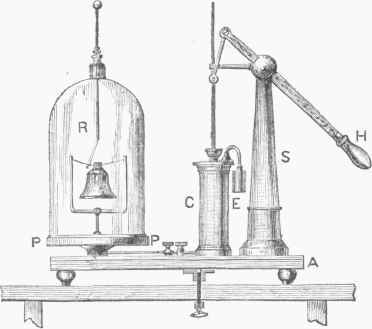
Fig. 3. - Improved Modern Air Pump.
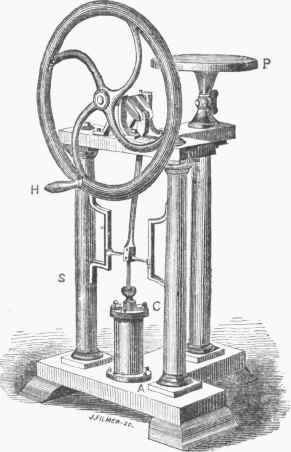
Fig. 4. - Large Improved Air Pump of Ritchie.

Fig. 5. - Geisler's Mercurial Air Pump.

Fig. 6. - Bunsen's Air Suction Pump.

Fig. 7. - Doyle and Martin's Rotary Air Pump.
Continue to:


My Books

