


Acoustics. Continued
Description
This section is from "The American Cyclopaedia", by George Ripley And Charles A. Dana. Also available from Amazon: The New American Cyclopædia. 16 volumes complete..
Acoustics. Continued
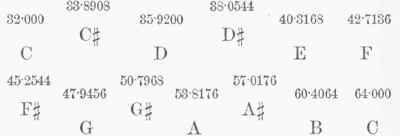
It is seen, by comparison with the numbers mentioned before, that this series gives C#, D, G, and G# too low, while the other eighth tones are too high. However, this is only the case when considering the interpolated semitones as sharps; but as we must use C# for Db, D# for Eb,, etc, and the calculation for the tones corresponding with these flats gives us different figures, between which and the former the equal temperament is a compromise, the advantages are acknowledged to be with the latter, and it is now therefore universally adopted. (See Music.) A column of air in a pipe will not necessarily vibrate in such a way that each wave will be equal to the length of the pipe. By modifying the manner of admitting the air, either by increased pressure or changing the aperture, the waves may be made one half, one third, one fourth, one fifth, etc, of the length of the pipe. In this way the so-called harmonics and the tones of the French horn are produced. They are called over-tones, if the fundamental vibration producing the lowest tone is still heard at the same time. In order to produce all kinds of shorter waves by means of the same pipe, holes may be made in its sides, closed by the fingers or by proper valves.
The opening of these holes is nearly equivalent to a shortening of the pipe. Thus the different tones of the flute, clarinet, haut-bois, bassoon, and several other wind instruments, are produced. In the trombone, the length of the tube is increased and diminished by a sliding arrangement; while in the cornet a piston and similar brass instruments, the same elongation and shortening is produced by piston valves admitting or shutting off the air from side channels of greater or lesser length. In stringed instruments the same results are accomplished by different length of strings. As in the organ every pipe produces only a single tone, so in the pianoforte every string is intended for one tone; while in the harp, by a slight shortening, the pitch of each string may be raised a so-called semitone. In all the other stringed instruments, as the violin, violoncello, and guitar, the different tones are produced by the use of very few strings only, which, however, by proper manipulation with the fingers, may be shortened so as to produce tones of which the vibrations become faster in proportion as the sounding portion of the string is shortened. In regard to the law governing their vibration, it is the same for strings as for pipes.
Other circumstances being equal, their velocity is inversely proportional to the length of the pipe or string. The tone of strings also changes by change of tension, and the velocity of their vibration is in the ratio of the square root of the weights which produce this tension. Further, the tone depends upon the thickness of the string, its rigidity, weight, and nature of material. When a string is subdivided into a number of equal parts, these parts will vibrate simultaneously, leaving the points of division at rest, and produce the harmonic tones, after the same law as in the case of a column of air in the French horn. The subjoined five figures give the manner of vibration of a string as a whole, half, third, fourth, and fifth parts, producing different tones, the harmonics of the fundamental tone, its octave, fifth above or twelfth, its double octave, and third above that, or seventeenth.

FUNDAMENTAL TOME.

OCTAVE.

FIFTH.

DOUBLE OCTAVE.

THIRD.
Harmonic Sound Waves of a String.
On the violin these subdivisions may be effected by slightly touching the string on one of the points dividing it into equal parts, and the harmonic upper tones thus produced are called the flageolet tones. In the Aeolian harp, in which the strings are put into vibration by the friction of a current of air, these divisions are incidentally and continually changing, and thus a variety of harmonic tones is produced. The division points, where the string happens to be at rest, are called nodal points. An elastic plate of glass, brass, steel, or other suitable material, may also be made to vibrate and emit tones; and when fixed at one point and excited at one of its edges by a violin bow, it may be made to produce a considerable variety of tones, by the fact that it may be subdivided into various systems of nodal lines; the spaces between these lines are the sounding portions, and the vibrations are more rapid or the tones sharper in proportion as these spaces are smaller. These nodal lines may be made visible by scattering dry sand over the plate, and when it is put into vibration with the violin bow, the grains of the sand which are not on the nodal lines will be thrown aside, and not come to rest until they are accumulated upon the nodal lines.
Thus many kinds of regular and almost geometrical figures may be formed, which are called, after the inventor of this method, Chladni's nodal sound figures. With different forms of plates, many hundreds of such figures have been obtained. Our figures illustrate only a few of the most remarkable. The first and most simple is produced by the lowest tone which can be obtained from the disk; the others belong to higher and higher tones, while the last and most complicated is produced by the highest tone; in this case the smallest parts of the glass disk vibrate for themselves, and produce then the most rapid vibrations. It is thus seen that every tone which may be drawn out of a disk produces its own characteristic nodal lines or figures. (See Chlad-ni's "Acoustics.") - Tones may differ not only in the velocity of their succeeding waves, but also in the form of these waves; this determines the character of the tone which the French call timbre. By it we distinguish the sounds of different instruments, the voices of different persons, etc.
Comparative physiology has determined which special portions of the interior structure of the ear are intended for the different functions in the act of hearing, by finding some parts more or less developed in proportion as the animal possesses the capacity of distinguishing variations of sound. So the dog, with no musical ear, distinguishes the voice of his master better than those singing birds which can learn a tune and thus have a musical ear. (See Ear.) Recently experimenters have succeeded in causing sounds to draw waving lines on slips of moving paper, these waves representing not only the pitch or velocity of vibrations, but by their different forms also the nature of the sounds. In our figures are represented a few illustrations of the waved lines produced by this method of registering the nature of diverse vibrations of the same length and pitch. The apparatus with which this is performed is called a phonauto-graph. - In regard to the application of acoustics to architecture, and the construction of buildings intended for music or public speaking, much learning has been erroneously applied. The elliptical and parabolic forms given to walls or ceilings have not answered expectation, for the simple reason that they concentrate the sound at single points at the expense of others.
Experience has however taught a few facts, of which the most important is that an echo is the greatest disturbing influence, and that large smooth walls and ceilings at a distance from the speaker make this disturbance a maximum. Speakers, singers, or musical instruments must therefore be placed as near to such a wall as practicable; and when a high flat or arched ceiling causes reflection or reverberation of sound, as is often the case in large churches, a horizontal sounding board of some 20 or more feet in diameter, thus projecting far beyond the pulpit, and placed as low as possible, only a few feet above the speaker's head, has been found the only effective remedy. It is seen in most of the cathedrals and large churches on the European continent. - Among the earlier writers and investigators must be mentioned Euler, Newton, Laplace, Chladni, and Savart; and among the later, Helmholtz, Weber, Konig, Herschel, Wulner, and Tyndall. See especially Helmholtz, Die Lehre Ton den Tonempfindungen (Brunswick, 2d ed., 1865); Tyndall, "Lectures on Sound;1' Peirce, "On Sound," prepared from Herschel's writings; and Wulner, Ex-perimentalphysik (Leipsic, 1871, vol. i.).



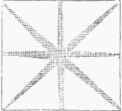


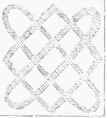
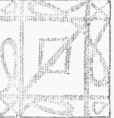
Chladni's Nodal Sound Figures.
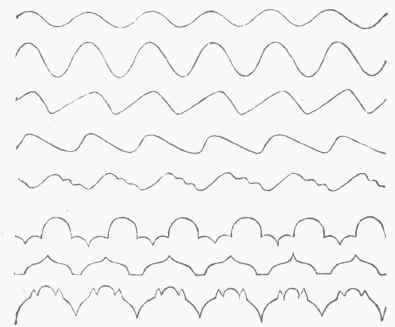
Sound Lines traced on Paper by the Phonautograph.
Continue to:


My Books

