


Aard-Vark
Description
This section is from "The American Cyclopaedia", by George Ripley And Charles A. Dana. Also available from Amazon: The New American Cyclopædia. 16 volumes complete..
Aard-Vark
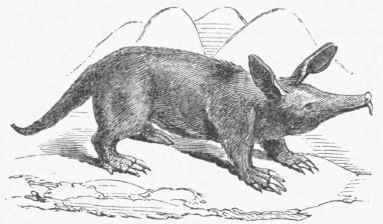
Aard-Vark (orycteropus capensis), a plantigrade animal of the class mammalia, order edentata, peculiar to Africa, and extremely common in the southern part of that continent, especially in the Cape Colony, where it is called aard-vark or earth pig. It was formerly classed with the myrmecophaga, or anteaters. The aard-vark is more closely allied in anatomical structure and in its dental system to the armadillos than to any other class of animals, although it has not their defensive armor. It has neither incisors nor canine teeth, and its molars are different in structure from those of any other quadruped; they have no roots, and, like the tusks of the elephant and the incisors of the gnawing animals, are constantly increased by the deposit of new bony matter at the base to compensate for the continual wear at the extremity. It has large, flat feet, hollow on the under side, with powerful claws, the toes, four in front and five behind, gradu-ally diminishing outward from the interior and second, corresponding to the fore and index fingers of the human hand.
This structure gives it great facilities for digging the burrows in which it lives, and for excavating the hills of the great ants, on which it feeds exclusively as do the pangolins of Asia, the myrmecophaga of America, and the echidna of Australia. At ! first sight, the aard-vark resembles a small, short-legged pig. Its length, when full-grown, exclusive of the tail, is about 3 feet 5 inches, its head 11 inches, its ears 0 inches, and its tail 1 foot 9 inches. Its head is long and attenuated, its upper jaw projecting beyond the lower; its mouth small; its tongue long, slender, and flat, unlike the cylindrical organ of the myrmecophaga, nor capable of so great protrusion, but. like theirs, covered with gluti- nous saliva, which firmly retains the ants with which it comes in contact. Its ears are long, erect, and pointed; its eyes of moderate size, two thirds nearer to the brow than to the snout. Its body is thick and corpulent, the limbs short and very strong. The skin is gen- i erally bare, but thinly scattered with a few stiff, reddish-brown hairs, which are more nu- merous on the hips and thighs than on the other parts of the body. The tail is nearly naked, very thick at the base, but tapering to a sharp point at the end.
The aard-vark is a very timid, inoffensive animal, burrowing in the ground, if pursued, so rapidly as to get wholly out of sight in the space of a few minutes, and working inward with such power and quickness that it is impracticable to dig him out. It is nocturnal in its habits and in its hours of feeding, and becomes exceedingly fat. Its flesh is wholesome, and its hams, salted and dried, are good eating.
Continue to:


My Books

