


Ims Of Court
Description
This section is from "The American Cyclopaedia", by George Ripley And Charles A. Dana. Also available from Amazon: The New American Cyclopædia. 16 volumes complete..
Ims Of Court
Ims Of Court, colleges in London, in which students of law reside and pursue their studies. In England at a very early date the science of law was taught in the metropolis in certain buildings in the immediate vicinity of the courts of law which were called inns of court, inn anciently signifying a mansion or place. The establishment of the court of common pleas at Westminster led to the gathering in its neighborhood of the whole body of "common" lawyers, and to the establishment in the metropolis of hostels or hospitia curia, which were so called because they were attached to or dependent upon the court. These hostels were occupied by the lawyers as offices and sometimes as dwellings, and contained also schools where the law was studied. But in 1346 the knights hospitallers of St. John of Jerusalem, to whom the pope had granted the English estates of the suppressed order of knights templars, leased the buildings and gardens of the templars in London to certain students of the common law, who established in them a hostel or inn of court. The place continued to be called the Temple, from its former occupants.
In the course of a few years the number of inns increased to four, which still exist, viz.: the Inner Temple, the Middle Temple, Lincoln's Inn, and Gray's Inn, each of which contained 200 members. Stow, in his "Survey of London" (1598), says of the lawyers who occupied these inns: " These societies are no corporations, nor have any judicial power over their members, but have certain orders among themselves which by consent have the force of laws. For slight offences they are only excommoned, that is, put out of commons, which is, not to eat with the rest in their halls; and for greater, they lose their chambers, and are expelled the house; and being once expelled, they are not to be admitted by any of the other three societies. The gentlemen in these societies may be divided into four ranks: 1, benchers; 2, utter benchers; 3, inner barristers; 4, students." In course of time two bodies were formed, called the "Honorable Society of the Inner Temple" and the " Honorable Society of the Middle Temple," who held their buildings as tenants of the knights hospitallers until the suppression of monastic bodies by Henry VIII., after which they held them of the crown by lease.
In 1608 the buildings of the two temples were granted by letters patent of James I. to the chancellor of the exchequer, the recorder of London, and the benchers and treasurers of the Inner and Middle Temples, for "lodging, reception, and education of the professors and students of the laws;" and it is by virtue of these grants that they are still held by an incorporated society of the " students and practises of the laws of England." The Temple garden, which lies between Whitefriars and Essex street, has been celebrated by Charles Lamb and Leigh Hunt, and was much frequented as a pleasure walk during the 17th and 18th centuries. In the hall of the Inner Temple, a noble room ornamented with emblematical paintings by Sir James Thornhill, and by portraits of Littleton and Coke, dinner is prepared for the members of the inn every day during term time. Students of law must keep 12 terms, that is, five years, at the inns of court before they are entitled to be called to the bar, and those of the Inner Temple are required to dine in this hall at least four times in each term. On certain "grand days" the judges, the masters in chancery, and many of the leading lawyers of England dine here, together with a large assemblage of the students.
Formerly the Inner Temple was celebrated for the magnificence of its entertainments and revels, especially in the 16th and 17th centuries. The hall of the Middle Temple, the largest and finest of the old inns of court, was built in 1562-'72. It is ornamented by elaborate carvings, by portraits and busts, and by the coats of arms of Somers, Hardwicke, Cowper, Thurlow, Dunning, Eldon, Blackstone, Stowell, Tenterden, Curran, and many other eminent lawyers, formerly members of the society, emblazoned on its windows. Lincoln's Inn, the next in importance to the Inner and Middle Temples, is on the W. side of Chancery lane, and derives its name from being on the site of the palace of an earl of Lincoln who died there in 1310, and by whom the land was assigned to certain professors of the law for the establishment of an inn of court. The ball and library, designed by Hardwick, and finished in 1845, form one of the noblest piles of building in London. The chambers of this inn are chiefly occupied by chancery barristers, conveyancers, and persons in attendance on the court of chancerv, which court is held in its hall.
Attached to the inn are extensive gardens, celebrated in the "Tatler," No. 100. Gray's Inn, the fourth inn of court in importance and size, is named from the lords Gray of Wilton, whose residence it originally was. It is in Gray's Inn lane, and has a garden which appears to have been planted with elm trees in 1600 under the direction of Francis Bacon, at that time treasurer of the society. The hall is a very handsome room, built in 1560. Its windows are emblazoned with the armorial bearings of Lord Bacon, Sir Nicholas Bacon, Lord Burleigh, and other eminent members. - Each of the inns of court forms an independent society, but they all agree in the observance of certain common regulations. No person can keep a term in any of them without being in the hall on three days when the grace is said after dinner. None of the societies can call a gentleman to the bar before he has been five years a member of the society, unless he is a master of arts or a bachelor of laws of the university of Oxford, Cambridge, or Dublin. No person in trade or in deacon's orders, and no one who has held the situation of a conveyancer's clerk, can be admitted at all; and solicitors and attorneys must have their names struck off the rolls for two years, and the articles of clerks must be expired or cancelled two years, before they can be admitted.
An applicant rejected by one society will not be admitted by any other. On his admission the student pays various fees amounting to £30 or £40, and enters into a bond of £100 for the payment of his commons or dinners while a student. On the expiration of his terms he addresses a petition to the benchers at a special council; and if they approve, he waits upon them after dinner, the oaths are administered, and he is called to the bar. The dues for admission vary in the different inns from £66 in Gray's Inn to £93 in Lincoln's Inn. There are different degrees among the members of the inns. The sergeants are the highest degree at common law, as the doctors are in civil law. Queen's counsel is another rank, admission to which is technically called giving a silk gown, the costume of the bearers of this honor. The benchers of the inns are elected from the barristers at the bar according to seniority. They govern the society, and may reject an application for admission without assigning a reason. - The four great inns of court have attached to them inns of chancery, of which the Inner Temple has two, Clement's and Clifford's (formerly also Lyon's, now the Globe theatre); the Middle Temple one, New Inn; Lincoln's Inn one, Thavies's; and Gray's Inn two, Barnard's and Staples's. Two others, Furnival's and the Strand, no longer exist.
These inns are principally inhabited by attorneys.

Middle Temple Hall.
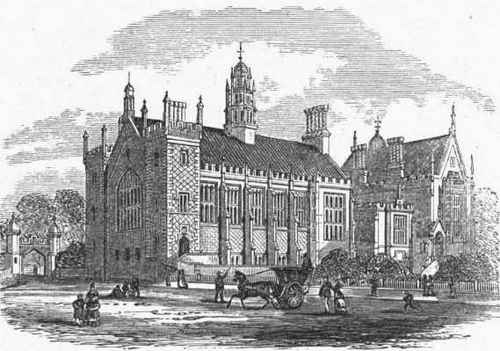
Inner Temple Hall and Library.
Continue to:


My Books

