


Hake
Description
This section is from "The American Cyclopaedia", by George Ripley And Charles A. Dana. Also available from Amazon: The New American Cyclopædia. 16 volumes complete..
Hake
Hake , a name properly applied to fishes of the cod family, of the genus merlucius (Cuv.), and improperly in New England to gadoids of the genus phycis (Artedi). There is great confusion in the application of the names to the first genus; the European merlucius, properly called hake, is styled the merlan or whiting in the Mediterranean; our merlucius is also generally called whiting, but the true whiting is a merlangus, one of the species of which we name pollack; the American hake, or phycis, is styled codling by De Kay, in order to avoid confusion. The European hake (merlucius vulgaris, Cuv.) is generically distinguished from the cod by having only two dorsal fins, a single long anal, and no barbule on the chin; the head is flattened, the body elongated, the first dorsal short, the second dorsal and the anal long and deeply emarginated. The color on the back is ashy gray, and below dirty white. The wide mouth is provided with numerous long, sharp, incurved teeth on both jaws, on the palate, and in the pharynx.
It is abundant in the ocean and in the Mediterranean, and on the coasts of Ireland and Cornwall in immense shoals from June to September during the mackerel and herring seasons; it grows to a length of 1 or 2 ft., is very voracious, and feeds principally on the last mentioned fishes. Its flesh is white and flaky, and is dried in northern countries like that of the cod; from its inferior quality it is commonly called " poor John;" the liver is a delicate dish, and was highly esteemed by the ancients. The American hake (M. albidus, De Kay), very generally called whiting in New England, and sometimes silver hake, is 1 or 2 ft. long; when alive, the upper parts of the body and sides are rusty' brown with golden reflections, becoming leaden after death; silvery white beneath; iris silvery; dorsals and caudal rusty, pectorals and ventrals sooty, anal colorless, inside of the mouth purple, and lateral line lighter than the upper parts; the lower jaw is the longer, and the teeth are very long and sharp.
It is found from New York northward, and is especially abundant in the British provinces; it is exceedingly voracious, pursuing the smaller fishes, and is caught in great numbers in some seasons both in nets and by hooks; its flesh, when fresh, is sweet and wholesome, but it soon becomes soft and tasteless. - The American hakes of the genus phycis have an elongated body; two dorsals, the first triangular with the third ray filamentous and prolonged, the second commencing just behind the first and extending nearly to the caudal; the ventrals with a single ray at the base, afterward divided; anal long and single; chin with one barbule. The white or common hake (P. Americanus, Storer) grows to a length of from 1 to 3 ft., and when alive is reddish brown above, bronzed upon the sides, and beneath whitish with minute black dots; upper edge of the dorsal black, as is the edge of the anal and end of the caudal; fins also dotted with black; after death the back becomes grayish brown, and the abdomen dirty white; the head is very flat above, broad, strongly convex back of the eyes, with prominent rounded snout and large eyes; upper jaw the longer, and both well armed with rows of sharp incurved teeth; teeth also on the vomer.
It is found from the New Jersey coast northward, and is taken in large numbers, chiefly on muddy bottoms, and generally at night or on cloudy days; it feeds principally on small fish and crustaceans. It is an excellent fish for the table, fried or boiled; it is also valuable when salted, and in this condition is largely exported from the British provinces under the name of ling. There is a small species (P. filamentosus, Storer), called squirrel hake by the Massachusetts fishermen, which rarely exceeds a length of 18 in. or a weight of 2 1/2 lbs.; the head is longer in proportion, the body more slender, top of the head depressed in its whole extent, and the filamentous ray of the first dorsal considerably longer than in the preceding species; there are no spots upon the pure white of the lower parts. Other species are described in America, on the coast of Europe, and in the Mediterranean. - The name hake is also erroneously given on the coast of New Jersey to the king fish, a sci-aenoid of the genus umbrina (Cuv.), from its having a barbule on the chin.
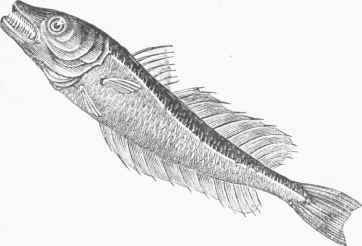
European Hake (Merlucius vulgaris).
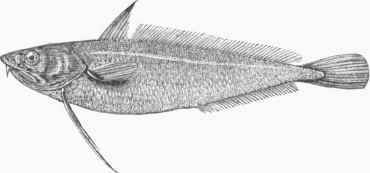
White Hake (Phycis Americanus).
Hake #1
Hake ,.I. Julias Charles, an English clergyman, born at Herstmonceaux, Sussex, in 1796, died there, Jan. 23, 1855. He was a son of the Rev. Robert Hare, rector of Herstmonceaux, and grandson of Bishop Francis Hare. After passing some time on the continent, he studied at the Charterhouse school, and was removed in 1812 to Trinity college, Cambridge, where he remained, with a brief interval, for 20 years; he became a fellow in 1818, and assistant tutor in 1822. During this period he applied himself especially to classical and philological learning, German literature, and the writings of Coleridge and Wordsworth. In 1827 appeared the first series of " Guesses at Truth, by Two Brothers," a volume of miscellaneous apophthegms and reflections, the joint production of himself and his elder brother, Augustus William. A second edition appeared in 1838 with additions by himself, and from the posthumous papers of his brother; a second series was published in 1848, and several editions have since been issued.
At Cambridge he united with Thirlwall in translating the first two volumes of the second edition of Niebuhr's "History of Rome" (1828-'32), and he published in 1829 a vindication of the work from the charges of the "Quarterly Review." He also contributed largely to the "Philological Museum." He became rector of Herstmon-ceaux in 1832, archdeacon of Lewes in 1840, prebendary of Chichester in 1851, and chaplain to the queen in 1853. Soon after settling at Herstmonceaux he married the sister of his friend the Rev. F. D. Maurice, and began his intimacy with Bunsen, who dedicated to him the first volume of "Hippolytus and his Age." His collected works would form a commentary on the leading events of a quarter of a century having special reference to the church of England. Besides several volumes of sermons and miscellaneous pamphlets on church questions, his principal later publications were: "The Means of Unity, a Charge, with Notes " (1847); "The Duty of the Church in Times of Trial" (1848); "The True Remedy for the Evils of the Age" (1850); "A Letter to the Hon. R. Cavendish, on the recent Judgment of the Court of Appeal as affecting the Doctrine of the Church" (1850); "The Contest with Rome" (1852); "A Vindication of Luther against some of his recent English Assailants " (1854); and an edition of the "Essays and Tales of John Sterling, with a Memoir" (2 vols., 1848). II. Augustus William, brother of the preceding, born at Herstmonceaux in 1793, died in Rome, Feb. 18, 1834. He was a fellow of New college, Oxford, and became rector of Alton Barnes in 1829. He was associate author of the first series of "Guesses at Truth," and published "Sermons to a Country Congregation" (2 vols., London, 1837). III. Augustus Julius Charles, nephew of the preceding, born in Rome, March 13, 1834. He has published "Epitaphs for Country Churchyards" (1856); "Winter at Mentone" (1802); "Walks in Rome " (1871); Wanderings in Spain " (1873); and "Memorials of a Quiet Life" (1872), which are records of the Hare family.
Continue to:


My Books

