


Elk
Description
This section is from "The American Cyclopaedia", by George Ripley And Charles A. Dana. Also available from Amazon: The New American Cyclopædia. 16 volumes complete..
Elk
Elk, a name properly applied to the alcine division of the deer of the snowy regions, constituting the genus alces or alee (H. Smith). In this genus the muzzle is very broad, and covered with hair, except a small bare spot in front of the nostrils; the upper lip is 4 in. longer than the lower, and answers for prehensile purposes; the neck is thick and short, and the throat somewhat maned in both sexes; the hair is coarse, thick, and brittle; the hind legs have the tuft of hair rather above the middle of the metatarsus; the horns in the males are broad and palmated; the tail is short. The nose cavity in the skull is very large, reaching posteriorly to a line over the front of the molars; the long intermaxil-laries do not reach to the very short nasals. The horns have no basal snag, the first branch being considerably above the crown. The young are not spotted, but colored like the adult. Elks live in the woods in the northern parts of both continents, but the American is by some considered a distinct species from the European. The true American elk, or moose (as it is universally called here), alee Ameri-canus (Jardine), exceeds all other existing deer in size and strength, and unites to great speed remarkable powers of endurance; it is as large as a horse, standing 5 ft. high at the shoulders, and measuring about 7 ft. from nose to tail; the length of the latter is about a foot; the weight of the horns varies from 45 to 70 lbs., and that of the animal from 8 to 12 cwt.
The moose is an awkward, clumsy, and dispropor-tioned creature, though from its size it possesses a certain majesty when seen amid the wild scenery of its favorite haunts. The head is too large in proportion to the body for any pretension to the symmetry usually seen in the deer family; the long, tumid, and movable upper lip gives to the face somewhat of an equine expression, and the heavy ears, more than a foot long, are decidedly asinine. Audubon says, " The head forcibly reminds us of that of an enormous jackass." The eyes are deep-seated and comparatively small; under the throat there is in both sexes a tuft of coarse bristly hair attached to a pendulous gland, which is most conspicuous in the young. The horns are found in the males only, and require five years for their full development; they begin to sprout in April, and complete their growth in July; the first year they are about an inch long; the second year, 4 or 5 in., with perhaps a rudimentary point; the third year, about 9 in., each dividing into a round fork; in the fourth year they become palmated, with a brow antler and three or four points; and the fifth year they have two crown antlers and four or five points; after this one or two points are added annually, up to as many as 23, with an expanse sometimes of nearly 6 ft. to the outside of the tips, with the palm a foot wide within the points, and a circumference above the burr of 9 in.
The horns diminish in size after the animal has passed the period of greatest vigor; in old and vigorous animals they are shed in December, but young animals sometimes carry them till March. The first inner branch begins about 9 in. from the base; the palms are often unlike on the right and left sides, and are channelled irregularly on both surfaces; their color is brownish yellow, with the ends yellowish white. The incisor teeth, six in the lower jaw only, are gouge-like and very white; the eyes are black; the nose, forehead, and upper lip yellowish fawn; the sides of the head yellowish brown; the general color above varies from blackish to ashy gray; below lighter, with a yellowish white tinge. In winter the color is darker, and in advanced age so dark as to merit the name given to it by H. Smith, "the American black elk;" the grayish are said to be the largest, reaching a height of 7 or 8 ft. In summer the hair is short and soft, in winter longer and very coarse, with a fine short wool next the skin. Moose are not uncommon in the northern parts of Maine, and in Canada, Nova Scotia, and Labrador, especially in winter. In summer they frequent lakes and rivers to free themselves from insect pests, and feed upon water plants and the tender branches of overhanging trees.
In winter they retire to the elevated ridges abundantly provided with maple and other hard-wood trees, on the twigs and bark of which they feed. By the elongated upper lip they pull down the branches, which they hold with their fore legs until they are stripped of the twigs; they peel off the bark by including it between the hard pad on the roof of the mouth and the lower incisors. In winter they tread down the snow, forming what are called "yards," in which are generally found a male, female, and two fawns; as the trees are stripped they tread down fresh snow, and they are fond of going always in the same tracks. They prefer the twigs of the maple, willow, buttonwood, birch, and aspen, and grasses; in captivity they will eat the food of domestic cattle. Though their flesh is coarse, it is esteemed by hunters; the nose or muffle is a special favorite, being rich, gelatinous, and juicy, when cooked like calf's head; the steaks are juicy, often tender, but seldom fat; the flesh of yearlings is always preferred; the tongue is much relished, as are the fatty appendages to the large intestines, by the hunters, who also consider the marrow warm from the shank bones an excellent substitute for butter.
The moose trots, runs, and jumps with great speed, passing through seemingly impenetrable thickets and over broken ground without apparent effort; it swims well, with only the head and part of the neck above water; it is never seen like the reindeer on the ice, except from absolute necessity; when walking on untrodden snow its feet generally sink into it to the ground. Its sense of smell is very acute, and enables it to detect an enemy at a great distance; the breaking of the smallest twig is sufficient to startle it from its hiding place. The pairing season begins in September; during October the males become furious, fighting each other whenever they meet; they run noisily through the woods, and swim lakes and rivers in pursuit of the female; at this time it is dangerous for the hunter to approach, as they do not hesitate to attack him. The young are born in May, the first time one, and two annually afterward; the females are also very fierce in defence of their calves. The males are called bulls and the females cows. The proper times for hunting the moose are in March and September; in the latter month the animals are in their prime, and in the former they are most easily taken on account of the sharp crust impeding their progress through the snow.
In hunting them in March, a few small curs are useful in worrying the animal and delaying it until the hunter comes up; it is useless to pursue them through soft snow, which offers no impediment unless it be deep, when the hunter can easily overtake them on snow shoes. Many are shot from canoes on moonlight nights in September; the hunter imitates the call of the male, which, angry at the supposed intrusion of a rival, rushes to the water's edge to fight him. Slip-nooses attached to strong saplings, bent down in the moose paths to the water, will occasionally entrap a victim. The most successful way is to start them from their yards, and pursue them over the snow. When wounded and brought to bay, they defend themselves fiercely, striking with their fore feet and horns; they will frequently turn upon the hunter when not wounded, and force him to fly for his life. Moose have been domesticated, and taught to draw carts and sledges, but during the rutting season they become perfectly intractable. Their geographical distribution is extensive; they have been found at the mouths of the Mackenzie and Coppermine rivers, on the E. slope of the Rocky mountains at the sources of Elk river, and in Oregon; on the E. coast they are found from Labrador to northern New England and New York, their southern limit seeming to be 43° 30'. As in all other deer of cold and mountainous regions, there is considerable diversity in the size of the body and the horns of the moose, according to the abundance of food in the places inhabited by them. - The European elk (A. malchis, Ogilby) was once found between the 53d and 65th degrees of latitude in Prussia, Poland, Sweden, Norway, and Russia, but is rarely seen at present except in the most northern of these countries; it is also found in Asiatic Siberia. The appearance is the same as that of the moose; from its long legs and overhanging lips the old authors thought that it grazed walking backward.
From the great height of the shoulders above the crupper its gait is awkward and shuffling, and when running fast the hind limbs are very wide apart; its joints crack at every step, with a sound which may be heard at a considerable distance; a part of the sound is said to be made by the hoofs striking against each other. According to Hamilton Smith, the Teutonic term elend (miserable) was applied to this animal from its supposed frequent attacks of epilepsy, while its falls are really attributable to its tripping itself up by treading on its fore heels, the elevated position of the nose, with the horns laid horizontally on the back, preventing it from seeing the ground distinctly before it. The European elk seems to attain a size equal to that of the moose, measuring 6 ft. high at the shoulder. The period of life is said to be about 20 years. Pennant states that elks were once used to draw sledges in Sweden, and that they could travel over 200 m. a day. Their hide makes excellent leather for belts and coverings for the feet. Though most authors have regarded the American and European elks as the same, Agassiz has described the former as distinct, with the specific name lobatus, from differences in the shape of the nose, the form and branching of the horns, and other points.
Sir John Richardson (in the "Fossil Mammals" of the "Zoology of H. M. S. Herald") also considers the species distinct, calling the American A. muswa; he compares the skeletons carefully, and mentions, among other characters, that the breadth of the face at the most protuberant part of the maxillary bones is less in the American than in the European elk; if they be regarded as the same, the proper name would be A. Americanus (Jar-dine). - The name of elk is applied in this country to the wapiti (cervus Canadensis, Briss.), which should be called the American stag (see Wapiti); this name is also given by the British sportsmen in India to some of the rusa or samboo deer; so that it is necessary to consider the country of the animal before deciding on the meaning of the word "elk." - There are many fossil species called elks, as the fossil or Irish elk (cervus giganteus, Cuv.; megaceros Hibernicus, Owen), found in the diluvial strata of Europe, and especially in the peat bogs of Ireland; this species was of great size, with an enormous development of horns, which, resembling those of the elk in their broad palmations, differed in the size and low situation of the basal antlers; in other parts of the skeleton it resembled most the stags.
Another species, found in the peat bogs and upper tertiary of France and Germany, seems to have been a gigantic fallow deer. The fossil elk described by H. de Meyer, from the diluvium of Europe, differed from the living animal in the form of its forehead. A fossil elk, allied to the wapiti, has been found in the United States, with the bones of the mastodon. The fossil sivatherium, described by Cautley and Falconer, from the Sivalik hills of the lower Himalaya range, seems in many respects to have resembled the moose; the form of the head and its size lead to the belief that it was elephant-like in the cellular prominences of its posterior portion; the face was short, and the nasal bones were raised into an arch over the external nostrils, indicating the probable existence of a trunk; we see the upper lip of the moose elongated also into a kind of prehensile proboscis; the head was also armed with two spreading horns, arising above and between the orbits; the molar teeth are entirely like those of ruminants; the anterior extremities (of which casts exist in the cabinet of the Boston society of natural history) indicate an animal of the size of a large elephant.
This animal was undoubtedly a ruminant, with the pachyderm characters of a heavy form, short neck, and probably a proboscis; in like manner the ruminant moose departs from the deer family, and approaches the pachyderms (especially the equidoe in its movable elongated snout, long ears, and general shape.
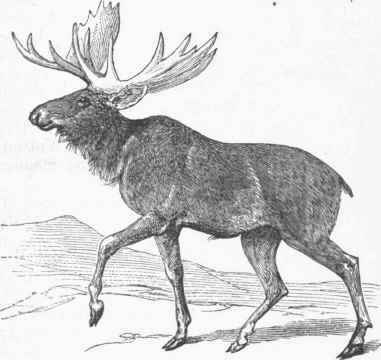
American Elk (Alce Americanus).
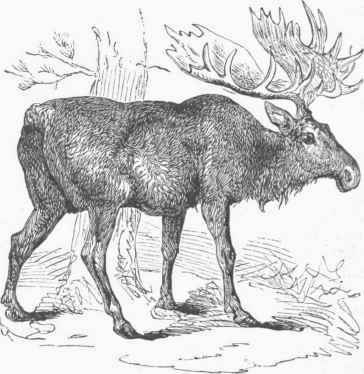
European Elk (Alee malchis).
Elk #1
Elk, a N. W. county of Pennsylvania, traversed by Clarion river, its branches, and some other small streams; area, about 700 sq. m.; pop. in 1870, 8,488. The surface is broken by many hills and rough mountain peaks, the principal of which is Elk mountain, in the S. part. The county is occupied chiefly by thick forests, and lumber is the most important article of export. Bituminous coal is found in great abundance. The soil is better adapted to grazing than to the culture of grain. The Philadelphia and Erie railroad passes through it. The chief productions in 1870 were 6,372 bushels of rye, 12,234 of Indian corn, 61,573 of oats, 35,694 of potatoes, 6,182 tons of hay, and 108,730 lbs. of butter. There were 2,953 cattle and 3,031 sheep; 2 flour mills, 36 saw mills, 4 breweries, 3 tanneries, and 3 manufactories of carriages. Capital, Ridgeway.
Continue to:


My Books

