


Edessa
Description
This section is from "The American Cyclopaedia", by George Ripley And Charles A. Dana. Also available from Amazon: The New American Cyclopædia. 16 volumes complete..
Edessa
I. An ancient city of northern Mesopotamia, the capital of the district of Os-roene; now Urfa, 84 m. S. W. of Diarbekir. Tradition ascribes its foundation to Nimrod, and supposes it to be on or near the site of Ur of the Chaldees. Sabaism is supposed to have been the religion of the early inhabitants, and in particular the worship of the goddess Atar-gatis. Under the Seleucidae it was called Cal-lirrhoe, and under Antiochus IV. it took the name of Antiochia. In 137 B. C. it became the capital of an independent kingdom. The name or title Abgar or Agbar (the mighty) appears as that of its sovereigns, and its manufactories of arms were celebrated. Edessa was sacked by Trajan, on account of the equivocal conduct of its rulers during the wars of the empire against the Armenians and Parthians. In 216 it was made a Roman military colony by Caracalla, who was murdered there in the following year. It played an important part in the early Christian church, was the residence of St. Ephraem Syrus, had famous schools of theology and more than 300 monasteries, and was for many years the principal seat of oriental learning.
It was taken by the Arabs shortly after the death of Mohammed, and in the time of the first crusade became a Christian principality under Baldwin I., brother of Godfrey de Bouillon. Baldwin ruled it from 1097 to 1100, purchased Samosata and several other places, and abandoned his fief for the crown of Jerusalem. Baldwin II., cousin of the preceding, reigned from 1100 to 1118, and was called in his turn to the throne of Jerusalem. Jocelin de Courtenay, the successor of Baldwin, was surnamed the Great by reason of his victories over the Saracens. Jocelin II., who reigned after him, was defeated by the sultan Nour ed-Din, who captured Edes-sa and exterminated the inhabitants. It was plundered by Tamerlane in 1393, subsequently annexed to Persia, and in 1637 fell into the hands of the Turks, who changed its name to Urfa or Orfah. The modern town is large and well built, with a wall 7 m. in circuit, and 40,000 or 50,000 inhabitants, of whom about 4,000 are Armenians, 1,000 Jacobites, and the rest Turks, Arabs, Kurds, and Jews. Its grand mosque has considerable architectural merit; within it are several schools for the instruction of young men in religion and law. Among the antiquities are the ruins of a tower said to have been the palace of Nimrod, and the catacombs in the rock beneath.
It derives great commercial importance from its. position on the route between Aleppo and Kurdistan. II. The ancient capital of Macedonia (probably the same as AEgae, now Vodena), situated on a branch of the river Ludias and on the Egnatian way, at the entrance of the pass leading from the mountain provinces into upper Macedonia, and also by another branch into Pelagonia and Lynces-tis. The town was the cradle of the Macedonian dynasty, and even after the removal of the seat of government to Pella, in the plains below, Edessa was still the national sanctuary and the burial place of the kings. From its commanding position it continued to be of importance under the Roman and Byzantine emperors. Taken by Basil II., the conqueror of Bulgaria, it was strongly fortified under his reign (976-1025), and was called Bodina, whence the modern name. The modern town, which has few remains of antiquity, is 45 m. W. by N. of Salonica. The locality is still celebrated for its scenery.
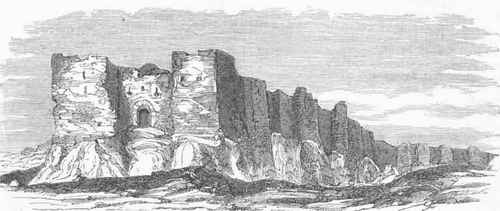
The Castle of Edessa.
Continue to:


My Books

