


Serins Tullius - Seth Green

Description
This section is from "The American Cyclopaedia", by George Ripley And Charles A. Dana. Also available from Amazon: The New American Cyclopædia. 16 volumes complete..
Serins Tullius - Seth Green
Serins Tullius
See Servius Tullius.
Serous Membranes
See Membeane.
Serpent
Serpent, a musical wind instrument of curvilinear form, consisting of a conical tube of brass, divided into three parts, a mouthpiece, neck, and tail, and having six circular apertures for the production of the notes. Its compass extends from B flat below the bass staff to G, the treble clef line, and its use is confined to military bands. It was invented by Edme Guillaume of Auxerre in 1590.
Serpentine
See Marble, vol. xi., p. 147.
Serra Da Estrella
Serra Da Estrella. See Portugal.
Serval
Serval (felis serval, Linn.), a carnivorous animal of the cat family, a native of southern Africa. It is about 4 ft. long, of which the tail is 15 in.; the color above is ochrey yellow, darkest on the back, and shading into white on the under parts; body with dark brown spots forming longitudinal marks on the neck and shoulders; inside of fore legs with two transverse black bands; tail tipped and ringed with black. The legs are rather long, the body slender, the head small and rounded, and the hair long and shaggy, especially on the flanks. It is about the size of the lynx, and preys upon the smaller mammals and birds; it is not very savage, and the young are gentle like the common cat.
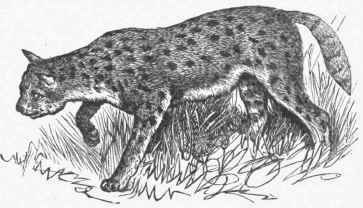
Serval.
Servant
See Master and Servant.
Service Berry
See June Berry.
Sesostris
See Egypt, vol. vi., p. 462.
Sesterce
Sesterce (Lat. sestertius), an ancient Roman brass or silver coin, worth a quarter of a denarius, or originally 2 1/2 asses, whence its name (semis tertius, the third a half, the Roman expression for two and a half); but the denarius being early divided into 16 instead of 10 asses, the sesterce became equal to 4 asses. Its value down to the time of Augustus was 4.1 cents, and afterward 3.6. The sestertium was 1,000 sesterces, and large sums were often counted in sestertia. There was a common formula for the expression of that value in thousands, as: SS, 1,000 sestertia; bina SS, 2,000; dena SS, 10,000; and centena SS, 100,000.
Sestos, Or Sestus, In Antiquity
Sestos, Or Sestus, In Antiquity, the principal city of the Thracian Chersonesus (now peninsula of Gallipoli), on the Hellespont, opposite Abydos, from which it is distant about 1 m. Though never large, it was important from its position. Its chief celebrity is from its connection with the romantic story of Hero and Leander, the former of whom was a priestess in the temple of Venus at Sestos. The western end of the bridge by which Xerxes crossed the Hellespont was a little S. of Sestos; and from its port the army of Alexander sailed over into Asia. Its site is now called Yalova.
Set, Or Typhon
See Demonology, vol. v., p. 794.
Seth Green
Seth Green, an American fish culturist, born in Rochester, N. Y., March 19, 1817. A fisherman by occupation, his attention was early attracted by the gradual diminution of fish in the waters of the state, and in 1838 he began to devote himself to practical fish culture. In 1864 he organized the fish-breeding establishment at Caledonia springs in Livingston co., which he managed with great success for four years. In 1867 he invented a shad-hatching box, which has been extensively used in stocking the Connecticut, Hudson, and other rivers. He published a work on "Trout Culture" in 1870, and in 1871 succeeded in transporting 10,000 young shad from the Hudson to the Sacramento. He was for some years commissioner of fisheries of the state of New York, and is now (1874) superintendent of the state hatching house at Caledonia. He has been justly styled the father of American fish culture.
Continue to:



My Books

