


Zinnia (Named After J. G. Zinn A German Botanist)
Description
This section is from "The American Cyclopaedia", by George Ripley And Charles A. Dana. Also available from Amazon: The New American Cyclopædia. 16 volumes complete..
Zinnia (Named After J. G. Zinn A German Botanist)
Zinnia (Named After J. G. Zinn A German Botanist), a genus of plants of the composite family, of which there are about 12 species, belonging to the Mexican flora, though some occur along our southern boundary, and a few are sufficiently ornamental to be popular garden plants. They are mostly annuals, with opposite, sessile, entire leaves, and the numerous branches each terminated by a solitary head of flowers; the several rays are persistent, becoming dry and papery, in the centre of which is a conical, prominent disk, which in the normal state is crowded with small tubular florets. The best known species is Z. elegans, introduced into cultivation late in the last century; it forms a much-branching plant, and as formerly cultivated its branches were terminated by a rather coarse but showy flower (properly head of flowers), 2 to 3 in. across, with rays varying from white through red and yellow to deep purple and orange; but as it began to ripen seeds it became unsightly from the dull color of its growing and very conspicuous disk. About a dozen years ago doubleflowered varieties were obtained, in which the disk produced ray or broad and showy florets, making an improvement quite as striking as any in floriculture, and the plant, which in its single state was barely tolerated, is now highly prized; its flowers, thoroughly double, present much the appearance of those of a well formed small dahlia, with a similar range of colors and shades; they are capable of producing brilliant effects when planted in masses, affording a profusion of bloom, which is continued all summer.
Among other species sometimes cultivated are Z. multijlora, with red-purple rays, and Z. angustifolia, which appears in the catalogues as Z. aurea and Z. Mexicana, and its double form as Z. Haageana; the latter is a widely spreading and much-branched plant, with small heads of orange-yellow flowers, which in the double ones are very showy. All are readily raised from seed, and succeed in any garden soil.
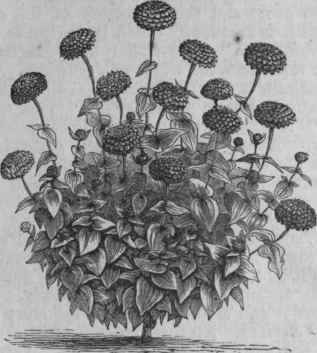
Plant of Double Zinnia (Zinnia elegans).
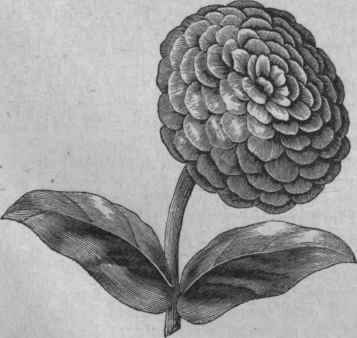
Double Zinnia (Zinnia elegans).
Continue to:


My Books

