


Thorn
Description
This section is from "The American Cyclopaedia", by George Ripley And Charles A. Dana. Also available from Amazon: The New American Cyclopædia. 16 volumes complete..
Thorn
Thorn, a name used in combination for various spinescent plants, but by itself restricted to species of the genus Crataegus, of the rose family. The genus belongs to that division of the family (tribe pomeoe) which includes pyrus, the apple, pear, etc, and differs from this chiefly in the structure of the fruit. About 65 species are described (which is probably many more than really exist), found in Europe, Asia, and North America, and a single one in the Andes of Columbia; they are shrubs, or sometimes small trees, and often armed with thorns, which are abortive or suppressed branches. The leaves are alternate, simple, often lobed, and in some species evergreen; the abundant flowers, usually in terminal clusters, though much smaller, closely resemble those of the apple in structure, are generally white, sometimes rose-colored, and fragrant; styles one to five; the usually red and sometimes edible fruit is a drupe rather than a pome; the carpels, instead of being parchment-like as in the apple, forming when ripe a hard, bony, one- to five-celled stone, or one to five distinct, bony, one-seeded stones.
There are about a dozen species of thorn in the Atlantic states, three or four of which are peculiarly southern, and two naturalized; a few of the native species extend across the continent, and a small number are peculiar to the far west. In their wild state, as well as in cultivation, the species are much disposed to vary. - One of the most noticeable and finest of the native species is the cockspur thorn (crataegus crus-galli), which extends from Canada to Florida and west of the Mississippi. When well developed it is a small tree, 10 to 20 ft. high, with numerous nearly horizontal branches forming a round head; the sharp and slender thorns are 2 to 4 in. long, and often show their branch-like nature by bearing leaves when young; the obovate leaves taper to a wedge-shaped base, are serrate toward the apex, very thick, smooth, dark green, and shining above, 1½ to 2 in. long; the flowers, produced on spurs shorter than the thorns, are succeeded by bright red, nearly globular fruit, about half an inch in diameter. This produces in the wild state varieties differing much in their foliage, and its synonymes are numerous; there are also some garden varieties, one of them remarkably dwarf.
It was introduced into England nearly 200 years ago, and is there valued as an ornamental shrub or small tree; experiments have been made with it here as a hedge plant, to which use it is perhaps better adapted than any other native thornrbut it has the disadvantages common to plants of this genus mentioned under Hedge. The hard close wood of this and other species takes a fine polish, and serves for handles to hammers and other tools, but on account of its small size its use is limited. Among the most conspicuous of the native species is the Washington thorn (C. cordata), which grows from Virginia southward, but has been somewhat cultivated as a hedge plant further north; it grows 10 to 20 ft. high, and is very spiny; its broad leaves, sometimes slightly heart-shaped at base, are often three-lobed; the fruit, the size of peas, is bright red. The scarlet-fruited thorn (G. coccinea), with smooth, thin, roundish-ovate leaves, and coral-red but scarcely edible fruit, is very common. So also is the pear or black thorn (0. tomentosa), which has thickish ovate or obovate, sharply toothed leaves, downy when young, very large fragrant flowers, and globular or pear-shaped fruit three fourths of an inch across, scarlet or orange, and edible, having often a pleasant flavor; there are several varieties of this, one of which has its fruit dotted with white.
The parsley-leaved thorn (0. apiifolia), distinguished by its much cut leaves, is found from Virginia southward. The summer haw (0. oetivalis) of South Carolina, and growing southward and westward, is a small tree found on the margins of the pine-barren ponds; it has wedge-obovate, thick leaves, and globose, large, red fruit, which ripens in early summer, and, being quite juicy with a pleasant acid flavor, is much esteemed for making tarts and jellies. The remaining native species are only of interest to the botanist. - Among exotic thorns, the best known is the hawthorn (C. oxyacantlui), also called white thorn, and in England May or May tree, and also quickset, from its being set to form a quick or living fence or hedge. The term haw is applied to the fruit of this and other thorns; but being from the A. S. haga, a fence or hedge, hawthorn really means a hedge thorn, and the origin of the name points to this use of it in very early times. The species is found throughout Europe, Siberia, and central Asia; and as it was early introduced into this country, it has become more or less naturalized in the older states. Its smooth leaves are wedge-shaped at the base and cut-lobed and toothed above; its abundant flowers appear in May, and are followed by ovoid, coral-red, rather small fruit.
The varieties are numerous, the catalogues containing 30 or more, which differ from the normal form in the shape of the tree, some being very pendulous, in the character of the leaves, and in the form and color of the flowers; the bloom, usually white, varies from blush through pink and rose color up to a recently introduced . scarlet, and there are double as well as single flowers of the white and various shades, so that a collection of the forms of this species alone would present a great variety. The Glastonbury thorn, near the abbey of that name in England, is a variety of hawthorn flowering twice a year; it blooms at the usual time, and also bears a crop of very early flowers, which open about Christmas. In England the hawthorn is the almost universal hedge plant, it being as well adapted to that climate as it is unfitted to ours; the early attempts at hedging in this country were, in imitation of the home practice, made with this plant; and the general failure with it brought all hedging into disrepute. (See Hedge.) The evergreen or pyra-canth thorn (C. Pyracantha), from the south of Europe, was distributed several years ago as a desirable hedge plant; it has shining, evergreen, mostly oblong leaves, about an inch long, with small clusters of flowers and brilliant red fruit; it has become naturalized near Washington and in some other localities; in a climate not more severe than that of Virginia it makes an excellent hedge.
An accidental variety with white or yellowish fruit is (as is sometimes the case with varieties) more robust than the type; this has proved perfectly hardy near New York in the most severe winters, and promises to bo a valuable hedge plant. - The pyracanth thorn is readily multiplied from cuttings, but the hawthorn and our native species are mostly raised from seeds, which are very slow in germinating; the fruit is placed in what is called the " rot heap," where mixed with earth it is exposed to the weather for a year before sowing. Thorns from the seed are used as stocks upon which to graft the double and other desirable varieties, and some of our vigorous native species have been used as stocks for the pear; but there is no advantage in using these stocks, and unless the grafting is done below the surface of the soil the pear is apt to break away from the thorn.
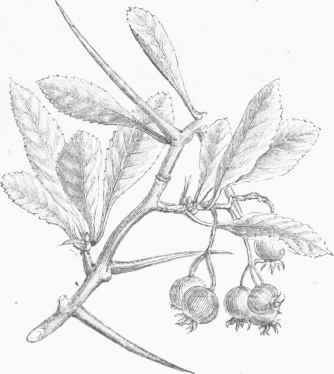
Cockspur Thorn (Crataegus crus-galli).

Hawthorn (Crataegus oxyaeantha).
Thorn #1
Thorn, a town of the kingdom and the province of Prussia, on the right bank of the Vistula, 52 m. S. W. of Marienwerder; pop. in 1871, 16,619. It has three Protestant and three Catholic churches, famous manufactories of gingerbread, and an important trade in corn and lumber. It is the birthplace of Copernicus, of whom there is a statue in the market place and a monument in the Catholic St. John's church. It is strongly fortified. - Thorn was founded about 1230 by the Teutonic knights. It joined the Hanse league, and in 1454 placed itself under the protection of Poland, to which it was confirmed by the peace with the order concluded there in 1466. In 1724 a riot between the students of the Protestant gymnasium and those of the Jesuit school led to a bloody persecution of the Protestant citizens. Thorn has repeatedly been besieged.
Continue to:


My Books

