


Tear
Description
This section is from "The American Cyclopaedia", by George Ripley And Charles A. Dana. Also available from Amazon: The New American Cyclopædia. 16 volumes complete..
Tear
Tear, an East Indian tree, tectona grandis (called in Malabar tecca), valuable for its timber. It belongs to the verbenacea', a family which, while its most familiar representatives with us are ornamental herbs and shrubs, includes some important tropical trees. The teak is remarkable for its size and beauty; it grows over 200 ft. high; the elliptical leaves are 12 to 24 in. long, and so rough as to be useful for polishing wood; the small white flowers are fragrant, in terminal panicles, and have the structure common to the family. The tree is found in various parts of India and the adjacent islands, and has been introduced into other Brit-ish possessions. It is probable that other and closely related species contribute to the supply of commerce. The wood of the teak is one of the most remarkable known on account of its great weight, hardness, and durability, qualities which have caused it to be long used in the East, not only for temples, but for dwellings. It is most employed in ship building, being practically indestructible by wear or decay, and vessels built of it have lasted 100 years, to be then only broken up on account of their poor sailing qualities from faulty models.
The wood works easily, but on account of the large amount of silex contained in it, the tools employed are quickly worn away; it is brownish, and contains an oil which prevents spikes and other iron work with which it is in contact from rusting, even when the wood is used green. Its weight varies in different localities, from 42 to 52 lbs. to the cubic foot; the teak from Malabar is the heaviest, while that from Burmah and Siam is much lighter; in ship building its great weight largely offsets its durability, and it is therefore now customary to use it only for planking. - Various similar woods are called teak; the African teak was long used in ship building before its origin was known; it is the genus Oldfieldia, of the euphorbia family.
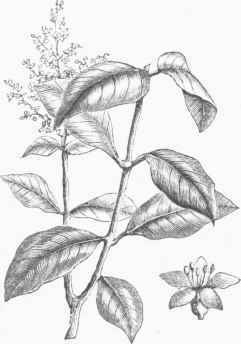
Teak (Tectona grandis).
Tears #1
Tears, the limpid, colorless, slightly saline secretion of the lachrymal glands, continually poured out in quantity sufficient to bathe the surface of the eyes, to secure the easy and free motion of the lids, and to wash off any irritating particles from their sensitive membrane. The lachrymal belong to the aggregated glands, or those in which the vesicles or acini are arranged in lobules; there is one at the upper, external, and anterior part of each orbit, in a depression of the frontal bone, in relation with the external rectus muscle, resting behind on a fatty areolar tissue; each gland is of the size of a small almond, reddish white, flattened, and enveloped in a fibro-cellular capsule; the secretion is poured out by six or seven trunks opening within the upper lid. At the inner angle of the eyes, in both lids, are two very narrow, always open apertures, the lachrymal puncta,, in the middle of a slightly prominent tubercle, about 1½ line from the inner junction of the lids; they are opposite each other, the lower turned up and the upper down, and both outward and backward.
Through these openings the tears are conveyed by the lachrymal ducts in each lid to the lachrymal sac, at the inner angle of each eye, in the bony groove between the lachrymal bone and the ascending process of the superior maxillary; it is a small membranous sac, opening below into the nasal duct, which conveys the tears into the nose beneath the inferior turbinated bone. At the inner angle of the lids, in front of the globe and behind the lachrymal puncta, is a small reddish tubercle, pyramidal, with the summit turned forward and outward; this is the lachrymal caruncle, and consists of a mass of small mucous follicles, covered by the conjunctiva, which forms in front and to the outside a semilunar fold, called the nictitating membrane; this is rudimentary in man, but remarkably developed in birds. The act of crying, generally accompanying an increased secretion of tears, as far as the movements of respiration are concerned, is very nearly the same as that of laughing, though occasioned by a contrary emotion; the expiratory muscles are in more or less violent convulsive movement, sending out the breath in a series of jerks, accompanied by well known sounds; in children the act is sometimes continued almost to the complete emptying of the chest of air, to the great dismay of parents, but the necessity of breathing is always stronger than the convulsive muscular movements.
Moderate excitement, whether of joy, tenderness, or grief, increases greatly the quantity of the tears, though the secretion is checked by violent emotions; in intense grief the tears do not flow, the restoration of the secretion being a sign of moderated sorrow, and itself affording relief by the resumption of nervous action. The sensory, emotional, or instinctive ganglia, situated at the base of the brain, to a certain extent independent of the will, in intense grief become congested, and the flow of tears is the natural method for their relief; hence the danger of cerebral disturbance from long continued tearless grief. Considering their size, there are no other glands which ordinarily can so increase the amount of their secretion as the lachrymal; the quantity is sometimes very great, and very easily stimulated; the shedding of tears is also contagious. - The lachrymal puncta may be closed, causing the tears to flow over the cheeks, for which the remedy is dilatation by tine probes. When the nasal duct is obstructed, the eye is watery and the corresponding nostril dry, the sac forming a small tumor at the side of the nose; the sac also may be inflamed, with pain, tenderness, swelling, and feverish symptoms; this may end in suppuration, and an external opening, constituting lachrymal fistula, requiring the restoration of the obliterated duct by styles of different materials.
Continue to:


My Books

