


Tattler
Description
This section is from "The American Cyclopaedia", by George Ripley And Charles A. Dana. Also available from Amazon: The New American Cyclopædia. 16 volumes complete..
Tattler
Tattler, the proper name of the wading birds of the snipe family, of the division to-tanem, as distinguished from the tringem or sandpipers; they are often called sandpipers, in England gambets, and in France chevaliers or totanes. The bill is slender, nearly straight, about as long as the tarsus, pointed, not grooved for the terminal fourth, gape extending beyond the culraen, terminal half hard and horny, and base covered with a soft skin; wings long; legs and neck elongated; toes connected anteriorly by membrane; tail almost always strongly barred. They are genuine waders, frequenting the water's edge, picking up insects, mollusks, etc.; they are swift fliers and runners, and some species take readily to the water; they perform migrations of considerable extent, going north to breed in spring, and returning through the temperate regions in early autumn, at which time the flesh is fat, juicy, and much esteemed. The French name is derived from the body being mounted on long legs, and appearing as if on horseback.
The nest is on the ground, usually near water, and the young quit it as soon as hatched; in the breeding season they keep in pairs, and the families remain together until spring. - The tell-tale tattler or greater yellow-legs (garribetta melanoleuca, Bonap.) is about 14 in. long, 25 in. in alar extent, with the bill 2¼ in.; wings long, first quill the longest; tail short; legs yellow and long; hind toe small. Above it is cinereous of various shades, with lines, spots, and edgings of dull white; lower back brownish black; rump and upper tail coverts white with more or less perfect brownish bands; white below, with brownish stripes on neck and bars of spots on breast; quills brownish black; tail white, with brownish black bands. This bird, sometimes called stone snipe, is found throughout temperate North America and Mexico, preferring large soft marshes and the vicinity of fresh water; it lives with other waders and _ the smaller ducks; the common name is derived from the habit of uttering its shrill whistle of four loud and rapidly repeated notes at the least sign of danger, giving the alarm to all the ducks and other game birds in the neighborhood; its notes are easily imitated, calling the bird within gun-shot; the flesh in autumn is excellent eating; the eggs are four, 2¼ by 1½ in., pale greenish yellow, with brown and purplish gray blotches.
The common yellow-legs and the willet will be noticed under those titles. - The spotted tattler or peet-weet (trin-goides macularhis, Gray) is 7½ to 8 in. long, 13 in. in alar extent, with the bill 1 in., and the tarsus rather less; the bill has both mandibles grooved and is tapering; lower third of tibiae naked; tail much rounded; outer toe webbed to first joint. It is brownish olive-green above, with bronzed lustre and lines and spots of brownish black; line over eyes and under parts white, the latter with circular brownish black spots; primaries, secondaries, and outer tail feathers tipped with white, the last with irregular brownish black bars. It is found over temperate North America, in Central America in winter, and also in Europe; it is one of the most common marsh birds of New England, arriving from the south about the beginning of May; it is often called "teeter " from the jerking of its tail up and down; it does not associate with other species, nor form large flocks; it alights on branches overhanging the water, and on fences and walls; the flesh is delicious in autumn; the eggs are 1¼- by 1 in., grayish yellow with deep brown blotches; both sexes incubate.
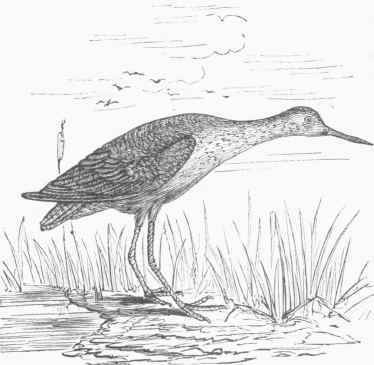
Tell-Tale Tattler (Gambetta melanoleuca).
Continue to:


My Books

